When Dual-Process Wins Thick-Walled Structures
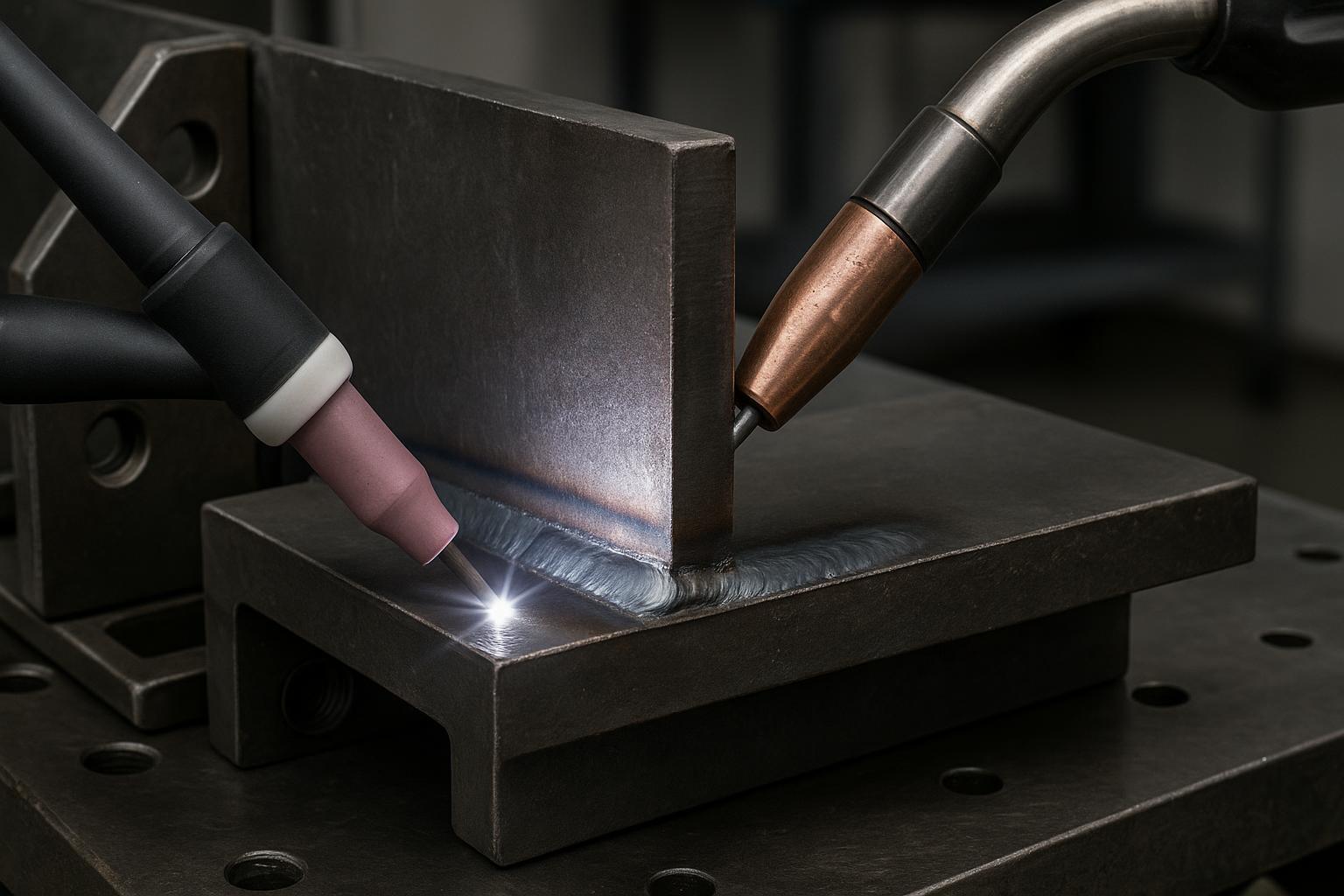
When certification tests demand reliable fusion in thick-walled joints, TIG-assisted MIG can offer a balance of precision root fusion and fast filler deposition. This approach helps you manage heat input, control distortion, and meet code expectations in demanding tests. Below is a practical guide to decisions, prep, and workflow that maximize pass chances on certification joints.
In thick sections, heat input control is critical. A TIG root pass provides clean fusion with reduced burn-through risk, while MIG filler lets you build up the bead efficiently without excessive heat. When the project calls for tight weld geometry and distortion limits, TIG-assisted MIG often performs better than a single process alone.
When to consider dual-process on certification joints
Use TIG for the root pass on thick plates when you need exact penetration and controlled starts, then switch to MIG for the fill passes to keep heat input reasonable and maintain bead shape. If the joint geometry is complex or the code requires specific bead profiles, dual-process can improve repeatability across certification coupons.
For real-world examples of applying these ideas to thick assemblies, see hybrid joints for thick assemblies. When thickness varies within a single weld, you’ll benefit from strategies described in thick-to-thin joints.
For heat control specifics, consult Precision Heat Control, which covers managing heat input across passes. Similar TIG-assisted MIG approaches are discussed in TIG-assisted MIG for thin-walled structures.
Heat input management
- Set a conservative heat index for the root TIG pass to prevent burn-through in thick base metal.
- Limit MIG fill passes with a measured voltage and travel speed to avoid excessive dilution and distortion.
- Use pulse or spray transfer settings to balance heat input and deposition rate.
- Keep clamp and fixture stability to reduce heat-induced movement during longer welds.
Joint prep strategies
- Cleanliness: remove oil, rust, and coating to ensure predictable fusion.
- Root gap and fit-up: aim for a consistent gap that supports TIG root control and MIG fill.
- Bead geometry planning: visualize the final weld profile and ensure space for both processes.
Practical workflow tip: begin with a TIG root pass to establish fusion, then perform MIG fill passes with controlled heat input, monitoring the overall temperature of the assembly. Check the bead for uniform penetration and minimal distortion before moving to the next coupon.
With careful planning, TIG-assisted MIG provides reliable pass results on demanding thick-walled certification joints. Practice on mock-ups to build muscle memory and align with certification requirements.