Selecting Sensors That Predict Defects in Real Time
Real-time arc monitoring relies on choosing the right sensing modalities and combining their signals to forecast weld defects before they appear in the bead. The three common arc-sensing options are current, voltage, and arc length. Each modality provides different clues about heat input, stability, and the geometry of the molten pool.
Arc-sensing modalities at a glance
Current sensing tracks amperage fluctuations that correlate with heat input. It’s robust and easy to implement, but it can be affected by arc length changes and shielding gas dynamics. Use current trends to monitor heat input consistency across the weld.
Voltage sensing monitors arc voltage, which relates to arc length and interelectrode distance. Voltage data helps detect arc wandering and bead consistency. Combine with current to separate heat input from arc geometry.
Arc length sensing directly estimates the gap between the electrode and workpiece. This metric is highly predictive of penetration and porosity when paired with current or voltage data, but it can be noisy in field conditions.
Data fusion for defect prediction
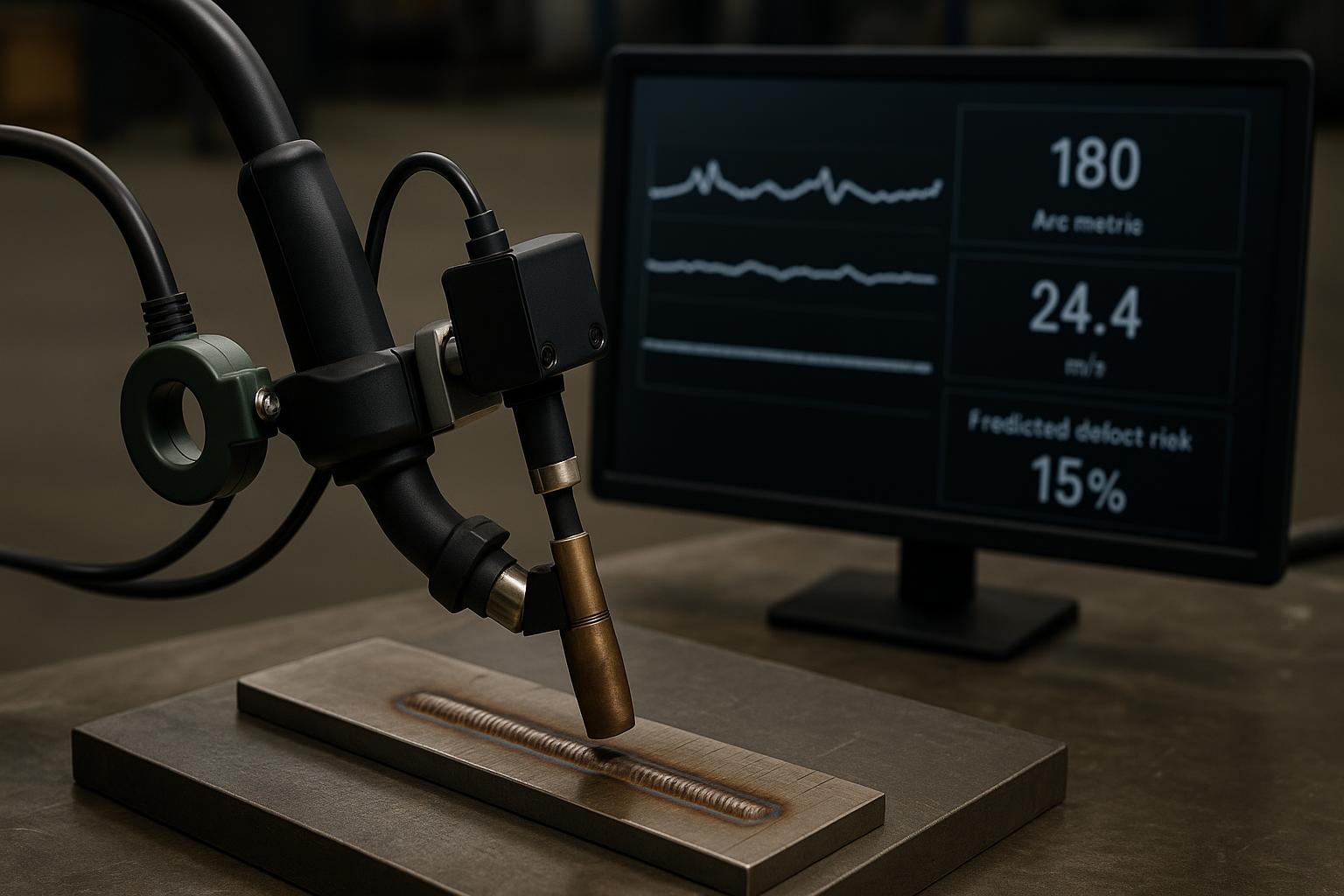
Single sensors rarely predict defects reliably on their own. Data fusion combines signals from multiple modalities to reveal patterns that precede porosity, lack of fusion, or underfill. A simple approach is to compute a real-time feature vector from current, voltage, and arc length and feed it into a predictive model that flags risk spikes.
For practical field or shop use, implement a tiered monitoring strategy. Start with a stable baseline using basic current and voltage sensing, then layer arc length data and higher-order analytics as you validate the model against welds you actually produce.
See how Real-Time Arc Tracking implements continuous arc data collection to drive predictive insights. Also, explore how sensor fusion for weld quality can improve detection performance in practice. For teams experimenting with AI-driven approaches, AI-powered arc monitoring offers a path to automated defect alerts during certification testing.
Practical selection guide
Choosing sensors comes down to your typical heat input, joint type, and inspection tolerance. MIG welds on thin material often benefit from arc-length sensing plus current trends to flag underfill early. TIG processes may rely more on arc-length precision and voltage trends for stable bead geometry. Whichever combination you choose, validate it with real welds that exhibit porosity, lack of fusion, or underfill, and continually tune the model with new data.
- Current sensing for heat input tracking
- Voltage sensing for arc length proxy
- Arc length sensing for penetration and bead geometry
- Data fusion for defect risk scoring
For a broader implementation strategy, see how Real-Time Arc Tracking shows continuous arc data collection in action, and how sensor fusion for weld quality improves detection performance in practice.