Let me paint you a picture. You pull up to a job site, customer’s already watching you from the porch. You drop the tailgate and spend the next twenty minutes digging through a pile of leads, fittings, borrowed tools you never returned, and three grinding discs that are already worn to nothing. That right there is your mobile rig setup problem. And it’s costing you money every single day you let it slide.
This isn’t about being neat for the sake of it. This is about dollars per hour. If you’re billing $85 an hour and you waste 30 minutes on every job just getting set up, that’s money you’re leaving on the ground. And if you’re running four jobs a day, that math gets ugly fast.
I’ve been doing this long enough to know that most guys don’t lose jobs because of bad welds. They lose jobs — or at least lose repeat business — because they looked like they didn’t have their act together. Organization is professionalism. And professionalism is what gets you called back.
Why Your Mobile Rig Setup Is Your First Impression
Before you even plug in your machine, people are watching. The homeowner, the foreman, the site super — they’re all clocking how long it takes you to get moving. A clean, organized rig says you’ve done this before. A dumpster fire of a truck bed says you’re winging it.
I’ve talked about picking the right strategic niche for your welding business before, and the truth is the same principle applies to your rig. Your setup should match your work. If you’re doing agricultural repairs, your truck should be loaded for that. If you’re doing structural field work, your rig needs to reflect that too. A one-size-fits-all disaster pile doesn’t serve either job well.
Check out this post on Strategic Niches if you haven’t nailed down what kind of work you’re chasing. Because until you know that, you can’t really build a rig around it.
The point is this: your truck is your shop. Would you run a shop where you couldn’t find anything? No. So stop running your mobile business that way.
Mistake #1 — No Dedicated Home for Anything
This is the big one. Most disorganized rigs aren’t disorganized because the welder is lazy. They’re disorganized because there was never a system to begin with. Everything just got thrown in wherever it fit that day, and now nobody — including you — knows where anything is.
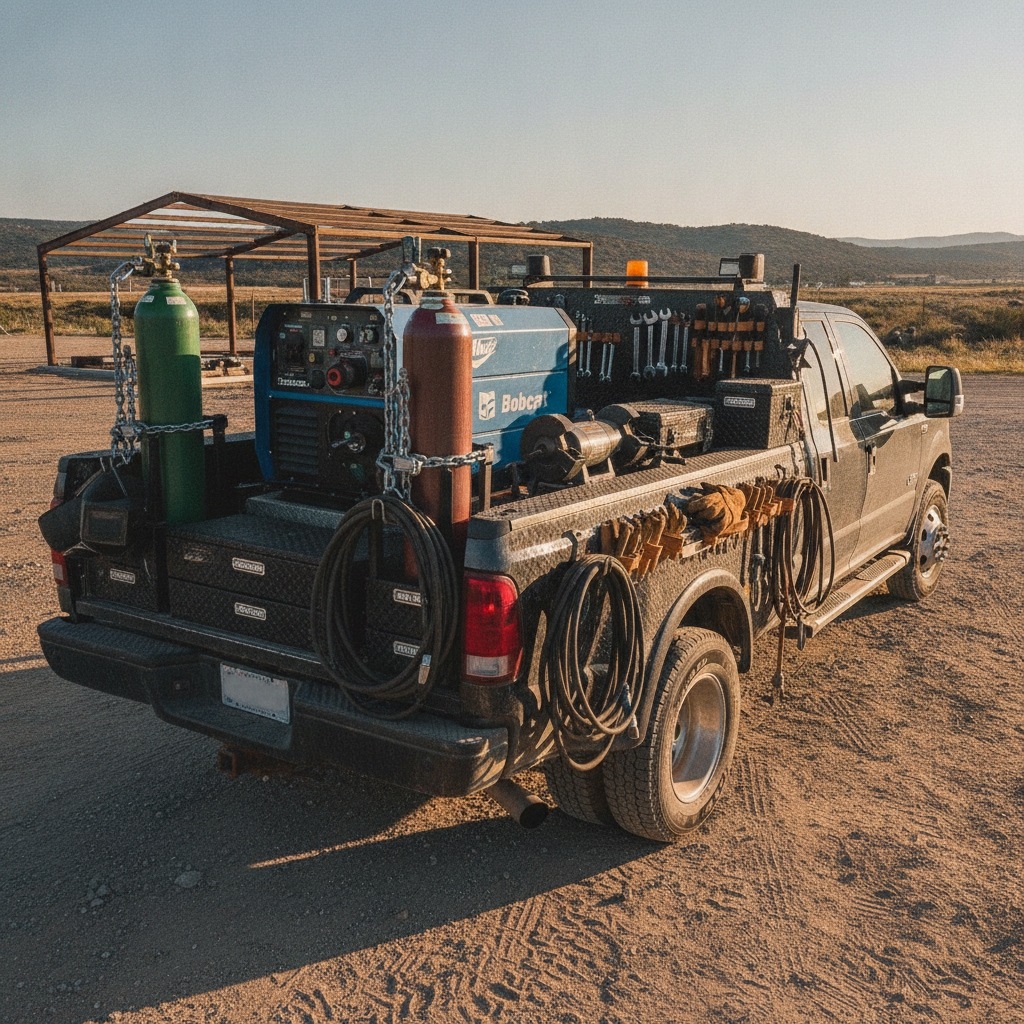
Fix this with zones. Seriously, just zones. Left side of the bed for leads and cables. Right side for consumables and fittings. Toolbox near the cab for hand tools. Cylinder area at the tailgate with proper chain-down. That’s it. You don’t need a label maker and color-coded bins. You just need a consistent spot for every category of gear.
Once you build the habit, loading and unloading goes from a guessing game to muscle memory. You reach for your stinger and it’s exactly where it should be. Every time. That’s the goal.
A Word on Lead Management
Tangled leads are probably the single most common time-waster I see on mobile rigs. You spend five minutes uncoiling a work lead that’s wrapped around a grinder that’s tangled up with a wire feeder gun hose. It’s a nightmare. Use a dedicated lead rack or even simple hooks welded to the inside of your truck bed rails. Coil your leads properly before you store them — figure-eight coil, not the spin-and-loop method that puts a twist in every time.
This alone can save you ten minutes a job. That’s real time. That’s real money.
Mistake #2 — Wrong Equipment for the Job On Hand
Rolling up to a job with the wrong machine, wrong wire, or wrong gas is the kind of thing that’ll make you want to retire early. And it happens more than people admit.
Part of good mobile rig setup is loading smart for the next day’s work the night before. Pull your job sheet. Look at what material you’re welding. Check your wire and gas against what’s actually needed. If you’ve been doing a lot of varied material work lately, you already know how fast you can get caught flat-footed without the right setup. The post on Dissimilar-Metal Welding Mastery breaks down just how many variables are in play when materials mix — and your rig needs to be ready for that.
If you’re running a multi-process machine — which honestly is the smart move for mobile work — make sure you know that box inside and out before you take it on the road. Read our breakdown on Field-Ready Multi-Process Welders if you’re still shopping or second-guessing your current machine. A capable machine loaded with the wrong consumables is still a problem.
Consumables — The Black Hole of the Truck Bed
You’ve got six half-empty boxes of wire in three different diameters, a bag of tips that may or may not fit your gun, four grinding discs, and a flap disc that’s seen better days. Sound familiar?
Set a minimum stock level for every consumable and check it at the end of each week. One full spool of your most-used wire. Ten tips in the size you run. A fresh pack of grinding discs. Don’t wait until you’re on a job to discover you’re out. That’s a rookie move, and you stopped being a rookie a while ago.
Mistake #3 — Gas Cylinder Chaos
Cylinders rolling around loose in the truck bed is a safety issue first and an organization issue second. Get that sorted before anything else. Proper cylinder securing means a chain or strap to the truck body, upright, every time. Non-negotiable.
Beyond safety, the bigger problem is running out mid-job. Nothing burns a customer relationship faster than having to stop and run for gas when you’re halfway through a repair. Track your cylinder levels. If you’re using a smart gas management approach, even better — there’s a solid overview of that in the Smart Shielding Gas Management post that’s worth reading if you’re not already tracking usage.
Keep a backup cylinder or have a refill scheduled so you’re never dry when it matters.
Mistake #4 — Your Machine Setup Takes Too Long
Some guys treat machine setup like it’s the first time every time. Dig out the manual. Try to remember where the wire goes. Fumble with the drive roll. Meanwhile the customer is standing there wondering if they hired the right guy.
Know your machine. Know it cold. Set it up the same way every time, in the same order, until it’s automatic. Power on, gas check, wire tension, ground placement, test arc on scrap. That whole sequence should take under three minutes. If it doesn’t, you’re either on unfamiliar equipment or you haven’t drilled it enough.
And if you’re considering upgrading to a battery-powered unit for sites where power access is sketchy, the options have gotten genuinely good. The rundown on Field-Ready Battery Welders covers what’s actually worth looking at on the market right now. Some of those units cut your setup time too because there’s no generator to fire up and warm.
Mistake #5 — No System for Job-Specific Kits
Here’s something that will make your day-to-day run smoother than almost anything else: pre-staged job kits. Build small bins or bags for common job types. Agricultural repair kit. Structural tack kit. Pipe repair kit. Each one has the consumables, fittings, and specialty tools for that type of work already staged and ready.
When a call comes in for a busted gate hinge or a cracked bucket lip, you grab the right kit and it’s already loaded with what you need. You stop reinventing the wheel on every dispatch. It also means when someone calls you for structural field work, you’re not accidentally showing up with a kit built for thin gauge sheet metal.
If you’re still figuring out which types of work are most profitable for your area, the Smart Heat Maps for Startups post has some solid thinking on where demand is concentrated geographically. Know where your work is, build your kits for it.
Mistake #6 — Ignoring the Little Time Killers
Big organization problems are obvious. The little ones sneak up on you. Here’s a list of the small stuff that quietly eats your day:
- Dead batteries in your angle grinder. Keep them on the charger overnight. Not in the truck, not in the toolbox — on the charger.
- No tape measure in the truck. Buy three. Put one in the cab, one in the toolbox, one in your apron pocket. Stop borrowing the GC’s tape.
- No spare fuses or circuit breakers. When your machine trips on a hot day and you don’t have spares, you’re done. Carry them.
- Striker and markers buried somewhere unreachable. These go in one spot on your apron or toolbox, always. Thirty seconds to find a striker adds up across a week.
- No rag or brush for pre-weld cleanup. Especially on repair work, you need to clean the area fast. Keep a wire brush and a rag in an accessible spot, not at the bottom of a parts bin.
None of these are revolutionary. But they’re all things I’ve watched experienced welders waste time on because they never built a system around them.
The Real Cost of a Sloppy Rig
Let’s put some numbers to this. Say you’re running five jobs a week, averaging two hours each. You waste an average of 20 minutes per job on setup, digging, and improvising. That’s over an hour and a half a week. At $85 an hour, you’re throwing away roughly $130 every single week. That’s $6,700 a year in lost productivity.
That number should make you uncomfortable. Because it’s not a client who didn’t pay. It’s not a bad debt. It’s time you burned yourself because of how your truck was loaded. And unlike bad clients, this problem is entirely fixable.
Good mobile rig setup isn’t a one-afternoon project. You’re going to tweak it over time as you figure out what works and what doesn’t. But the guys who take this seriously — who spend a couple hours on a Sunday building a real system — they show up Monday moving faster and looking more professional than the guy who hasn’t touched his truck layout in three years.
Building Your System Without Breaking the Bank
You don’t need a custom-fabricated truck bed with laser-cut tool holders to get organized. Here’s what actually works and doesn’t cost a fortune:
Cheap plastic bins with lids — stackable, labelable, and they keep dust and moisture off your consumables. Get them at any hardware store. Beat the heck out of cardboard boxes that fall apart in the rain.
Welded-on hooks and hangers — if you can fab it, weld a few hooks on your truck bed rails for leads, chains, and hoses. Costs you scrap metal and an hour. Saves you daily.
Magnetic parts trays — for small fittings, tips, and hardware during a job. Keep a couple on the truck. Stop setting small parts on the bumper where they fall off.
A whiteboard or notepad in the cab — for job notes, material specs, and a pre-load checklist. It sounds simple because it is. But simple systems get used. Complex systems get ignored.
Before you spend money on new equipment, spend time on your current setup. Most of the time, the problem isn’t what you have — it’s how it’s arranged. If you’re at the stage where you’re thinking about growing from a garage to a real shop operation, a tight mobile rig is still foundational. That discipline carries forward into every workspace you’ll ever run.
What a Dialed-In Mobile Rig Actually Looks Like
Here’s the honest version of a well-organized welding rig. It’s not pretty. It’s not Instagram-worthy. But it works.
The machine is mounted or positioned the same way every job, with its leads already run to both sides so you’re not re-routing every time. The toolbox has a specific spot for hand tools that don’t migrate. Consumables are in a sealed bin with a quick-inventory checklist taped to the inside of the lid. Cylinders are chained, gauges checked at the start of the week. The cab has your paperwork, your phone charger, and a copy of your pricing sheet because sometimes customers ask on the spot and you need to be ready. If you haven’t thought through your pricing structure lately, the breakdown on Pricing for Certification Services has some good frameworks even if you’re not exclusively doing cert work.
Everything else is details. But the details matter because they compound. Ten seconds here, two minutes there, and over a week you’ve either bought yourself a lunch break or you’ve worked through it for free.
Final Word
Your mobile rig setup is a direct reflection of how you run your business. That’s not a judgment — it’s just how customers see it and how you should see it too. A sloppy rig isn’t a personality quirk. It’s a liability. It makes you slower, less professional, and more likely to show up to a job unprepared.
The good news is this is one of the easiest things to fix in your whole operation. No certifications required. No expensive equipment. Just a few hours of honest work on your truck and a commitment to keeping the system running.
Stop digging. Start welding. That’s what you’re getting paid for.