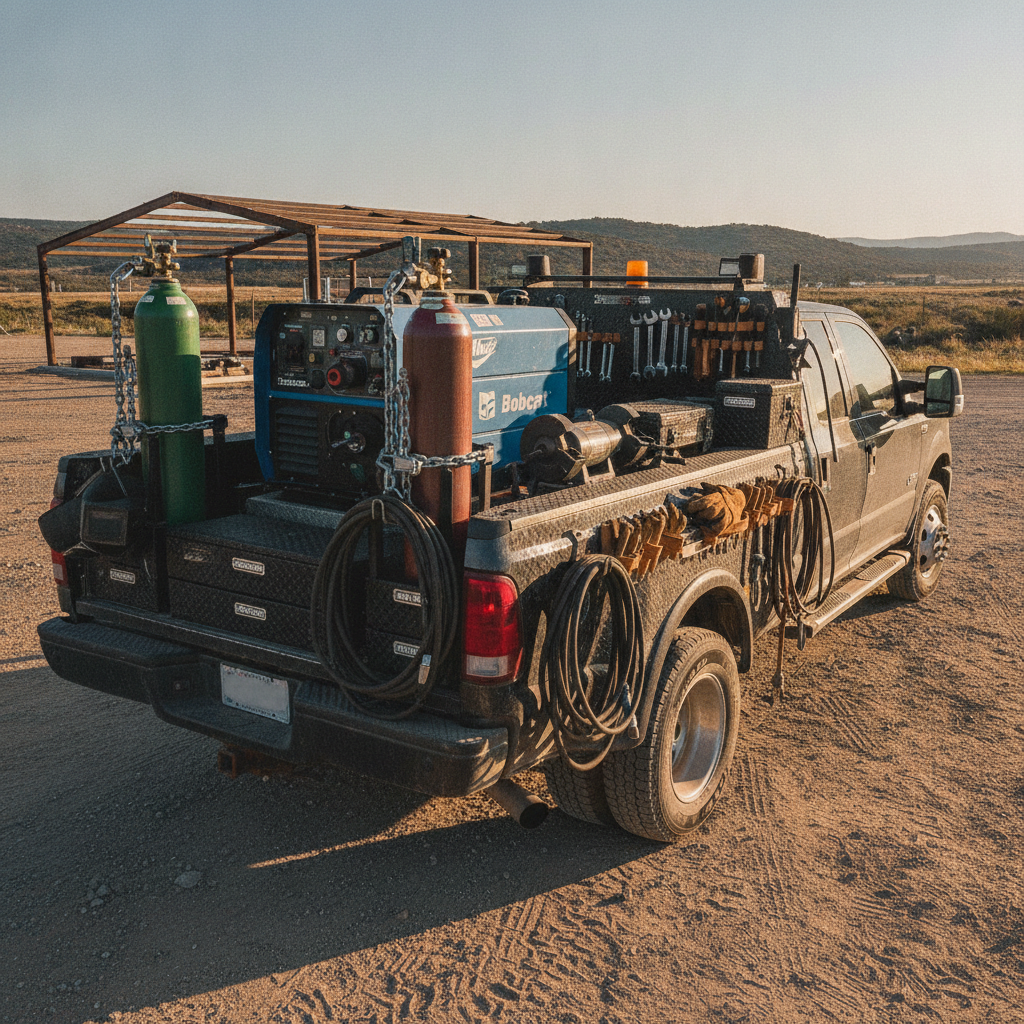
Let me paint you a picture. You pull up to a job site, customer’s standing there watching, and you spend the next twenty minutes digging through your truck like you lost your keys in a ball pit. Cables everywhere. Consumables buried under a tarp. You’re not sure if you even grabbed the right rod. That right there is the real cost of truck setup mistakes — and it’s coming straight out of your pocket, not the customer’s.
I’ve been running a mobile rig for over a decade. I’ve made every one of these mistakes personally. Some of them twice. If you’re just getting started or you’ve been winging it for a while and wondering why jobs feel harder than they should, this is the post you need to read before you load your truck one more time.
Why Truck Setup Mistakes Cost You More Than Time
Here’s the math nobody talks about when they’re romanticizing the mobile welding life. Say you’re billing $95 an hour. You waste 25 minutes on setup and teardown per job. That’s roughly $40 a job you’re eating because your rig looks like a yard sale survived a tornado.
Run three jobs a day, five days a week. That’s $600 a week gone. Over a month, you’ve lost the equivalent of a full day’s billing just because your consumables don’t have a home.
And that’s just the money side. The other cost is credibility. Customers notice when you’re fumbling around. They start to wonder if you actually know what you’re doing. First impressions on a job site matter more than most guys want to admit. When you pull up organized, move fast, and look like you’ve done this before — that’s what gets you referrals.
Before we get into the fixes, it’s worth noting that your rig efficiency connects directly to how you price your work. If you haven’t thought hard about your rates lately, check out this breakdown on pricing for certification services — the same logic applies to how you structure your mobile rates.
Mistake #1: No Zones, No System
The biggest truck setup mistake most mobile welders make is treating the truck like a storage unit instead of a work platform. Everything gets thrown in after each job and nothing ever has a permanent spot.
Fix this with zones. Every section of your truck — bed, side boxes, cab — gets a job. Not a suggestion. A job.
Here’s a basic zone layout that works:
- Zone 1 — Power and gas: Welder, generator if you run one, cylinders secured upright. This stuff is heavy. Keep it low and toward the cab to help with weight distribution.
- Zone 2 — Leads and cables: These need a dedicated spot, not just “somewhere in the bed.” A simple cable reel mount or a set of hooks on the headache rack works. The goal is no tangles, no hunting.
- Zone 3 — Consumables: Rods, wire, tips, nozzles, grinding wheels. These need to be in a weatherproof, labeled drawer or box. Not a cardboard box. Not a grocery bag.
- Zone 4 — Hand tools and PPE: Grinders, chipping hammer, brushes, helmet, gloves. Quick access. You reach for these constantly.
- Zone 5 — Cleanup and misc: Rags, spray, tie wire, whatever else you carry. Back of the truck or a lower compartment.
Sounds basic. But I’d bet money your current setup doesn’t actually look like this. Most guys have zones one and four mixed together with zone three scattered between them. That’s where the twenty-minute dig sessions come from.
Mistake #2: Cables That Live on the Floor
This one drives me crazy more than almost anything else. Loose cables on a truck bed are a trip hazard, a tangle nightmare, and a sign to every customer watching that you’re operating in chaos mode.
Get your leads off the floor. Period.
A proper cable reel — either a manual crank mount bolted to the headache rack or a simple set of D-ring hooks — takes maybe an afternoon to set up and changes how fast you can deploy and pack. You pull up, unroll the lead you need, run your job, roll it back up clean. That’s it.
Same goes for your ground cable. It needs a spot. Not “wherever it lands when I throw it in.” A spot. When your ground cable has a home, you don’t spend five minutes untangling it from your welding lead before your first arc.
If you’re running a multi-process setup in the field, your cable management gets even more important. More leads means more potential chaos. Worth reading up on field-ready multi-process welders to think through how your machine choice affects your rig layout.
Mistake #3: Consumables Are a Disaster
You know what’s a fun way to lose fifteen minutes? Needing a 3/32 rod and finding out your 7018 box got wet, your 6013 is mixed in with the 6011, and you can’t find the right tip for your MIG gun because it’s loose at the bottom of a toolbox somewhere.
Consumables need a system. Here’s what actually works in the field:
Dedicated weatherproof drawer or box. Aluminum toolboxes with individual drawer inserts are your friend here. Label every drawer. Stick labels on with a label maker or even a paint pen. You should be able to find any consumable in under ten seconds without looking.
Keep a burn list. After each job, note what you used. Before you drive to the next job, you know what needs restocking. You stop showing up to a job site and realizing you’ve got two tips left and the next supply house is forty minutes away.
Rod ovens and storage tubes. If you’re running low-hydrogen electrodes and you’re not storing them properly, you’re fighting your own weld quality before the job even starts. Portable rod ovens exist for a reason. Use one or at minimum use sealed storage tubes.
Your consumable game also matters when you’re working with different materials. Running jobs on mixed metals means you’re carrying more variety — which makes organization even more critical. If that’s your world, dissimilar-metal welding mastery is worth your time.
Mistake #4: Weight Distribution Is An Afterthought
Most guys think about weight on their rig when it’s too late — meaning when the truck handles like a shopping cart or when their payload rating is a distant memory.
Bad weight distribution doesn’t just wear out your truck faster. It makes your rig harder to drive, harder to maneuver in tight job sites, and in bad cases, it’s a safety issue.
The basics:
- Heaviest gear (welder, generator, cylinders) as far forward as possible in the bed.
- Balance side to side as much as your layout allows.
- Know your truck’s payload rating and actually stay under it. Most service trucks running full rigs are right at the edge or over. Upgrade your truck before you upgrade your gear if you’re pushing limits.
Also — secure everything. This isn’t a safety lecture, it’s a practical one. A cylinder that shifts in transit is a problem. A welder that moves around in the bed is a problem. Strap it down, chain it down, bolt it down. Whatever it takes.
Mistake #5: Your Lighting and Power Situation Is a Joke
You show up to a job that runs late into the evening and you’re fumbling around your truck with a phone flashlight because you don’t have work lights rigged. Or you need to run a grinder and your generator setup is a tangle of extension cords that take ten minutes to sort out.
Rig lighting is not optional. LED strip lights inside your toolboxes and under your canopy if you run one cost almost nothing and save you constantly. A few magnetic work lights you can slap anywhere are worth their weight in rod.
Power layout matters too. Know where your outlets are on the generator, have a short dedicated extension cord for common tools, and don’t rely on a hundred-foot cord running from one outlet for everything. Map your power needs the same way you map your zones.
If you’re running or considering battery-powered equipment as part of your setup, there’s some useful thinking in this post on hybrid battery-powered welders that might affect how you plan your power layout.
Mistake #6: No Standard Setup Routine
Even a well-organized truck can cost you time if you don’t have a consistent routine for how you set up and break down at each job.
A setup routine doesn’t have to be complicated. It just needs to be the same every time. Here’s an example of what a tight ten-minute setup looks like:
- Park and set the brake.
- Open the cylinder box, check regulator, crack the valve.
- Unroll your lead and ground to where you need them.
- Power up the machine, verify settings for the job.
- Grab consumables for the work at hand.
- PPE on.
- Strike an arc.
That’s it. Same every time. No looking around wondering what you forgot. You built the checklist once, you run it every time, you stop bleeding minutes before every job.
The same principle applies to how you think about building your business overall. If you’re still figuring out what kind of work to chase with your mobile rig, this post on strategic niches is worth a read — knowing your niche helps you spec your rig properly too.
Mistake #7: The Truck Is a Rolling Junk Drawer
Every piece of gear on your truck should earn its spot. If it hasn’t been used in the last thirty days and it’s not an emergency spare, it might not belong on the truck.
I know guys running around with equipment they haven’t touched in six months because “you never know.” Meanwhile, they can’t find their MIG pliers because there’s too much stuff competing for space.
Do a purge. Seriously. Pull everything off your truck one Saturday morning and only put back what you actually need for the jobs you’re running. Spare parts and rarely-used gear can live in the shop or garage. The truck is a work platform, not a warehouse.
A lighter, leaner rig also helps your fuel economy, your payload numbers, and your sanity. Win all around.
Mistake #8: Ignoring Shielding Gas Management
Running out of gas mid-job because you didn’t check your cylinder before leaving the shop is the kind of mistake that makes you look like you’re new to this. And driving back to swap cylinders is pure lost time.
Check your gas before every job. Full stop. If you’re below a quarter tank on a cylinder, swap it before you head out, not after you run dry on site. Carry a backup if the job size warrants it.
There’s more to gas management than just checking the gauge though. Regulator condition, hose condition, proper storage — all of it matters. If you want to go deeper on this, smart shielding gas management covers it in detail.
The Bottom Line on Truck Setup Mistakes
None of this is complicated. That’s the frustrating part. These truck setup mistakes are completely fixable with one dedicated afternoon and maybe a couple hundred bucks in organizers, labels, and mounting hardware.
The guys running tight, profitable mobile operations aren’t doing anything magical. They’re just organized. They show up ready to work. They don’t waste the customer’s time or their own before the first arc is struck.
Your truck is your business. Treat it like one.
If you’re in the process of building your operation from the ground up and still figuring out how all the pieces fit together, the post on going from garage to shop has some solid thinking on building a sustainable mobile business that doesn’t eat you alive.
Clean up the rig. Build the routine. Stop digging through junk before every job. Your hourly rate will thank you.