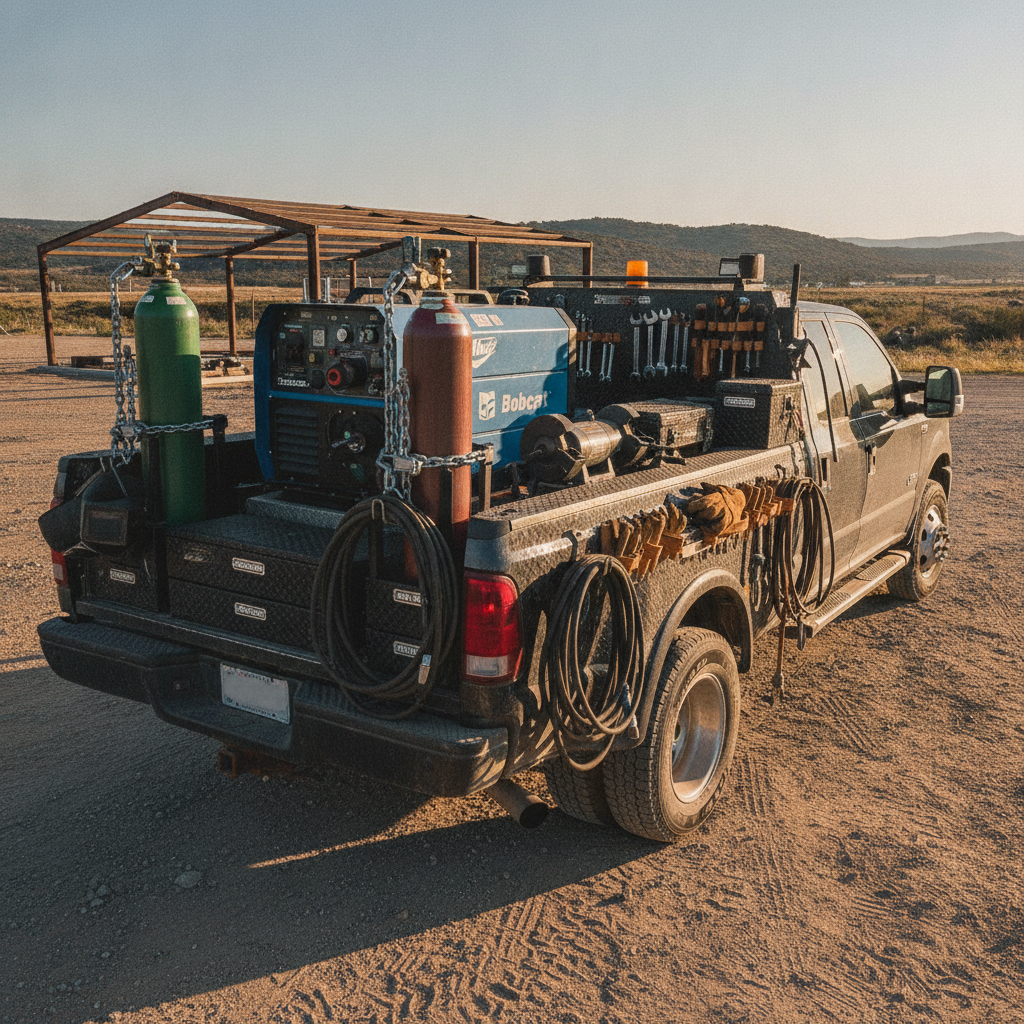
Let me paint you a picture. You pull up to a job site, customer’s watching you from across the yard, and you spend the next twenty-two minutes digging through a pile of cables, grinding discs, and mystery junk just to find your chipping hammer. That right there is a truck setup mistake — and it’s costing you money before you’ve even turned on the machine. If you’re running a mobile welding business and you haven’t dialed in your rig, you are working harder than you need to, full stop.
This isn’t about having a pretty truck for Instagram. This is about cutting wasted time, looking like a professional, and getting home before dark. Small changes to how you load and organize your rig can shave real hours off a week’s worth of jobs. Let’s get into it.
Why Truck Setup Mistakes Kill Your Hourly Rate
Here’s the math nobody wants to do. Say you’re charging $95 an hour. You waste fifteen minutes every job digging for gear, finding the right rod, or untangling cable. That’s a quarter hour, gone. Five jobs a week? That’s over an hour of your time you’re not billing. Multiply that across a month and you’ve basically donated a half-day’s work to chaos.
When you’re building a mobile business, time efficiency is everything. I’ve written before about how going from a garage to a proper shop forces you to get serious about systems. The same mindset applies to your truck. Your rig is your shop. Treat it like one.
The other thing nobody talks about is perception. Customers notice when you look organized. They notice even more when you don’t. A guy who fumbles around his truck for fifteen minutes before starting does not inspire confidence. First impressions matter, especially when you’re trying to build repeat business and referrals.
The Most Common Truck Setup Mistakes
1. No Dedicated Zone for Every Tool Category
This is the big one. Most disorganized rigs have tools just living wherever they landed last. Your grinding discs are in three different spots. Your electrodes are loose in a box with a come-along and some zip ties. Nobody can find anything, including you.
Fix it with zones. Every category of tool gets one spot and one spot only. Consumables together. Hand tools together. Safety gear together. Power cables and leads in one place. It sounds obvious until you look at your truck and realize nothing is actually where it should be.
Label your drawers and bins. Yes, even if you’re the only one who uses the truck. Labels mean you put things back in the right place, even when you’re tired and it’s getting dark.
2. Cables and Leads Stored Like Spaghetti
Tangled leads are one of the most frustrating time-wasters on any job. You need to deploy thirty feet of lead fast, and instead you’re standing there like you’re untying a knot on a fishing line at 7 AM. Not a great look. Not a great use of time.
Invest in proper cable hangers, reels, or at minimum some large velcro wraps. If you’re running a multi-process machine — and if you’re not, you might want to look at what field-ready multi-process welders can do for your setup — you’ve got multiple lead sets to manage. Get them separated and coiled before they become a problem.
A good rule: if you can’t pull your lead in under sixty seconds, it’s stored wrong.
3. Gas Cylinders That Aren’t Secured Properly
This one is both a safety issue and a logistics issue. Unsecured cylinders rolling around in your truck bed are a hazard. They’re also getting damaged, scuffing your regulators, and generally making a mess of everything around them.
Get proper cylinder racks or a chained upright mount. Your cylinders should not move, period. When you pull up to a job, your gas should be ready to connect and go — not tipped on its side because you hit a pothole on the way over.
If you’re working with mixed gases or specialty shielding, staying on top of your supply management matters even more. We covered smart shielding gas management in detail if you want to get that side of your operation sorted out too.
4. Consumables Without a System
Running out of rods on a job is embarrassing. Running out of grinding discs is just annoying. But digging through a bin of mixed consumables — 6010s, 7018s, 6013s, various disc grits all jumbled together — that’s a daily tax on your time.
Organize your consumables by type and size, in clearly marked containers. Use rod ovens or sealed containers to keep your rods dry and ready. Know what you have on the truck before you leave the yard. Build a quick pre-job checklist that you actually use, not one that sits in a folder somewhere.
Running a variety of processes on different jobs? That consumable load gets complicated fast. Think through what each job type requires and stock accordingly without turning your truck into a rolling warehouse.
5. The Welder Is Buried or Hard to Access
If moving your welder to get to something else is part of your setup routine, you’ve got a layout problem. Your machine should be accessible without shifting three other things out of the way first.
Think about how your rig is loaded with a workflow mindset. What do you reach for first when you arrive at a job? Work backwards from that. The first things you need should be the easiest things to get to. The stuff you rarely use can go deeper in the truck.
Battery-powered and hybrid machines have changed some of this equation. If you’re running a lighter setup, take a look at what hybrid battery-powered welders can do for your truck layout — they free up a lot of real estate and simplify your power management.
Building a Rig Layout That Actually Works
Start With Your Most Common Jobs
Don’t build your rig layout around every possible job you might do someday. Build it around the jobs you actually do most of the time. If 70% of your work is structural repair and agricultural equipment, your layout should reflect that. Optimize for your bread and butter, then figure out how to accommodate the specialty stuff on the side.
Before you reorganize anything, spend one week tracking how you use your truck. What do you grab first? What do you waste time looking for? Where do you put things when you’re done? Use that real data to drive your layout decisions. It’s the same principle I talked about in measuring before you invest — you don’t spend money and time rearranging things based on guesses.
Create a Staging Area
A staging area is a small section of your truck — a fold-out shelf, a section of bed rail, whatever works — where everything for the current job gets laid out before you start. Rod, leads, PPE, hand tools, grinder. Everything for this job, right here, before you go.
This one habit eliminates most of the mid-job “where did I put that” trips back to the truck. Lay it out first. Do the job. Clean it up and put it back. Simple.
Every Tool Has One Home
If a tool doesn’t have a specific, designated home on your truck, it will end up somewhere random. Then you’ll spend ten minutes finding it. Then it’ll move again. Assign every tool a location. Enforce it with yourself. After every job, everything goes back where it belongs before you drive away.
This is non-negotiable if you ever want to get a helper or apprentice involved in your operation. They can’t put things away correctly if there’s no correct place to put them.
Lighting Matters More Than You Think
Most welding trucks are dark inside the tool boxes after sunset. Get LED strip lighting in your drawers and compartments. It costs almost nothing and it means you can actually see what you’re grabbing at 5:30 AM or when a job runs long into the evening.
Small quality-of-life upgrades like this add up. A well-lit, well-organized truck is a faster truck.
The Business Case for Getting This Right
Here’s the thing about being a solo mobile welder — you are the business. Your efficiency, your professionalism, your systems, they’re all tied directly to your income. A poorly organized truck isn’t just annoying, it’s a business problem.
When you’re figuring out how to price your services, your actual time on task matters. If you’ve priced a job based on three hours and two of those hours are wrapped up in setup and fumbling for gear, you’ve just cut your own effective rate in half. Take a look at how smart pricing strategy works when you factor in real overhead and time — we covered it in our piece on pricing for certification services, but the principles apply across the board.
Getting your truck dialed in is also a signal to yourself. It says you’re running a real operation, not just winging it job to job. That mindset — systems, professionalism, efficiency — is exactly what separates mobile welders who build sustainable businesses from the ones who stay perpetually busy but never get ahead.
If you’re still figuring out your niche and what kind of work you want to anchor your business around, understanding your strategic positioning will also shape how you outfit your truck. Strategic niches for welding businesses is worth a read if you haven’t been through it.
Quick-Reference: The Truck Setup Mistakes Checklist
Before your next job, run through this fast:
- Zones defined? Every tool category has a dedicated area.
- Cables coiled and secured? You can pull your lead in under sixty seconds.
- Cylinders chained upright? Nothing rolling around back there.
- Consumables labeled and sorted? You know exactly what you have and where it is.
- Welder accessible without moving other gear? First thing in, first thing accessible.
- Staging area clear and ready? You’ve got a spot to lay out the job before you start.
- Everything put back after the last job? Don’t start the next one with yesterday’s mess.
Print it out. Stick it in the truck. Use it.
Final Thoughts
Truck setup mistakes are one of those things that experienced mobile welders eventually stop tolerating because they’ve done the math. Wasted time is wasted money. It really is that simple. The good news is this is one of the easier problems to fix in your business. It doesn’t require new certifications, new equipment, or a marketing campaign. It requires about a Saturday afternoon and some discipline going forward.
Get your rig organized. Stop digging through junk before your first arc. Your hourly rate will thank you.