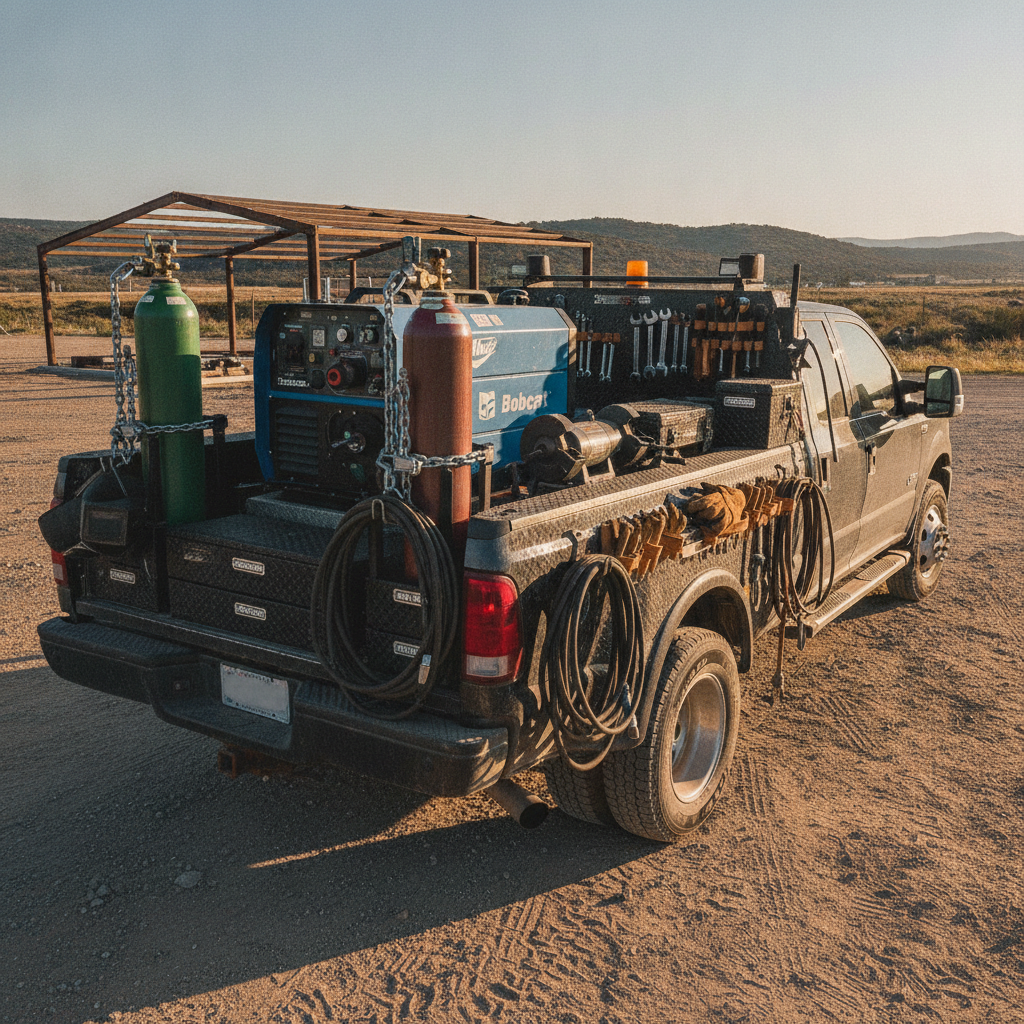
Let me paint you a picture. You pull up to a job. The customer is standing there watching. You hop out, walk around to the back of your truck, and spend the next eighteen minutes digging through a pile of cables, consumables, and mystery junk just to find your stinger. That’s not a good look. More importantly, that’s your time — time you’re either eating or billing for while doing absolutely nothing productive. Mobile rig organization isn’t a nice-to-have. It’s the difference between running a tight operation and hemorrhaging money before you strike a single arc.
I’ve seen rigs that looked like a scrap yard on wheels. I’ve also seen trucks dialed in so well that the welder was set up and striking an arc in under ten minutes. The difference wasn’t equipment or experience. It was how the truck was loaded. That’s it. This post is about the dumb mistakes that slow you down, and more importantly, how to fix them without spending a fortune or reinventing your whole operation.
Why Mobile Rig Organization Directly Hits Your Hourly Rate
Before we get into the specific mistakes, let’s talk about why this matters in dollars and cents. Say you waste twenty minutes per job digging around your truck. If you’re running five jobs a week, that’s over an hour and forty minutes of wasted time every single week. Over a year, that’s nearly ninety hours gone. At even $100 an hour, you’ve burned $9,000. Not because you can’t weld. Because your truck is a disaster.
That math hurts, doesn’t it? It should. If you’ve been grinding away trying to figure out why your numbers don’t add up, your job costing might be telling you something worth listening to. A lot of times the problem isn’t the rates — it’s the invisible time leaks you haven’t bothered to fix.
Good mobile rig organization is also about professionalism. Customers notice. They don’t know a 6010 from a 7018, but they absolutely notice when you’re calm, organized, and moving with purpose. It builds confidence. It justifies your rate. It gets you referrals.
Mistake #1 — No Dedicated Home for Consumables
This is the most common and most painful mistake on any mobile rig. Electrodes rolling around loose in a drawer. Filler wire stuffed behind the seat. Wire brushes mixed in with your grinding discs. It’s chaos, and it costs you every single job.
Every consumable you use regularly needs a dedicated, labeled spot. Full stop. Not “roughly in this area” — an actual spot. Rod ovens or sealed rod containers mounted where you can grab them without thinking. Wire spools on a proper holder, protected from moisture and road grime. Grinding discs in a clearly marked bin separated by type and size.
Here’s the thing about consumables — when you can’t find them fast, you either waste time looking or you improvise with the wrong thing. Using the wrong filler on a job because you couldn’t find the right one isn’t just a time problem. It’s a quality problem. And if you’re working on dissimilar metals, grabbing the wrong wire can turn a straightforward repair into a callback nightmare.
Spend a Saturday organizing your consumables into a real system. Label everything. Restock before the start of every week, not in the parking lot of a customer’s job site.
Mistake #2 — Cables and Leads Piled Like a Plate of Spaghetti
Nothing eats setup time like untangling welding leads. If you’re throwing your stinger lead, work lead, and extension cords into the same bin without coiling them properly, you’re setting yourself up for a ten-minute untangle session every single morning. It gets old fast.
Coil your leads properly every time you break down a job. Every time. Not most of the time. Every time. Use hook-and-loop straps, not wire ties that you cut off and leave on the ground. Mount dedicated lead hooks or cable reels on your rig if you have the space. Keep your stinger lead and work lead separate and accessible without having to move other gear to get to them.
If you’re running a multi-process machine — and most of us are at this point — label your leads clearly. When you’re switching from stick to TIG at a job, you don’t want to be guessing which lead goes where. Clear labels, consistent storage, same spot every time. If you haven’t dialed in your machine selection yet, this rundown on field-ready multi-process welders is worth a look before you invest in your next rig machine.
Mistake #3 — Hand Tools Buried Under Everything Else
Your angle grinder, chipping hammer, wire brush, and clamps should be the easiest things to grab on your truck. They’re the tools you reach for on literally every single job. So why are they buried under your come-along, your chain binders, and that tarp you haven’t used in three months?
High-frequency items go in high-access spots. That’s the organizing principle, and it’s not complicated. If you touch it on every job, it lives where you can grab it without moving anything else. If you use it once a month, it can live in the back corner under the heavy stuff.
Consider a dedicated side box or top shelf for your daily-use hand tools. Some guys mount a simple pegboard-style rack inside a compartment door. Others use a small tote that lives right at the truck door. It doesn’t need to be fancy. It needs to be consistent.
A Quick Note on Grinders Specifically
Keep your grinders loaded and ready. Don’t wait until you’re on the job to put a disc on. Have at least two grinders ready to go — one for grinding, one with a flap disc for finishing. Switching discs mid-job because you only brought one grinder is a time tax you keep paying. Protect the discs in transit too. A cracked disc that shatters at speed is a health problem, not just an inconvenience.
Mistake #4 — Your Gas Setup Is a Liability
Cylinders rolling around unsecured. Regulators getting dinged. Hoses tangled around everything in the compartment. If this sounds like your rig, you’ve got a problem that goes beyond just wasted time — you’ve got a safety issue and a potential equipment damage issue rolled into one.
Cylinders get properly chained or strapped. Every time. This isn’t optional. Beyond the safety argument, loose cylinders bang up your regulators and your truck. Good regulators aren’t cheap, and replacing one because it took a hit during a hard stop is the dumbest expense in this business.
Your hoses should be coiled and stored where they don’t get pinched by other gear. If you’re running shielding gas regularly, a smart storage and management system for your bottles and hoses will save you real money over time. This breakdown on smart shielding gas management covers the details if you want to get into the specifics of minimizing waste and handling your gas setup right.
Mistake #5 — No System for PPE and Safety Gear
Your helmet, gloves, and jacket shouldn’t be a scavenger hunt at the start of every job. I know guys who have spent ten minutes looking for their auto-darkening helmet on a customer’s job site. It’s embarrassing, and the customer is standing there watching the whole time.
PPE gets a designated spot. Period. Same spot on the truck, every day, no exceptions. When you break down a job, PPE goes back to its spot before you do anything else. Not on the seat, not in the bed, not wherever you happen to set it down. Its spot. Build the habit, and you’ll never waste time hunting for your helmet again.
A simple hook on the inside of a cab door or a dedicated bin in the most accessible compartment is all it takes. Some guys use a separate tote bag for PPE that rides in the cab. Whatever works for your truck and your habits — just make sure it’s consistent.
Mistake #6 — Carrying Everything “Just in Case”
There’s a version of this job where you figure you might need everything at some point, so you load it all up. Stainless rod, aluminum wire, specialty fixtures, every fitting you’ve ever purchased — all of it, all the time. Your truck becomes a warehouse on wheels and you can’t find anything because there’s too much everything.
Be honest about what your actual jobs require. If you’re doing 80% structural repair and fabrication work, you don’t need to carry your TIG setup for aluminum every single day. Carry what your work demands, and rotate specialty gear in when you have specific jobs coming up.
This also applies to your business positioning. If you’re focused on a strategic niche in your market, your truck should reflect that focus. A rig set up for pipeline work looks different from one set up for agricultural repair. Stop trying to be everything to everyone with a truck that carries every tool you’ve ever touched.
Trimming the load also makes your truck easier to drive, reduces fuel costs, and extends the life of your suspension. The benefits compound.
Mistake #7 — No Breakdown and Restock Routine
This is the mistake that makes all the other mistakes worse. You hustle to get a job done, you throw everything back in the truck, you go home. Tomorrow morning you show up at the next job and nothing is where it should be, half your consumables are gone, and you’re starting the day already behind.
A breakdown and restock routine at the end of every job — or at minimum at the end of every day — is what holds the whole system together. Five to ten minutes of discipline at the end of a job saves you twenty minutes of chaos at the start of the next one. The math on that trade is obvious.
Your routine should include: coiling and storing leads, returning all tools to their designated spots, checking and restocking consumables, securing cylinders, and doing a quick visual scan to make sure you haven’t left anything on site. That last one matters more than people admit — leaving a good grinder on a job site because you were in a hurry is an expensive lesson.
Building the System From Scratch (Or Fixing What You Have)
If your rig is currently a mess, don’t try to fix everything in one Saturday. You’ll burn out and it won’t stick. Pick the two or three biggest time-wasters first. Usually that’s consumables storage and cable management — fix those first and you’ll immediately feel the difference.
Then layer in the rest over a few weeks. Add a dedicated PPE spot. Audit what you’re actually carrying and cut the dead weight. Build your end-of-day routine and stick to it for thirty days until it’s automatic.
If you’re just getting started in the mobile welding business and building your rig from the ground up, you’re in a better position than someone trying to retrofit years of bad habits. Get the organization right from day one. Starting from a garage operation is hard enough without adding a disorganized truck to the list of things working against you.
And if you’re thinking about equipment upgrades as part of the overall rig build, think carefully about power source options. Hybrid battery-powered welders are changing what’s possible for mobile rigs in terms of flexibility and noise reduction — worth understanding before you commit to your next machine purchase.
The Bottom Line on Mobile Rig Organization
A well-organized rig doesn’t make you a better welder. But it makes everything around the welding faster, smoother, and more professional. It protects your equipment. It protects your margins. It makes customers trust you before you’ve even picked up a hood.
Mobile rig organization is one of those things that costs you almost nothing to fix and pays you back every single day. There’s no excuse for letting it slide. Your truck is your shop. Treat it like one.
You put in the work to learn the trade, get the certifications, and build a customer base. Don’t let a sloppy truck be the thing that holds your business back. Sort your rig out this week — not someday, this week — and you’ll feel the difference on your very first job after.