You know that guy who shows up to a job, opens his truck, and within five minutes he’s striking an arc? That’s not luck. That’s a mobile rig setup that actually works. Then there’s the other guy — and we’ve all either seen him or been him — who spends the first twenty minutes of a job digging through a pile of leads, hunting for his second chipping hammer, and trying to remember where he threw his extra contact tips. Every minute of that nonsense comes straight out of his effective hourly rate. It’s a self-imposed pay cut, and it happens every single day.
This post is about fixing that. Not with some fancy system that takes a weekend to build. Just practical, no-excuse changes to how you load and organize your rig that will shave real time off every job you run. If you’re serious about running a mobile welding business, your truck is your shop. Treat it that way.
Why Your Mobile Rig Setup Is Costing You Real Money
Let’s put a number on it before we get into the fixes. Say you lose 20 minutes per job to disorganization. That’s digging for tools, untangling leads, figuring out where you put the damn soapstone. If you’re running three jobs a day, that’s an hour gone. At $100/hr, you just handed back $100 before you even burned a rod.
Multiply that over a full week. Over a month. It adds up fast enough to make you want to sit down.
And it’s not just the money. Showing up and fumbling around in front of a customer tells them a story. That story is: this guy isn’t sure what he’s doing. First impressions on a job site matter more than most guys want to admit. A sharp mobile rig setup says you’ve done this before. A disaster of a truck bed says the opposite.
If you’re still dialing in your business side beyond just the truck, the post on strategic niches for mobile welders is worth a read. Knowing what work to chase is step one. Showing up ready to do it is step two.
Mistake #1: No System for Your Leads and Cables
This is the number one time killer on most rigs. Leads and cables that are just tossed in the truck bed after the last job. By the time you need them, they’re a knotted mess that takes ten minutes to sort out, and you’ve probably got them pinched under something heavy.
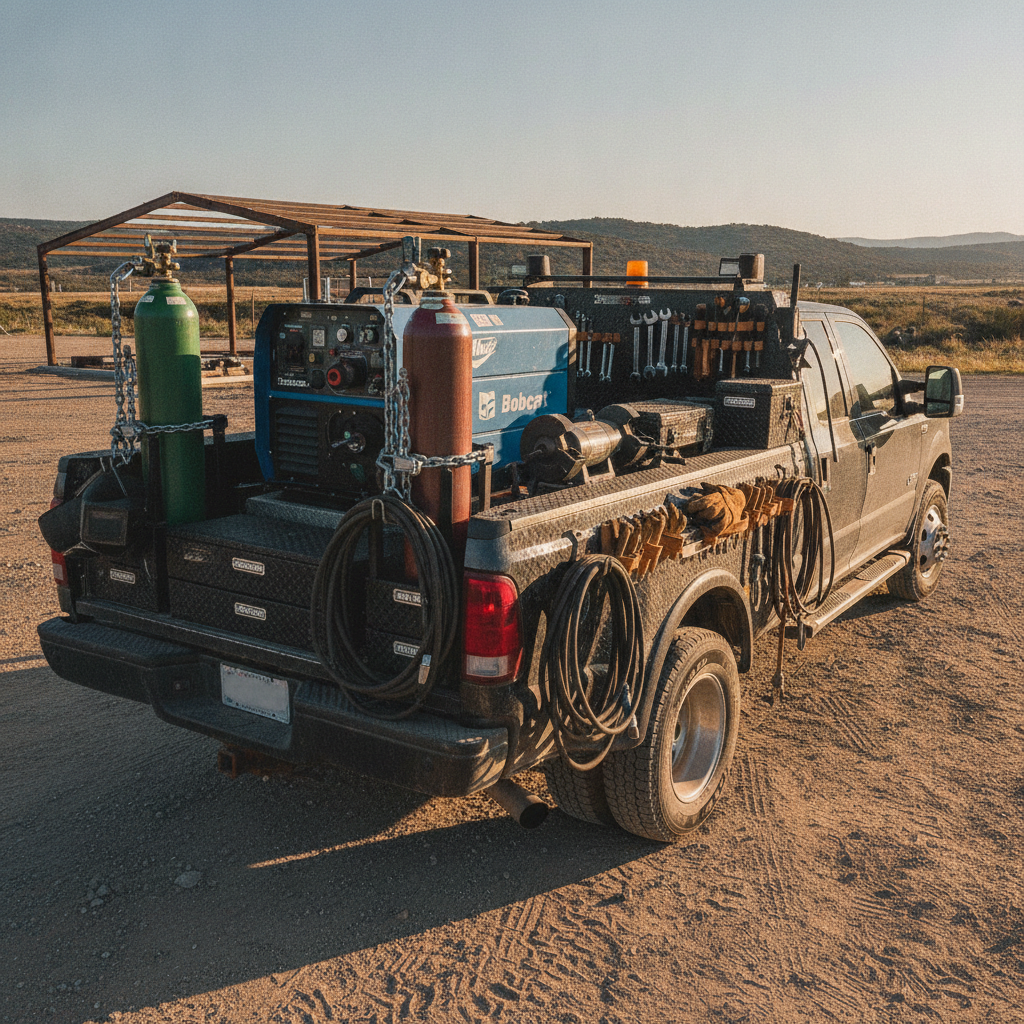
Fix it with a dedicated lead management system. That doesn’t have to be expensive. A set of large cable hooks bolted to the side of your truck bed, or a reel mounted to the headache rack, gets your leads off the floor and organized every single time. Some guys coil their leads on a purpose-built bracket. Others use a cable reel. Either way, the rule is simple: when you pull the leads out, they come out clean. When you put them back, they go back the same way.
Stinger cables, ground clamps, and machine leads should each have a home. Not “somewhere on the truck.” A specific, consistent home. Build the habit and it becomes automatic.
Mistake #2: Consumables Scattered Everywhere
Contact tips, nozzles, wire liners, electrodes, grinding discs — if these are living loose in a toolbox drawer mixed in with everything else, you’re going to be on a job site hunting for a 0.035 contact tip with a customer watching you. That’s a bad look and a waste of time you’re billing for.
Get a dedicated consumables box. Doesn’t have to be fancy. A small plastic organizer, a divided tool tray, even a repurposed tackle box works. The point is that every consumable type has its own slot. You open that box, you find what you need in ten seconds or less. You close it, everything’s back where it belongs.
Label everything if you need to. There’s no shame in a labeled system. Shame is being on the clock and spending four minutes looking for a nozzle.
Keep your most-used consumables at the top or front. The stuff you grab every single job should be the easiest to reach. The backup stock lives behind it. Think about how a well-run shop is organized and apply that logic to your truck bed.
Mistake #3: Cylinder Management That’s Actually Dangerous
Unsecured cylinders are both a safety violation and a logistical mess. If your shielding gas bottle is rolling around in the truck bed or leaning against the toolbox held up by wishful thinking, you’ve got a problem that goes beyond slow setup times.
Chain your cylinders. Every time. Mount dedicated cylinder holders if you run the same gases regularly. Know what’s in each cylinder and roughly how full it is before you leave for a job. Running out of gas on a job site because you forgot to check is an amateur move that costs you time and credibility.
The post on smart shielding gas management goes deeper on this if you want to dial in how you handle your gas supply. It’s one of those overhead costs that bites you when you’re not paying attention to it.
Also know your regulator fittings and keep spares. Getting to a job and realizing the fitting on site doesn’t match what you’ve got is the kind of thing that kills an afternoon.
Mistake #4: Tools Without a Home
Every tool on your rig should have a designated spot. Every single one. Angle grinders, wire brushes, chipping hammers, clamps, levels, squares — if each of those has a specific hook, drawer, or bracket it lives on, you will find it every time. If they’re just floating around in the bed, you won’t.
The fastest way to build this system is to do a full inventory of what’s actually on your truck. Lay it all out. Then ask yourself: how often do I use this on a job? Sort by frequency of use. The stuff you grab every day should be the most accessible. The specialty stuff can live deeper in the rig.
Pegboard and drawer toolboxes are your friends here. A good set of underbody boxes with divided drawers can hold a serious amount of gear in a way that’s actually retrievable. Spend the money on storage once and stop paying for it in wasted time every day after that.
The Two-Minute Rule for End-of-Day Reset
Here’s the habit that holds the whole system together: before you leave every job, spend two minutes putting the rig back in order. Coil leads, put tools back where they belong, toss consumable trash, check cylinder levels. Two minutes now saves you fifteen minutes at the start of the next job.
Most guys skip this because they’re tired at the end of a job. Understandable. Do it anyway. Future-you will appreciate it at 7 AM when you’re pulling up to the first job of the day and everything is exactly where it’s supposed to be.
Mistake #5: The Wrong Machine for the Work You’re Running
This one’s a little different, but it fits the conversation. Some guys are slowing themselves down because their machine isn’t well-suited to the variety of work they’re taking on. If you’re running mostly MIG but occasionally need to TIG or run stick, a single-process machine means swapping out equipment or turning down work. That’s time and money left on the table.
A proper mobile rig setup for a versatile mobile welder means having a machine that can handle what shows up. Multi-process units have gotten good enough that there’s no good reason to be limited on a field rig. The post on field-ready multi-process welders covers what to look for when you’re shopping for a machine that earns its keep in the truck.
If you’re also keeping an eye on the newer battery-powered options for remote jobs, check out the breakdown on hybrid battery-powered welders. The technology has moved faster than most people realize.
Mistake #6: No Pre-Job Checklist
The guys who never forget anything don’t have better memories. They have systems. A pre-job checklist is one of the simplest things you can build and one of the highest-return habits on this whole list.
Write down every item you need to have with you to run a job competently. Machine, leads, ground clamp, stinger, consumables for the process you’re running, gas cylinder and regulator, PPE, tools, any job-specific hardware. Check the list before you leave the yard. Takes two minutes and eliminates the thirty-minute round trip back home because you forgot your hood.
Customize it to the work you typically run. If you do a lot of structural work, your checklist looks different than someone doing mostly trailer repairs. The point is to have one and actually use it.
Speaking of running a tighter operation overall — if you’re building your business and thinking about how to price your services smartly, the post on pricing for certification services has some solid frameworks that apply to mobile work too.
Mistake #7: Ignoring Ergonomics and Physical Layout
How your truck is physically laid out matters more than people give it credit for. If your machine is in the far corner of the bed and you have to climb in and over stuff to reach the controls, that’s friction. If your heaviest gear is stacked on top and you’re pulling it down fifty times a day, your back is going to let you know about it eventually.
Think about traffic patterns. What do you reach for first when you open the truck? What do you need quick access to mid-job? Build your layout around how you actually work, not how the stuff happened to land when you first loaded up.
Keep the things you access most at tailgate height and within arm’s reach. Run your layout like a kitchen — prep area, tool area, storage in a logical sequence. It sounds fussy until you’ve been doing it for a week and you realize you haven’t wasted a single minute digging for anything.
Mistake #8: Not Thinking About Weather and Job Conditions
A lot of guys have a summer rig and a winter headache. If you’re running jobs year-round, your setup needs to account for weather. Gear that freezes up, leads that stiffen in cold temps, consumables that get wet in the rain — these are all setup problems masquerading as weather problems.
Weatherproof storage for your consumables is non-negotiable if you’re working in a wet climate. Leads coiled and off the bed floor don’t sit in ice melt in the winter. Small stuff that adds up to fewer surprises when you’re already dealing with a miserable job site.
If you’re expanding the kind of work you do and taking on more complex materials in the field, the breakdown on dissimilar-metal welding mastery is worth bookmarking. More process capability means more work, and your rig needs to support that.
Putting It All Together
Here’s the honest summary. A good mobile rig setup isn’t a luxury. It’s table stakes for running a profitable mobile welding operation. Every minute you spend searching for a tool or untangling leads is a minute you’re not billing, not moving to the next job, and not making the impression you want to make.
The fixes aren’t complicated. Leads have a home. Consumables have a home. Tools have a home. Cylinders are secured. You have a checklist. You reset at the end of every job. You’ve thought about your layout like it actually matters — because it does.
Build the system once. Maintain it as a habit. Let the other guy be the one fumbling around in his truck bed at 8 AM while you’re already running your first bead. That’s the difference between a guy who owns a welding truck and a guy who runs a welding business.
If you’re still in the early stages of building out your operation, the post on going from garage to shop has a lot of the groundwork thinking that applies here too. Get the business side right and the truck side right, and you’re ahead of most of the competition before the work even starts.