Let me guess – you’ve been putting off welder insurance shopping because every quote makes your wallet cry. Yeah, insurance agents love mobile welders. We’re walking dollar signs with torches and liability nightmares written all over us. But here’s the thing: you don’t need half the coverage they’re trying to sell you, and you definitely don’t need to pay premium prices for basic protection.
I’ve been through this dance more times than I care to count. Ten years of mobile welding taught me that insurance companies speak a different language – one designed to separate you from your cash faster than a plasma cutter through sheet metal.
The Real Talk on Welder Insurance Shopping
First things first: you absolutely need insurance. Period. I don’t care if you’re just welding your buddy’s trailer on weekends for beer money. The moment you strike an arc for pay, you’re in business. And business means liability.
But that doesn’t mean you need every bell and whistle the insurance salesman throws at you. These guys make commission, remember? They’re not looking out for your bottom line – they’re padding theirs.
The insurance maze is deliberately confusing. General liability, professional indemnity, equipment coverage, commercial auto, workers comp – it’s enough to make your head spin. That’s the point. Confused customers pay more.
General Liability: Your First Line of Defense
This is your bread and butter coverage. General liability protects you when your work goes sideways and someone gets hurt or property gets damaged. It’s not optional.
Here’s what you actually need: $1 million per occurrence, $2 million aggregate minimum. Don’t let them talk you into $5 million unless you’re working massive commercial projects. Most residential and small commercial jobs won’t require more than $1 million.
Watch out for these gotchas:
- Products and completed operations coverage – this covers you after the job is done
- Fire damage coverage – because we work with fire, genius
- Property damage to property in your care, custody, or control
Expect to pay $800-1,500 annually for decent general liability. If someone’s quoting you $3,000+ for basic coverage, keep shopping.
Professional Indemnity: Do You Really Need It?
Professional indemnity (or errors and omissions) covers you when your professional advice or services cause financial loss to a client. Most mobile welders don’t need this.
You’re not an engineer. You’re not designing structures or providing professional consulting. You’re following prints and welding to spec. Save your money unless you’re doing actual design work or pricing for certification services where your recommendations could cost clients serious cash.
However, if you’re getting into specialized work like dissimilar-metal welding mastery or offering technical consulting, then yeah, consider it.
Equipment Coverage: Protecting Your Bread and Butter
Your tools are your livelihood. Lose your welder, and you’re out of business until you can replace it. Equipment coverage is essential, but don’t overpay.
Cover your actual replacement cost, not retail. That $3,000 field-ready multi-process welder might only cost $2,200 to replace if you shop smart.
Include:
- Welders and plasma cutters
- Hand tools over $500 total value
- Safety equipment
- Your truck/trailer setup
Skip the coverage for consumables. Electrodes and gas aren’t worth insuring – they’re operating expenses.
Pro tip: Some policies require you to store equipment in locked vehicles or buildings. Read the fine print. If you’re leaving your field-ready battery welder in an open truck bed, you might not be covered.
Commercial Auto: More Complex Than You Think
If you’re using your personal vehicle for business, your personal auto policy won’t cover business use. Don’t try to slide by – they will deny claims.
Commercial auto covers:
- Your truck/van while driving to jobs
- Equipment being transported
- Liability if you cause an accident while working
The tricky part is equipment in transit. Make sure your policy covers tools and welders while they’re in your vehicle. Some policies exclude this, leaving you vulnerable.
Workers Compensation: When You Need Help
Solo operators don’t usually need workers comp, but some states require it even for single-person LLCs. Check your local requirements.
If you hire help – even part-time – you need workers comp. No exceptions. Getting caught without it is a fast track to bankruptcy if someone gets hurt.
And before you think about paying cash under the table to avoid this – don’t be an idiot. One accident and you’re liable for medical bills, lost wages, and potentially criminal charges.
Where to Shop Without Getting Burned
Forget the big-name insurance companies for specialized coverage. They don’t understand welding businesses and will either decline you or quote ridiculous rates.
Try these instead:
- Trade associations: AWS offers group rates to members
- Industry-specific insurers: Companies like BTIS specialize in contractors
- Independent agents: They shop multiple carriers for you
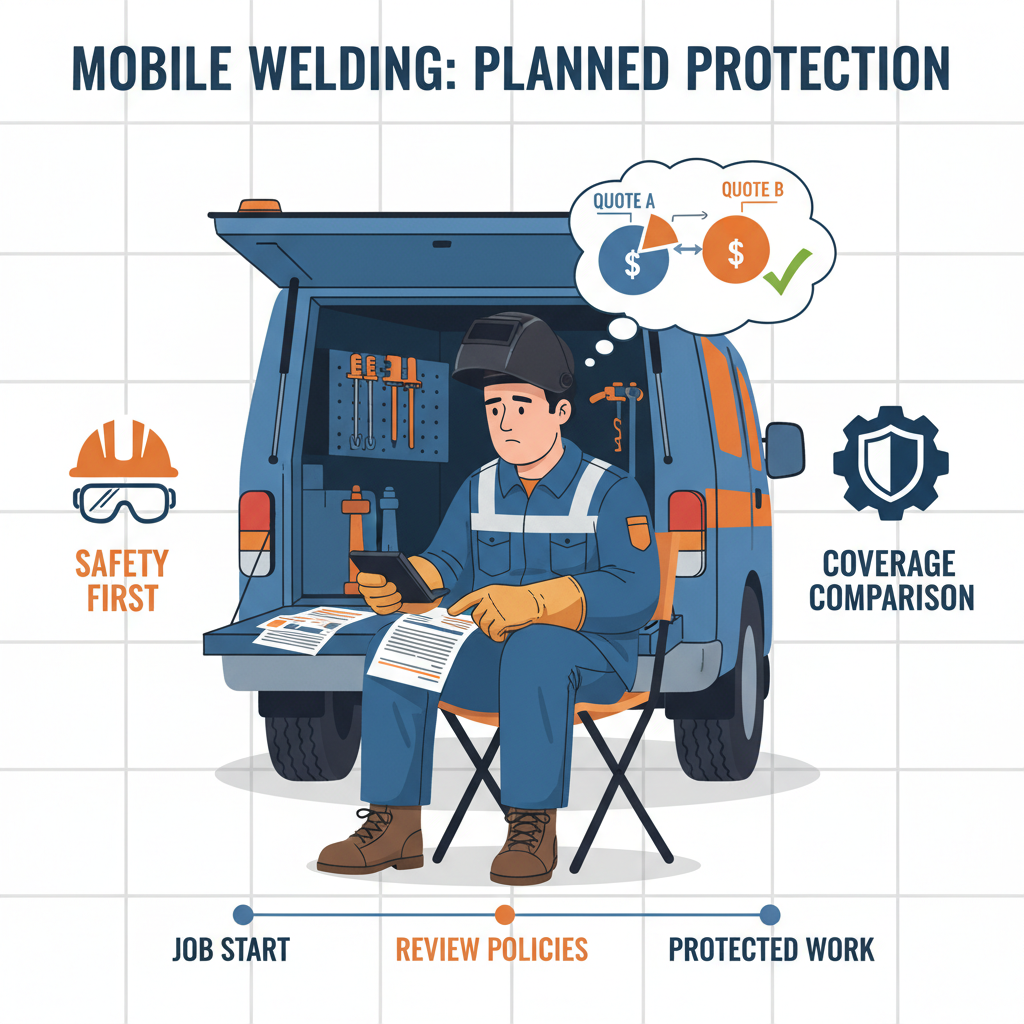
Get at least three quotes. Insurance pricing varies wildly between companies. I’ve seen identical coverage quoted at $1,200 from one company and $3,800 from another.
When you’re going from garage to shop, your insurance needs will change. Start with basic coverage and expand as you grow.
Red Flags to Watch For
Some agents will try to oversell you. Here are the warning signs:
- Pushing coverage limits way higher than you need
- Adding endorsements without explaining what they do
- Refusing to explain policy terms in plain English
- Pressuring you to sign immediately
Ask questions. Lots of them. If they can’t explain coverage in terms you understand, find someone else.
Exclusions That’ll Bite You
Every policy has exclusions – things they won’t cover. Common ones for welders:
- Pollution (including welding fumes in some cases)
- Asbestos exposure
- Nuclear hazards (yeah, really)
- War and terrorism
- Intentional acts
More relevant exclusions:
- Work on pressure vessels without proper certification
- Structural work exceeding certain heights
- Work in hazardous locations (refineries, chemical plants)
If you’re doing specialized work like sequential multimaterial weld sequencing for structural frames, make sure your policy covers it.
The Fine Print on Claims
Filing claims is where insurance companies show their true colors. Know what to expect:
- Reporting requirements: Most require immediate notification of incidents
- Documentation: Photos, witness statements, incident reports
- Cooperation: You must cooperate with their investigation
Keep detailed records of every job. If something goes wrong six months later, you’ll need to prove what you did and when.
Bundling: Sometimes Worth It, Often Not
Insurance companies love to bundle policies. Sometimes it saves money, sometimes it doesn’t. Do the math yourself.
Bundling works when:
- You actually need all the coverage
- The discount is significant (10% or more)
- Claims handling is simplified
It doesn’t work when:
- You’re paying for coverage you don’t need
- Individual policies from specialists cost less
- One claim affects all your rates
Annual Review: Don’t Set and Forget
Your insurance needs change as your business grows. Review coverage annually, not just when it’s renewal time.
Reasons to increase coverage:
- Taking on larger projects
- Adding employees
- Expanding service areas
- Investing in expensive equipment like field-ready robotic welders
Reasons to decrease:
- Scaling back operations
- Eliminating high-risk services
- Improving safety record
Don’t just accept automatic renewals. Shop around every few years. Loyalty doesn’t pay in insurance.
Building Your Insurance Strategy
Think of insurance as part of your business strategy, not just a necessary evil. Good coverage protects your assets and gives clients confidence in your professionalism.
When you’re developing strategic niches, consider the insurance implications. Some specialties require additional coverage but command higher rates.
For example, if you’re getting into certification testing and need to understand certification readiness calendars, make sure your policy covers testing-related activities.
The bottom line: don’t let insurance agents fleece you, but don’t go naked either. Get the coverage you need at a price that won’t kill your margins. Shop around, ask questions, and remember – the cheapest policy isn’t always the best deal if it doesn’t actually protect you when you need it most.
Your business depends on managing risk smartly. Welder insurance shopping is just another skill to master, like reading blueprints or setting up your hybrid battery-powered welder. Do it right, and you’ll sleep better knowing you’re covered without going broke in the process.