A Practical Guide for Fabricators
Friction stir welding (FSW) offers solid-state joining of aluminum alloys with low distortion and high strength. This guide helps fabricators decide when to add FSW to their toolkit and how to apply it in automotive, aerospace, and marine applications.
What is Friction Stir Welding?
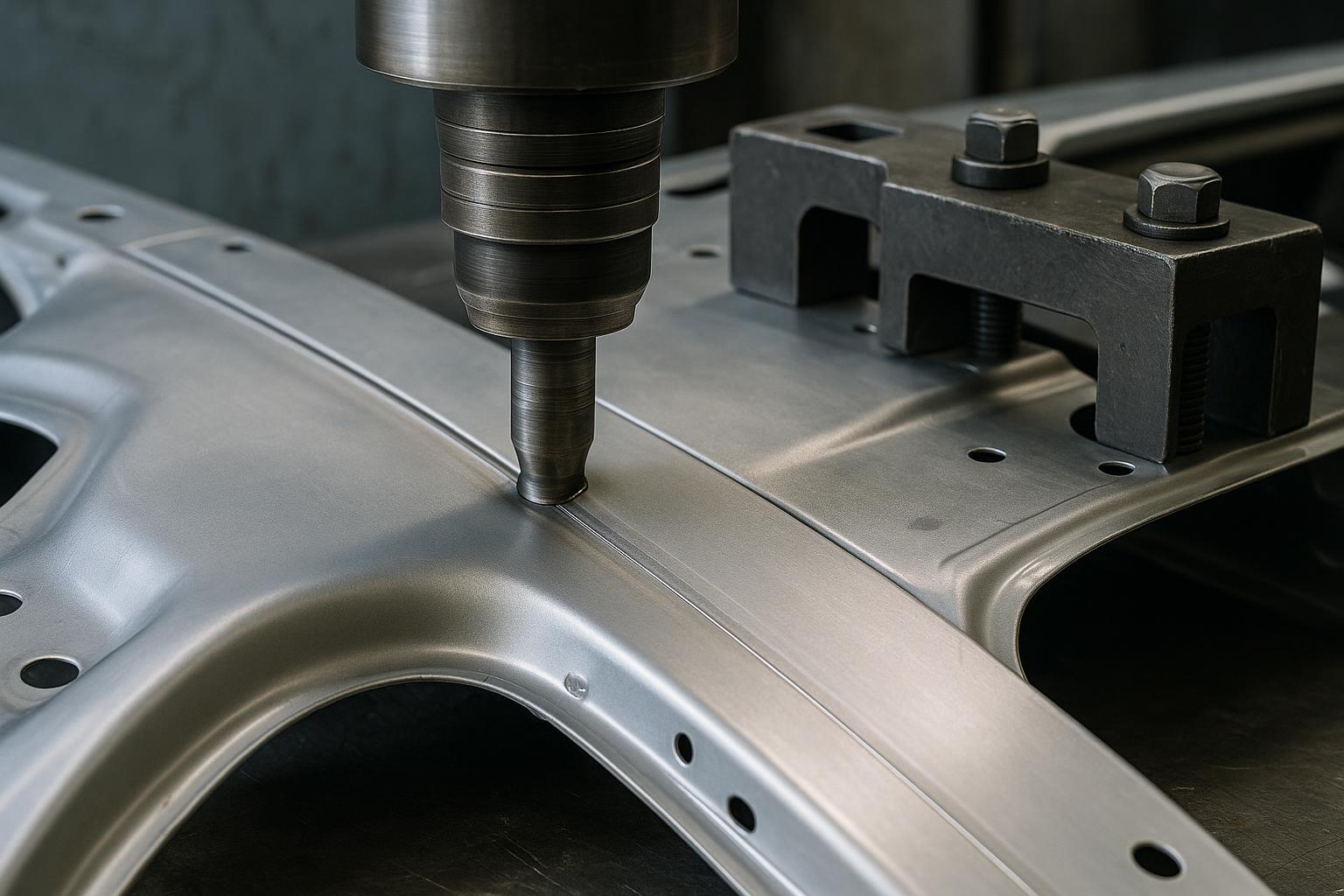
FSW uses a rotating tool with a pin and shoulder that plunges into two aligned aluminum sheets. The friction heats the material and, as the tool travels along the joint, forges a solid-state weld. The process avoids melting and can reduce distortion relative to traditional fusion welding.
When to add FSW to your toolkit
Introduce FSW when you are working with aluminum panels and extruded profiles where distortion controls and joint strength matter. Consider FSW for high-integrity assemblies in automotive bodies, aerospace skins, and marine structures. For design considerations, see our multimaterial joints guide.
- Joint thickness and material type are favorable for FSW with common aluminum alloys.
- When low distortion and high weld strength are critical for the part function.
- When avoiding melting and porosity associated with fusion welding is desired.
Key joint designs and tooling needs
FSW readily joins butt and lap configurations in aluminum. For complex geometries, consider T-joints with backing features. Typical tooling includes a welded pin and shoulder assembly, a compatible tool material for aluminum, and a clamping setup that minimizes heat sag. See our advanced process playbook for more on process selection and tooling strategies.
Qualification steps
Qualification for FSW follows standard welding procedure documentation: define a WPS (Welding Procedure Specification), run a WPQ (Welding Procedure Qualification) with representative joints, and collect conformance data. For a structured path, consult our process selection playbook and plan a small-scale pilot before production.
Industrial applications and examples
FSW is widely used in automotive body assemblies, aerospace skin panels, and marine hulls when aluminum weight savings and corrosion resistance are priorities. In practice, expect longer cycle times on early setups as you optimize tool geometry and feed rate. An initial prototype stage with a 4–6 mm thick aluminum panel can be a solid starting point.
Next steps and practical checklist
- Audit your current aluminum joints and identify panels that would benefit from FSW
- Invest in essential FSW tooling and fixtures
- Run a process qualification plan using a WPS/WPQ framework
For additional guidance on planning and implementation, you can explore related resources like the advanced process playbook and the process selection playbook as you map this into your shop.