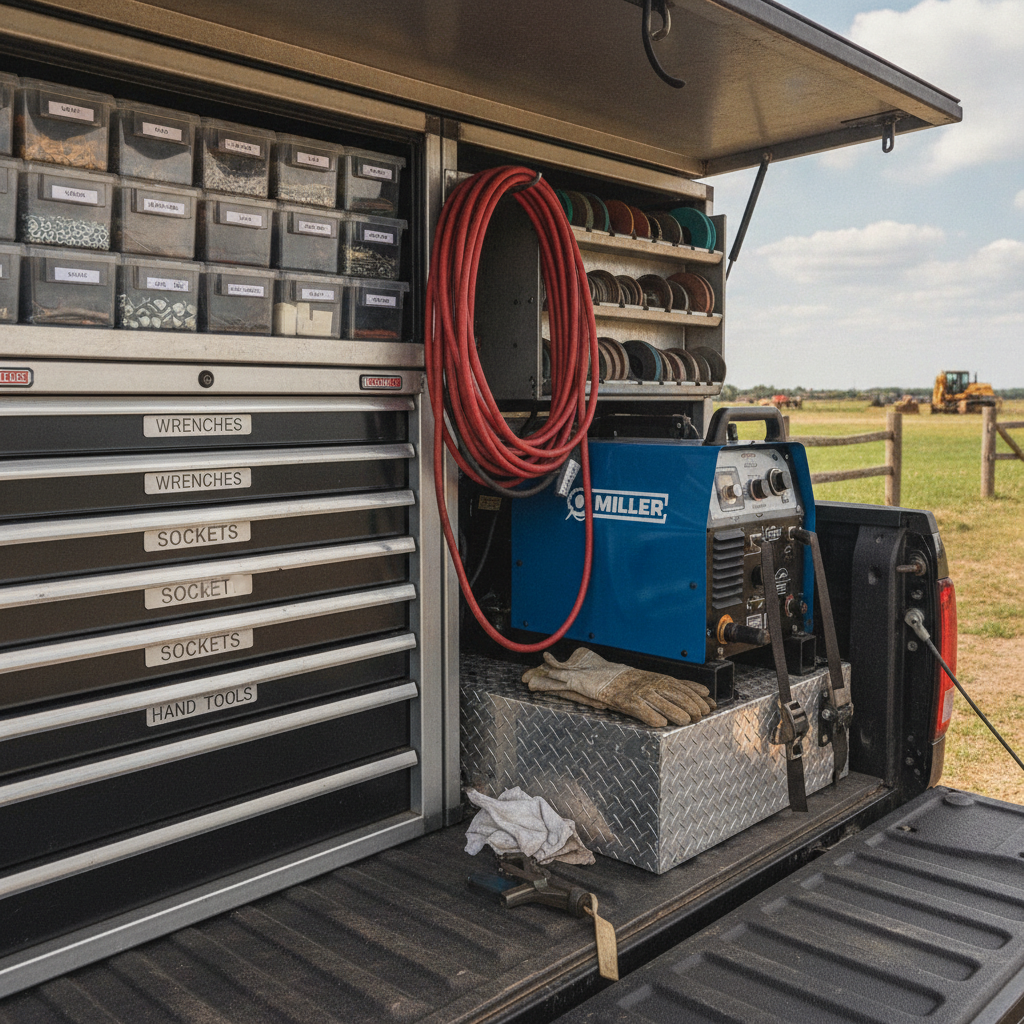
Let me paint you a picture. You pull up to a job, customer’s already waiting, and you spend the next twenty minutes digging through your truck like you’re looking for a lost sock. Cables tangled around a grinder. Consumables rattling loose in a milk crate. Your hood buried under a tarp you swore you’d organize last Tuesday. Sound familiar? Those truck setup mistakes aren’t just annoying — they’re eating your profit margin one wasted minute at a time. If you’re charging by the hour, you’re basically donating that time to the customer. And if you’re charging flat rate, you just made the job less profitable. Either way, you lose.
This post is about fixing that. Not with some Pinterest-worthy rig that never gets dirty. Real, practical organization that shaves actual hours off your week and makes you look like someone who’s been doing this longer than yesterday.
Why Truck Setup Mistakes Cost More Than You Think
Most guys underestimate how much time they lose to a disorganized rig. It doesn’t feel like a big deal when it’s five minutes here, ten minutes there. But add it up across a full week of jobs and you’re staring at a couple hours of unbillable time — easy. That’s real money walking out the door.
Beyond the time, there’s the professionalism angle. Customers notice when you’re digging through a pile of junk to find a wire brush. They don’t say anything, but they’re taking mental notes. First impressions on a job site matter more than people want to admit. A tight, organized rig signals that you run a tight operation. A rolling junkyard signals the opposite.
And then there’s safety. A disorganized truck is a liability. Unsecured cylinders, cables draped over sharp edges, grinding discs loose in a drawer — it’s all an accident waiting to happen. Organization isn’t just efficiency. It’s risk management.
If you’re still figuring out how to price your time properly once you’ve cleaned up your operation, this breakdown on pricing for certification services has some solid framing around valuing your hours correctly.
The Most Common Truck Setup Mistakes in the Field
1. No Designated Home for Every Tool
This is the big one. Everything needs a home. Not a general zone — an actual specific spot. If your angle grinder doesn’t have a hook, bracket, or drawer slot it lives in, it’s going to end up somewhere different every single time. Then you’ll spend three minutes every job locating it.
Go through every single item you carry. Every tool, every consumable, every piece of PPE. Assign it a location. Label the spot if you have to. It sounds like overkill until the third time you’re not searching for your tip cleaner in the dark.
2. Cables and Leads Stored Like Spaghetti
Tangled leads are one of the most common truck setup mistakes out there. You know the drill — you pull one end and the whole pile comes out in a knot. Now you’re fighting cables instead of welding.
Get a real system. Big loops on dedicated hooks or a cable reel. Keep your ground lead separate from your stinger lead. If your truck setup has the space, a side-mount cable management rail is worth every penny. The few minutes you spend coiling properly saves you ten minutes of untangling on the other end.
3. Consumables Scattered Everywhere
Rods in one box, tips in a bag, nozzles rattling in the cup holder, wire brushes in three different locations. Sound about right? Consumables need to be centralized and sorted. A small parts organizer or a dedicated consumable drawer is the move.
Sort by process. Your stick rods together, your MIG consumables together, your TIG stuff together if you’re running multiple processes. If you’re running a multi-process setup in the field, you already know how fast things get chaotic — check out what we covered on field-ready multi-process welders and how the right machine choice affects your whole rig layout.
4. Gas Cylinders Not Secured Properly
This one isn’t just an organization problem — it’s a serious safety problem. Cylinders rolling around in your truck bed or leaning against the tailgate is not a solution. A falling cylinder can become a projectile. The valve breaks off, and now you’ve got a torpedo situation.
Mount a proper cylinder rack or bracket. Bolt it down. Chain the bottles. This should be non-negotiable regardless of what else you have or haven’t figured out on your rig.
5. Your Most-Used Items Are the Hardest to Reach
You shouldn’t have to move three things to get to your angle grinder. Or climb into the truck bed to reach your helmet. Think about frequency of use when you’re laying out your rig. High-frequency items go in the most accessible spots. Stuff you use once a month goes in the back corner.
This sounds obvious but almost nobody does it on the first pass. You load the truck based on what fits, not what makes operational sense. Then you live with a rig that fights you every single job.
How to Actually Fix Your Rig Layout
Start With a Full Unload
Pull everything out. Every single item. Lay it on the ground or the shop floor and look at it honestly. You’re going to find stuff you forgot you had. You’re going to find stuff you haven’t used in two years. You’re going to find three tape measures and zero soapstone.
Sort into three piles: daily use, occasional use, and dead weight. The dead weight either goes to the shop, the scrap pile, or the trash. Stop hauling around tools you don’t need on a mobile rig. Every extra pound is fuel cost and every extra item is clutter.
Map Out Your Truck Before You Reload
Before you put anything back, sketch out your truck layout. Doesn’t have to be fancy — a napkin works. Think about workflow. Where do you stand when you’re setting up? What do you need in the first two minutes of a job? What stays in the truck 90% of the time?
Build the layout around how you actually work, not how the truck happens to be built. You might need to add some hooks, brackets, or organizers before you reload. That investment is worth it. A measure-twice approach before you invest applies here just as much as it does to equipment purchases.
Use Vertical Space
Most welding rigs are loaded like a single-level parking garage — everything flat on the floor of the bed. You’re ignoring the walls. Side rails, ladder racks, enclosed toolboxes mounted to the headache rack — all of that vertical space is usable real estate.
Hang your leads on hooks. Mount your helmet holder to the side of a toolbox. Use magnetic strips for small tools. Get creative with the space you have before you assume you don’t have enough room.
Weatherproof the Important Stuff
If your consumables get wet, your rods get moisture damage and your MIG tips corrode. If your machine sits in the rain uncovered, you’re shortening its life. An enclosed service body is the gold standard, but even a quality toolbox and a good cover goes a long way.
Think about where your sensitive items live relative to the weather. This is especially relevant if you’re running battery-powered or hybrid equipment — those systems have specific storage requirements. Worth reviewing what we covered on hybrid battery-powered welders if that’s part of your rig.
The Tools That Actually Help With Rig Organization
You don’t need to spend a fortune to get organized. But a few targeted purchases make a real difference.
Magnetic parts trays: Cheap and useful. Mount them to the side of your toolbox or the truck body for small parts that would otherwise end up on the ground.
Cable hangers and retractors: If you’re running the same leads job after job, a proper retractor or dedicated hooks pay for themselves in saved time within the first month.
Labeled bins for consumables: Stack-able, labeled, and sorted by process. No more hunting. No more mixing your 7018s with your 6010s.
A dedicated PPE spot: Your helmet, gloves, and sleeves should have a home that’s easy to reach. A lot of guys treat PPE like an afterthought in the truck layout, then wonder why they’re always scrambling for their hood.
A real first aid kit in a fixed location: Not buried. Not in the glovebox. Mounted, accessible, and restocked regularly.
The Operational Discipline Part Nobody Talks About
Here’s the part that actually separates the guys with tight rigs from the guys who reorganize every six months and slide back into chaos: discipline to put things back after every job.
Reorganizing your truck is a one-time thing. Keeping it organized is an ongoing habit. At the end of every job, before you pull out, do a quick sweep. Put the leads back where they go. Put the consumables back in the bin. Stow the grinder. It takes five minutes. It saves you twenty minutes tomorrow.
This kind of operational discipline is the same thing that makes a welding business run well overall. If you’re thinking bigger picture about how to set up a real operation — not just a truck — the From Garage to Shop post covers a lot of the same thinking applied to the business side.
When Your Rig Reflects Your Business
Your truck is your shop. For a mobile welder, it’s also your storefront, your tool room, and your business card. Customers form opinions based on what they see when you show up. A well-organized rig with labeled toolboxes and neatly routed cables says you’re a professional who runs a tight operation.
That matters when you’re trying to build a customer base or land commercial accounts. It matters when you’re asking for top-dollar rates. A messy rig undercuts all of that, even if your welds are flawless.
The good news is this stuff is fixable. Unlike welding skills that take years to develop, rig organization is something you can sort out in a weekend. And once you’ve built the habit of putting things back where they go, it mostly maintains itself.
If you’re trying to figure out which niche to build your mobile welding business around — which will also shape what you carry on your rig — the strategic niches post is worth your time.
The Bottom Line on Truck Setup Mistakes
Most truck setup mistakes come down to one thing: loading the truck based on convenience once instead of building a system that works every day. It’s a short-term thinking problem with a long-term cost.
You don’t need a brand-new service body or a custom rig build to run a tight operation. You need to unload, think it through, and reload with intention. You need a home for every tool, a system for every consumable, and the discipline to put things back after every job.
Do that, and you stop donating time to setup. You show up looking like you’ve done this before — because you have, and now your rig finally shows it.
Small changes. Real hours saved. That’s the whole point.