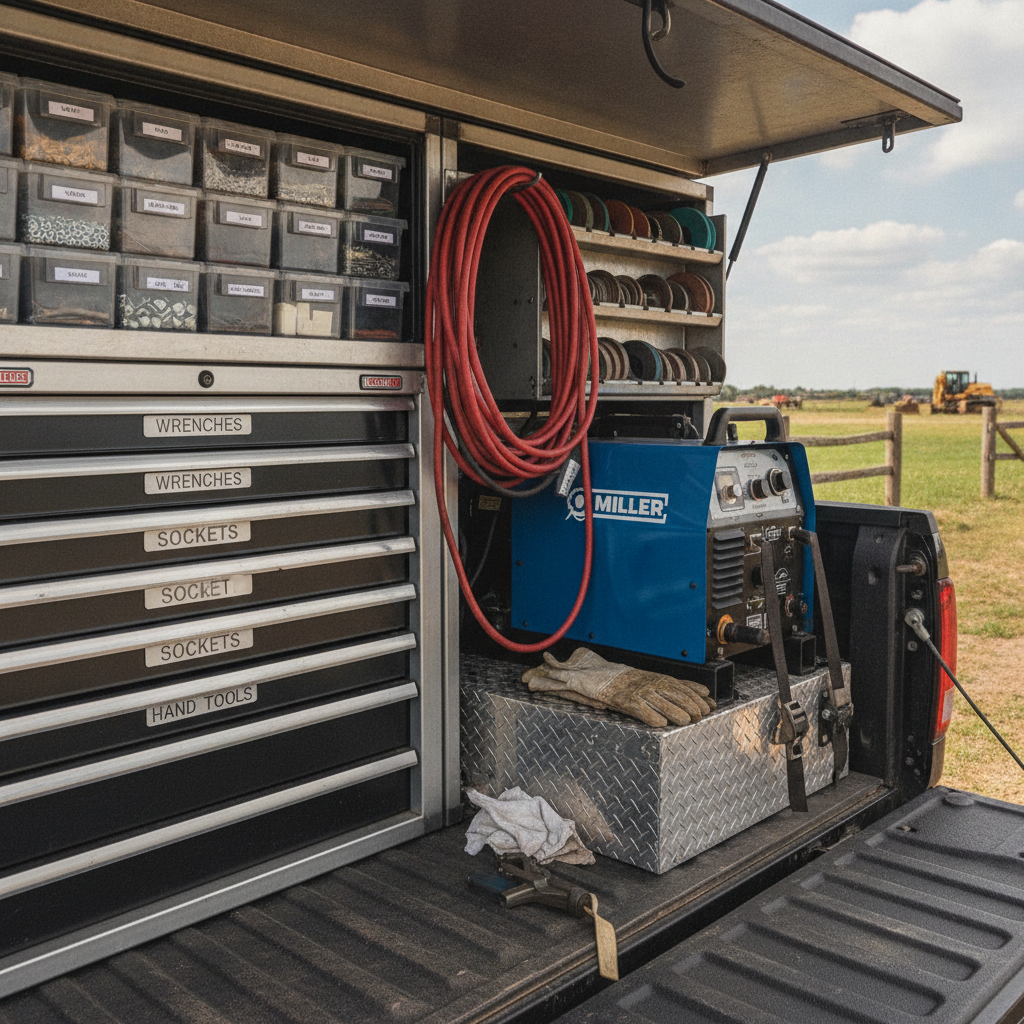
If you’re spending twenty minutes digging through your truck before you strike your first arc, you don’t have a welding problem — you have a mobile rig organization problem. And that problem is billing itself directly to your bottom line every single day. Time you spend hunting for a contact tip or untangling cable is time you’re not charging for. Nobody’s writing you a check for the ten minutes you spent moving a grinder to find your chipping hammer.
I’ve been running mobile welding rigs for over a decade. I’ve made every one of these mistakes myself, and I’ve watched plenty of other guys make them too. The good news is that most of these fixes cost almost nothing. They just require you to stop loading your truck like you’re cramming for a final exam at 6 AM.
Let’s get into it.
Why Mobile Rig Organization Is a Business Problem, Not Just a Convenience
Before we talk specifics, let’s be clear about something. This isn’t about being neat. This isn’t about impressing anyone. This is about money.
Say you’re charging $95 an hour. If you waste 20 minutes per job on setup and breakdown inefficiency, that’s roughly $31 per job you’re eating. Run five jobs a week and you’re losing $155 weekly. That’s over $8,000 a year in unbilled time — all because your truck looks like a yard sale.
When you’re trying to build a sustainable business, those numbers matter. If you’ve read anything about investing wisely in your operation, you already know that small inefficiencies compound fast. Your rig is no different.
Good mobile rig organization also signals professionalism to customers. When a client watches you walk up to a job with everything in its place, they don’t question your rate. When they watch you dig through a pile of junk for four minutes while they stand there, they start doing math in their head.
Mistake #1 — No Zones, No System
The biggest error guys make is loading their truck with no logical zones. Everything just goes wherever it fits that day. Gas in the back, then up front, then behind the seat. Consumables in three different boxes. Cables thrown loose on the bed.
Fix this with a simple zone system. Think of your truck as a job site. Everything has a home, and that home makes sense for how you actually work.
How to Zone Your Rig
- Hot zone: Everything you touch in the first five minutes of a job. Helmet, gloves, chipping hammer, wire brush, electrodes or wire, contact tips. This goes in one box, front-facing, easy open.
- Process zone: Your machine, leads, ground clamps, gas hoses. Staged and ready to deploy in a straight line without crossing over each other.
- Repair and spare zone: Backup consumables, spare tips, extra tungsten, rod oven if you run low-hydrogen. Not buried, but not prime real estate either.
- Tool zone: Grinders, cut-off wheels, clamps, measuring tape. Separate from your welding gear so you’re not digging through grinding discs to find your stinger.
This sounds obvious. You’d be amazed how many experienced welders skip it entirely.
Mistake #2 — Cables and Leads Are a Disaster
Tangled leads are the tax you pay for not coiling them right the last time. If you’re the guy who drags his lead out in a knot every morning and spends five minutes fighting it, you already know what I’m talking about.
Coil your leads the same way every single time. Use the over-under method if you can — it keeps the cable memory from turning into a spiral mess. Hang them on dedicated hooks or pegs inside the truck box, not thrown loose over the welder.
Same goes for your ground cable. Mount a dedicated cleat or peg inside the rear compartment. When you pull up to a job, your ground should be in your hand in under ten seconds.
If you’re running a multi-process machine, keeping leads organized gets even more critical. Take a look at what’s available now in field-ready multi-process welders — some of the newer machines are designed with cable management in mind from the factory. Worth knowing before you buy your next unit.
Mistake #3 — Gas Cylinders Stored Wrong
Cylinders rolling loose in the truck bed is a safety issue first and an efficiency issue second. But it’s also an organization issue. If your cylinder is laying on its side because you didn’t build a proper mount, you’re also not set up to connect and disconnect quickly.
A simple built-in cylinder rack — even just a couple of angle iron brackets with a chain — gets your bottles upright, secure, and accessible. Your regulator stays connected and protected. You pull up, open the valve, connect your hose, and go.
Compare that to the guy fishing a cylinder out from under a pile of straps, standing it up, and then remembering his regulator is in a different box.
If you’re running battery-powered or hybrid equipment alongside your gas processes, the organization challenge is different but the principle is the same. Check out the breakdown on hybrid battery-powered welders if you’re thinking about adding that capability to your rig — knowing the equipment helps you build storage around it properly.
Mistake #4 — Consumables Scattered Everywhere
Your consumables should live in one place. One dedicated, labeled, weatherproof container. Contact tips, nozzles, diffusers, electrodes, tungsten — all of it, sorted by process and size.
I use a small parts organizer with labeled drawers mounted inside one of my side compartments. Cost me about $30 and ten minutes of drilling. Now I never dig for a contact tip. I open the drawer, grab what I need, and move on.
The guys who keep consumables in their pockets, loose in the cab, scattered across three tool boxes, or half in a zip-lock bag in the glove compartment — those guys spend more time looking for a .035 tip than it takes to run the bead.
Label Everything
This sounds like something your shop teacher told you. It’s also something that saves you five minutes a day at minimum. Label your drawers. Label your bins. Put a strip of tape on the side of your storage box if that’s what it takes.
When you’re tired at the end of a long day, you don’t want to think. You want to grab and go. Labels make that possible. No thinking required.
Mistake #5 — Your Welder Has No Permanent Home on the Truck
If your welder slides around, tips over, or has to be repositioned every time you hit a bump, you’re dealing with a real problem. This isn’t just an equipment safety issue. It means you’re always adjusting before you can work.
Mount it. Build a skid. Bolt it down with rubber isolators if vibration is a concern. Your machine should sit in exactly one spot and stay there whether you’re doing 70 on the highway or crawling across a gravel field access road.
This also applies to your toolboxes, grinders, and anything else that needs to be in a specific location to be useful. If it moves, it’s disorganized. Period.
Mistake #6 — No Pre-Job Checklist
Most disorganization doesn’t happen on the truck — it happens at the shop the night before or the morning of. You load in a hurry. You forget to restock consumables. You grab one thing and put something else down in the wrong spot. By the time you arrive at the job, the system you built has already been undermined.
A laminated pre-job checklist on the inside of your toolbox lid fixes this. Take five minutes when you’re loading to run down the list. Consumables stocked? Ground lead coiled and hung? Cylinder valve closed and regulator connected? Helmet lenses clean and shade correct?
It feels like overkill until the day you show up to a job site with no contact tips and your nearest supply house is 45 minutes away.
This same discipline applies to the business side. If you’ve thought about using smart tools to track where you’re actually spending time and money, you’ll start to see a pattern in where your day falls apart — and it’s often before you ever light an arc.
Mistake #7 — Treating Your Truck Like a Storage Unit
Over time, mobile rigs become rolling storage units for everything you might need someday. Spare parts from three machines ago. A piece of angle iron you’ve been meaning to use. A bag of hardware from a job you finished in March.
Dead weight slows you down in every sense. It makes finding real tools harder. It adds weight to your truck. And it tells every customer who looks in your boxes that you don’t actually have a system.
Purge your rig every 90 days. Pull everything out. Put back only what you actually used in the last three months. Donate, trash, or shop the rest. Your back will thank you and your setup time will drop immediately.
Building a System That Actually Sticks
The best mobile rig organization system is the one you’ll actually maintain. Start simple. Pick one problem from this list — the one costing you the most time right now — and fix just that. Get it working for two weeks. Then move to the next one.
Don’t try to overhaul your entire rig in one Saturday morning. You’ll make a mess, get frustrated, and put half of it back where it was before.
If you’re in the early stages of running your own operation, the organizational habits you build now compound over time. The guys who figure this out in year one run tight, profitable operations by year three. The guys who never fix it are still digging through the same pile of junk in year five, wondering why their numbers don’t work.
Speaking of making the numbers work — if you’re pricing your services, check out the breakdown on pricing for certification services. Understanding where your time actually goes is the first step to pricing it correctly. And if you’re still figuring out what niche to build your business around, the post on strategic niches for mobile welders is worth your time.
The Bottom Line on Mobile Rig Organization
Your truck is your shop. Unlike a fixed shop, it goes everywhere with you, and it has to be ready to work in five minutes on a good day or two minutes on a hard one. That only happens when everything has a place and everything is in its place.
Good mobile rig organization isn’t about being fussy. It’s about being fast, professional, and profitable. Every minute you save on setup is a minute you can bill. Every time a customer watches you set up efficiently, you’ve justified your rate without saying a word.
Stop losing money to a disorganized truck. Fix one thing this week. Then fix the next thing. In a month, you’ll have a rig that works as hard as you do — and you’ll stop dreading the first twenty minutes of every job.
You’ve already got the skills. Stop letting your truck be the reason you’re slow.