You pull up to a job, the customer is standing there watching, and you spend the next twenty minutes digging through a pile of leads, grinding discs, and mystery rods just to find your damn stinger. That right there is the problem with bad mobile rig organization. It doesn’t just look unprofessional — it comes directly out of your pocket. Every minute you waste on your own truck is a minute you’re not billing. Let’s talk about the truck setup mistakes that are quietly wrecking your day rate and what to actually do about them.
Why Mobile Rig Organization Is a Business Problem, Not Just a Tidiness Problem
Some guys treat their truck like a rolling junk drawer. They know where everything is — sort of — and they’ve been getting by. Fine. But “getting by” isn’t the same as running a tight operation.
If you’re billing $95–$150 an hour and you’re wasting 30 minutes per job on setup and digging through gear, you’re eating $50–$75 before you’ve laid a single bead. Do that on five jobs a week and you’ve just donated $250–$375 to nobody.
Good mobile rig organization is a revenue decision. Full stop. If you’re still figuring out your pricing structure and where that time fits in, go back and read this post on pricing for certification services — a lot of the same logic applies to field work rates.
Now let’s get into what’s actually going wrong.
Mistake #1: No Zones, No System
The biggest mobile rig organization mistake is having no system at all. Everything just ends up wherever it landed last time. Your welding leads are piled on top of your angle grinders, which are sitting on your rod cans, which are getting crushed by your chain binders.
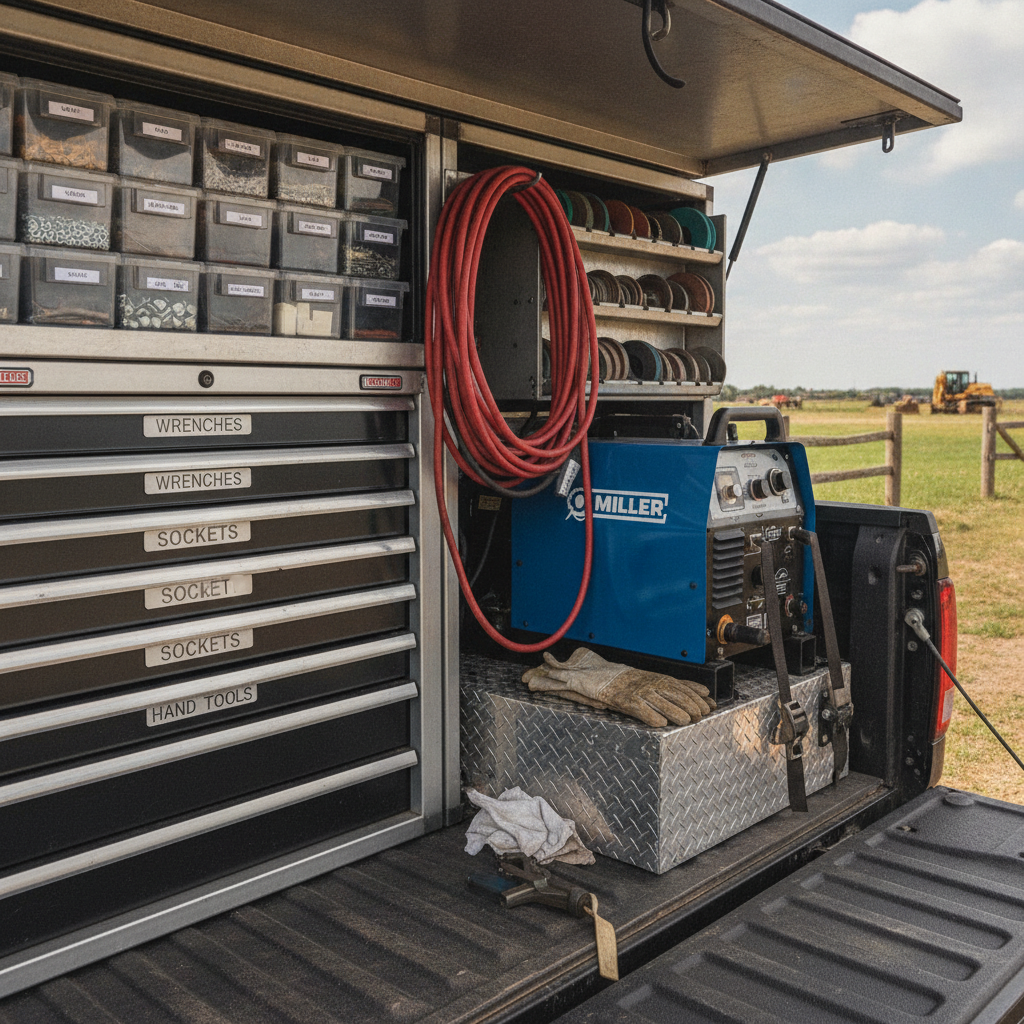
Fix this by dividing your truck into zones. It sounds obvious. Most guys still don’t do it.
Here’s a basic zone structure that works:
- Arc zone: Machine, leads, stinger, ground clamp, lead connectors
- Consumables zone: Rods, wire, tips, nozzles, anti-spatter
- Grind and prep zone: Grinders, discs, wire wheels, cutting wheels, clamps
- PPE and safety zone: Hood, gloves, chipping hammer, slag brush, fire extinguisher
- Misc and hardware zone: Tape measure, markers, soapstone, hardware, drill bits
Each zone stays put. Every time. Not “mostly” every time. Every time. That’s the whole point.
Mistake #2: Leads Are a Disaster
Welding leads are the serpents of the mobile welder’s world. They tangle, they snag, they hide under everything, and if they’re not stored right, they’ll develop a kink that’ll drive you insane for the next two years.
A lot of guys just throw their leads in a pile. That pile will waste your time every single morning. It takes thirty seconds to coil a lead properly. It takes five minutes to untangle one that wasn’t.
Get a dedicated lead storage spot — either a horizontal rod or a vertical coil hook mounted inside your box. Keep your work lead and ground lead coiled separately. Label the connectors with a paint marker if you run multiple lead lengths. You’ll thank yourself when it’s 6 AM and you haven’t had coffee yet.
Also: get your lead lengths right for your typical jobs. Too short and you’re moving the machine constantly. Too long and you’re hauling 100 feet of cable for a 15-foot reach. Know your common work scenarios and set up accordingly. If you’re running multi-process out in the field, this post on field-ready multi-process welders covers equipment setups that pair well with a tight truck layout.
Mistake #3: Consumables Are Scattered Everywhere
You know what kills a job faster than anything? Realizing your last 6013 rod is buried under a seat somewhere and you’re not even sure it’s dry.
Consumable storage is where most rigs fall apart completely. Rods in plastic bags. Tips rolling around loose in a drawer. Wire spools without covers. Discs stacked randomly and getting nicked.
Here’s what you actually need:
- A rod oven or rod vault bolted in the truck. Not optional if you’re doing structural work.
- Labeled bins or dividers for MIG tips, nozzles, and liners by size.
- Grinding discs in a sealed flat container — they chip and crack when they bounce around loose.
- A running inventory. Yes, an actual list. Even just a whiteboard on the inside of a cabinet door.
Running out of consumables mid-job and having to make a parts run is a rookie mistake. It also tells your customer exactly how prepared you are. Spoiler: not very.
Mistake #4: The Machine Itself Is Not Set Up for Your Work
This one’s less about storage and more about knowing your process before you arrive. Your machine should be set for the most common process you’re running that day — not neutral, not “whatever it was last time.”
Take five minutes the night before to dial in your machine settings for the next day’s job. Check your polarity. Check your wire feed if you’re running MIG. Check your gas flow. When you roll up to the job, you should be able to strike an arc in under two minutes of actual setup time.
If you’re running diverse materials in the field — aluminum one day, mild steel the next, stainless the day after — your machine choices matter a lot. We’ve covered some of this in the piece on dissimilar-metal welding mastery and it’s worth reading before you commit to a rig loadout.
Mistake #5: Your Truck Looks Like You Don’t Care
Here’s the uncomfortable truth: customers judge your work before you do any. They watch you get out of the truck. They watch you open the box. They watch how you move.
A disorganized truck tells a customer that you’re probably disorganized in your work too. Fair or not, that’s the read. And in a service business, perception matters.
This doesn’t mean your rig needs to be showroom clean. It means it should look like a professional works out of it. Tools in their spots. Leads coiled. Consumables organized. Nothing flopping around or falling out when you open a door.
If you’re building your mobile welding business from scratch and thinking about the bigger picture — how customers see you, how you price, how you position yourself — this older post on strategic niches for welding businesses is worth a read. Your truck is part of your brand whether you like it or not.
Mistake #6: No First-Out Kit
This is a simple one that almost nobody does: a first-out kit.
It’s a small bag or box that lives right at the door of your truck. It contains the things you need for the first five minutes of every single job. Every time. No exceptions.
A solid first-out kit usually includes:
- Soapstone and a straight edge
- Tape measure
- Chipping hammer and wire brush
- Gloves
- Marking paint or paint markers
- A small notepad or work order book
When you open your truck, this comes out first. You set it down next to your work. You assess the job. You mark what needs marking. Then you go get your machine and gear.
That sequence alone — assess before you drag out equipment — will save you fifteen minutes on half your jobs just from not having to rearrange gear because you grabbed the wrong thing first.
Mistake #7: Gas Cylinders Are a Safety and Workflow Hazard
If your shielding gas cylinders are rolling around in the back of your truck, that’s a safety issue first and an organization issue second. But it’s also a workflow issue because you’re checking connections, re-securing cylinders, and messing with regulators that got jostled in transit.
Mount your cylinders. Use proper cylinder brackets. Chain them down. Period. This isn’t a suggestion — in most states it’s a DOT requirement for transport.
While you’re thinking about gas management, this post on smart shielding gas management covers how to stop bleeding money on gas waste, which is another thing that kills your margins without you noticing.
Mistake #8: No Standard Shutdown Routine
You finish a job, you’re tired, you throw everything in the truck and drive home. Next morning, you’ve got to re-sort everything before you go. Sound familiar?
A shutdown routine takes five minutes and saves you fifteen the next morning. It’s the same idea as mise en place in a kitchen — everything back in its place before you leave so you’re ready to go when you show up.
Your shutdown routine should include:
- Coil and store leads
- Purge and cap your gas line
- Store grinders and discs
- Sweep the truck bed for scrap, rods, and trash
- Note any consumables that need restocking
- Reset your machine settings for tomorrow
Build the habit. It’s not glamorous. Neither is spending your first paid hour of the day cleaning up from yesterday.
What a Well-Organized Rig Actually Gets You
Let’s put some numbers on this. Say you’re doing four jobs a day. Right now you’re losing an average of 20 minutes per job to bad mobile rig organization — setup, searching, re-coiling leads mid-job, making a parts run. That’s 80 minutes a day. At $120/hour, that’s $160 a day you’re not billing.
Five days a week. That’s $800 a week. $3,200 a month. Just from a messy truck.
Now obviously you won’t claw back all of that. But even if better organization saves you half that time, you’re looking at $1,600 a month in recovered billable hours. That’s a truck payment. That’s new equipment. That’s a week off.
If you want to build a real mobile welding business — not just stay busy, but actually grow and scale it — the operational stuff matters as much as your skills at the machine. This post on going from garage to shop touches on a lot of the same growing pains and is worth bookmarking if you’re in that stage.
Building Your Mobile Rig Organization Plan
Here’s how to actually implement this without tearing your rig apart over a weekend and losing momentum.
Week 1: Do a full audit. Pull everything out. Throw out what’s dead — cracked discs, burned tips, mystery rods with no ID. Assess what you have and what’s actually living in your truck versus what should be.
Week 2: Set up your zones. Even if you’re using milk crates and zip ties for now, get zones established. Label them. Stick to them.
Week 3: Build your first-out kit. Get a cheap tool bag. Stock it. Make it a habit.
Week 4: Write your shutdown routine on a card and tape it inside your truck door. Follow it every single day for a month until it’s automatic.
After that, you start upgrading — proper drawer systems, mounted cylinder racks, better storage solutions. But the system comes first. Hardware without a system is just expensive clutter.
One More Thing: Know Your Machine Before You Need It
All the organization in the world won’t help if you show up to a job and your machine isn’t dialed in for what you’re doing. As field work gets more varied — more aluminum, more stainless, more multi-process situations — knowing your equipment deeply matters more than ever.
Worth spending some time with resources like this piece on hybrid battery-powered welders if you’re thinking about updating your rig’s power source. The landscape is changing and the right machine choice impacts everything about how your truck is set up.
The Bottom Line on Truck Setup Mistakes
Your truck is your shop. Unlike a fixed shop, it rolls down the road and gets shaken, bounced, rained on, and dug through by your hands every single day. It deserves a system that’s designed for how you actually work, not just whatever happened to accumulate over the last three years.
Good mobile rig organization is not about being neat for its own sake. It’s about being fast, professional, and profitable. It’s about walking up to a job looking like you know what you’re doing — because you set your rig up that way on purpose.
Stop donating your labor to a disorganized truck. Fix the system once and it pays you back every single day.