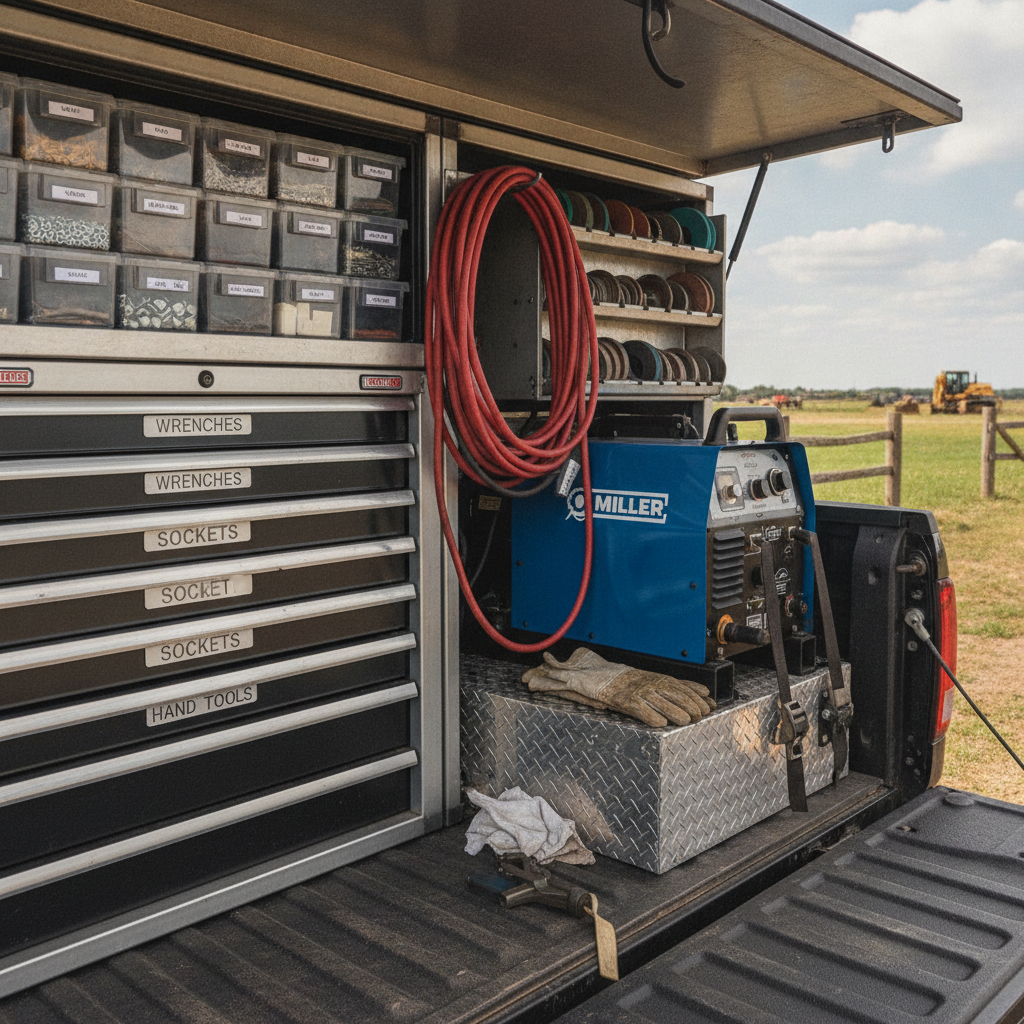
Let me paint you a picture. You pull up to a job site, customer’s watching, and you spend the next twenty-two minutes digging through your truck bed like a raccoon in a dumpster looking for your stinger leads. That’s not a great first impression. More importantly, that’s your time — and if you’re billing hourly, that’s your money walking right out the door. Getting your mobile welder truck setup dialed in isn’t glamour work, but it’s one of the fastest ways to put more money in your pocket without landing a single extra job.
I’ve been running a mobile rig for over a decade. I’ve made every mistake in this post. Some of them I made twice because apparently I enjoy suffering. So consider this your shortcut — a breakdown of the dumbest, most common rig organization mistakes that are quietly bleeding time and money out of your operation every single week.
Why Your Mobile Welder Truck Setup Is a Business Problem
Here’s what most guys don’t think about when they’re tossing gear in the truck at 5 AM: disorganization compounds. It’s not just one lost ten minutes on one job. It’s ten minutes on every job, every day, five days a week. That’s nearly an hour a week you’re not billing. Stretch that across a month and you’ve given away four billable hours for free. At $100/hr, that’s $400 a month you’re leaving in the dirt.
Your rig is your business. How it’s organized tells a customer a lot about how you operate before you’ve said a single word. A sloppy truck suggests sloppy work. Fair or not, that’s how people think. On the flip side, a clean, organized rig signals that you’re a professional who knows what he’s doing. That matters when you’re trying to build a reputation and get repeat customers.
If you’re still figuring out the bigger picture of running a mobile welding business, take a look at this breakdown on strategic niches for mobile welders — knowing what work you’re chasing changes what gear you need and how you set up your truck.
Mistake #1: No Zones, No System
The number one crime on most mobile rigs is throwing everything everywhere with no rhyme or reason. Consumables mixed in with hand tools. Safety gear buried under leads. Rod cans rolling around loose in the bed. There’s no system, so every job starts with an excavation project.
Fix it with zones. It sounds basic, and it is. But basic works.
- Zone 1 — Daily use: Everything you touch on almost every job. Stinger, ground clamp, angle grinder, chipping hammer, wire brush, gloves, helmet. This stuff lives at the front of your truck bed or in the most accessible compartment. No exceptions.
- Zone 2 — Job-specific gear: Plasma cutter, MIG gun, TIG torch, specialty consumables. Organized and accessible but not taking up prime real estate.
- Zone 3 — Backup and rarely used: Spare parts, extra tips, backup cables, anything you grab once in a blue moon. This goes in the back or in a lower bin.
You do this once, and you stop playing find-the-grinder every morning. Seriously, zone your truck this weekend. It takes two hours and pays you back immediately.
Mistake #2: Loose Cables and Leads Going Everywhere
Tangled welding leads are the slow death of a mobile rig. You know the scene — you go to pull your stinger out and you end up dragging half your truck with it because everything’s wrapped around everything else. Then you spend five minutes untangling it while the customer stands there watching.
Get a dedicated cable management solution. At minimum, use large cable hooks or reels mounted inside the bed or on the side of the truck. Some guys run a simple wooden spool bolted to the side of their service body. Others use commercial cable reels. Whatever works for your rig, the point is the cables have a home and they go back there every time.
Same goes for your ground cable. Don’t just toss it. Same home, every time. When you’re tired at the end of a long day, muscle memory is your friend. You want to be able to put gear away without thinking.
Also worth noting: if you’re running newer field-ready multi-process welders, the cable management demands change a bit depending on what processes you’re switching between on a given day. Set up your zone system around your most-used machine first.
Mistake #3: Rod Storage That’s Actually a Rod Disaster
Loose rod cans rolling around in a truck bed are a liability — literally. A can of 7018 bouncing around gets moisture exposure, gets damaged, and can roll off and take out someone’s shin. And digging through a pile of loose rods to find the right electrode mid-job is embarrassing.
Invest in a proper rod oven or, at minimum, a dry rod holder if you’re running stick on a regular basis. If you’re doing structural work or anything where rod condition matters — and it does matter — moisture-damaged electrodes are not a joke. Your quality goes down and your liability goes up.
For organization, label your rod cans clearly and store them upright in a dedicated slot or tray. A simple welded bracket in the bed does the job. You know exactly what you have, where it is, and whether it’s been properly stored.
Speaking of quality — if you’re working with multiple materials on field jobs, check out this piece on dissimilar-metal welding mastery. The right consumables for the right base metal matters more than most guys realize until it’s too late.
Mistake #4: Grinding Gear Scattered to the Wind
Angle grinders, cutting wheels, flap discs, wire wheels — these things multiply on a truck like rabbits. And somehow, when you need a fresh cutting wheel, you can never find one. Then you’re running a worn-out disc because you “know there’s a good one in here somewhere.”
Grinding consumables need a dedicated bin or drawer. One spot, always. Label it if you have to. Keep a rough inventory in your head — when you grab your last backup disc, add it to your restock list. Don’t wait until you’re on a job, an hour from the supply house, to find out you’re out.
Your grinders themselves should have a specific home too. A lot of guys put a grinder holster or magnetic strip on the inside of a side compartment door. You grab it, you use it, you put it back. Simple and fast.
Mistake #5: Ignoring Weight Distribution
This one’s less about organization and more about not wrecking your truck or yourself. A lot of mobile welders load their rigs heavy on one side or throw everything in the back without thinking about how the weight sits. Then they wonder why their truck handles like a boat or why their payload rating is getting chewed through faster than expected.
Think about weight distribution when you’re building or reorganizing your setup. Heavy items — welder, generator, gas bottles — should sit low and centered as much as possible. Cylinders need to be secured properly. This isn’t optional. A cylinder that breaks loose in a collision is a rocket, and OSHA will have a field day with your operation if you’re not tying them down.
If you’re running battery-powered equipment alongside traditional gear, the weight math changes a bit. There’s a useful breakdown on field-ready battery welders that’s worth reading if you’re considering mixing power sources on your rig.
Mistake #6: No Dedicated Safety Gear Location
Your PPE should never be the thing you’re hunting for. Helmet, gloves, leather sleeves, fire-resistant jacket, safety glasses — these need a permanent home that’s easy to get to fast. Not buried under your leads. Not in the cab with your lunch. Not “around here somewhere.”
A lot of guys mount a helmet hook right inside the side compartment at eye level. Gloves go in the same spot every time — a shelf, a hook, a bin. You put them on the same way every morning and put them back the same way every afternoon. Non-negotiable.
Beyond being a time saver, this is also about not showing up to a job and realizing you forgot your helmet because it was sitting on your workbench at home. That’s a wasted trip or a borrowed helmet from someone who may or may not have the same head size as you.
Mistake #7: Gas Bottle Organization Nobody Thought About
Gas bottles are heavy, awkward, and dangerous if they’re not secured. On a lot of trucks, they’re just chained loosely to the side of the bed in whatever order they got loaded. You end up with argon where you thought CO2 was, and you don’t realize it until the weld starts acting funny.
Label your bottles. Use color-coded caps or valve covers if it helps. Keep a simple log in the cab of what’s full, what’s running low, and when you last swapped. This sounds like overkill until you show up to a multi-day job with a bottle you thought was full and it runs dry two hours in.
Also, think about flow. If you’re using your MIG machine most of the day, your shielding gas should be on the same side of the truck and accessible without moving three other things to get to it. Check out this post on smart shielding gas management for more on keeping your gas costs and logistics under control in the field.
Mistake #8: No Regular Restock System
Running out of consumables on a job is one of the most avoidable ways to lose time and look unprofessional. Tips, nozzles, wire, rods, grinding discs, anti-spatter, contact tips — these things run out. And they always seem to run out when you’re forty-five minutes from a welding supply house with two hours left on a job.
Build a restock checklist. At the end of every week — or every day if you’re burning through material — go through your bins and note what’s getting low. Have a standing order or a supplier relationship where you can call in what you need. This is basic business hygiene, but a surprising number of guys skip it.
Tying your rig management into your overall business systems is part of scaling past the one-man-band stage. If you’re thinking about where your business is headed, this post on going from garage to shop has some useful perspective on building systems that grow with you.
The Payoff of Getting This Right
A well-organized mobile welder truck setup isn’t about being neat for the sake of it. It’s about running a tighter, more profitable operation. When you can pull up to a job site and be striking an arc in under ten minutes, you look like a veteran and you’re billing more hours. That’s the whole game.
Small improvements compound fast. Fix your cable management — save five minutes a job. Zone your truck — save ten minutes. Build a restock system — stop losing hours to emergency supply runs. Add it up over a month and you’ve recovered half a day of billable time you were just throwing away.
If you’re serious about running a tight mobile welding business, the truck is just one piece. Your pricing, your equipment choices, how you manage your time in the field — it all stacks together. Take a look at the smart heat maps for startup welders post for a data-driven way to figure out where your time and money are actually going.
Quick Reference: Mobile Rig Organization Checklist
Here’s a fast summary you can use when you’re reorganizing your rig:
- Zone your truck: daily use, job-specific, backup/rarely used
- Dedicated cable management — hooks, reels, or spools
- Rod storage that’s dry, labeled, and upright
- Single bin for all grinding consumables
- Balanced weight distribution with secured cylinders
- Fixed PPE location — same spot every single time
- Labeled gas bottles with a basic inventory system
- Weekly restock checklist so you never run dry mid-job
None of this is complicated. That’s the point. The guys running the tightest rigs aren’t doing anything magical — they just built a simple system and they stick to it. You can do this in a weekend and feel the difference by Monday morning.
Your mobile welder truck setup is a direct reflection of how you run your business. Get it right, and everything downstream gets a little easier. Keep ignoring it, and you’ll keep donating time to disorganization that should be going in your pocket instead.