You know that guy who pulls onto a job site and has his first arc struck before most people finish their coffee? That’s not luck. That’s mobile rig organization doing exactly what it’s supposed to do. Then there’s the other guy — digging through a pile of leads, mismatched consumables, and mystery hardware for twenty minutes while the customer watches. Don’t be that guy. Every minute you spend hunting through your own truck is a minute you’re not billing. And over the course of a week, those minutes stack up into hours you’ll never get back.
This post is for the welder who’s serious about running a tight operation. Whether you’re just getting your rig dialed in or you’ve been doing this for years and you know something’s off, these are the truck setup mistakes that cost real money — and the fixes that actually work on a job site.
Why Mobile Rig Organization Directly Affects Your Bottom Line
Let’s do some quick math. If you waste fifteen minutes on setup per job and you’re running four jobs a day, that’s an hour gone. At $85 an hour, you just threw away $85. Every single day. That’s $425 a week. Nearly $22,000 a year vanishing into a disorganized truck bed.
It’s not glamorous. Nobody’s going to put “spent Saturday reorganizing my rig” on Instagram. But this is exactly the kind of operational detail that separates a profitable mobile welding business from one that stays broke despite staying busy. If you haven’t thought hard about your pricing structure yet, check out our breakdown on pricing for certification services — because a tight rig and a tight rate sheet work together.
The good news: you don’t need a new truck. You need a system. Let’s go through the most common mistakes, one by one.
Mistake #1 — No Zones, No Logic, No Consistency
The number one mobile rig organization mistake is treating your truck like a storage unit. You throw stuff where it fits, you pull it out when you need it, and over time it becomes a junk drawer on wheels.
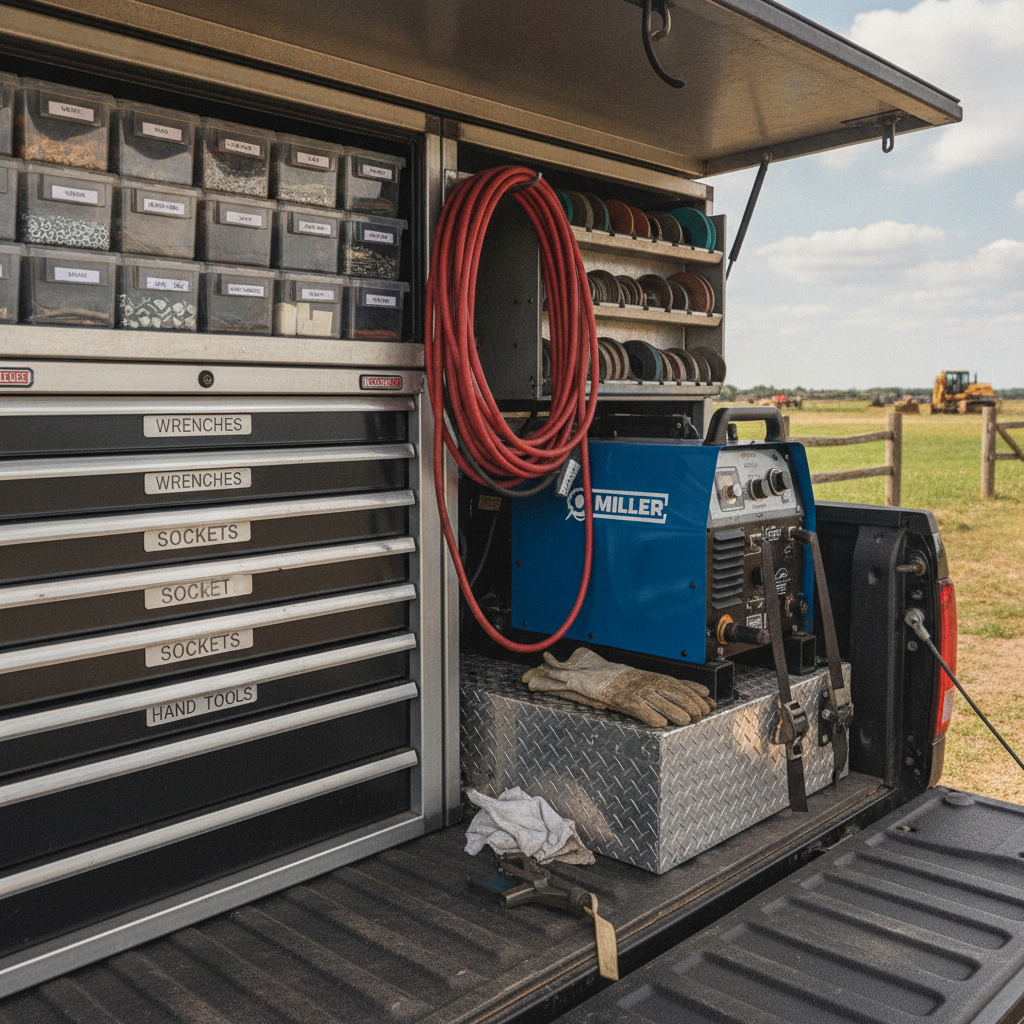
Fix it with zones. Every compartment, every drawer, every corner of that bed has to have a defined purpose. Here’s a simple framework that works:
- Zone 1 — Hot Zone: Everything you touch first on every job. Leads, clamps, hood, gloves. This should be the first door you open. Period.
- Zone 2 — Process Zone: Machine controls, wire spools, rod canisters, consumables sorted by process. One spot. Always.
- Zone 3 — Grind and Prep: Angle grinders, discs, wire brushes, clamps, magnets. Separate from your weld gear so grinding dust doesn’t contaminate consumables.
- Zone 4 — Deep Storage: Spare parts, extra stock, backup equipment, documentation. This is the stuff you shouldn’t need every day.
The whole point is that muscle memory takes over. You stop thinking about where things are. You just move.
Mistake #2 — Leads Everywhere Like Spaghetti
Tangled leads are a tax on your time. Every single job. You pull one thing out and three other things come with it. Then you spend five minutes untangling before you even start the real work.
Get lead hangers or dedicated hooks mounted inside your compartments. Roll your leads the same way every time. If you’re using a service body, D-rings and simple bungee retention straps cost almost nothing and they work. Some guys swear by PVC pipe conduit mounted along the inside walls for stiff leads. Whatever system you pick, be consistent. Consistency is the whole game.
Also — label your leads. Ground lead, work lead, extension. When you’re working fast and it’s dark or dirty, labels save mistakes and time. This isn’t rocket science. It’s just discipline.
Mistake #3 — Consumables Stored Like a Garage Sale
Random rods rattling around a milk crate. Wire spools stacked sideways. Gas lenses and cups mixed in with drill bits. This is one of those mobile rig organization failures that doesn’t just slow you down — it ruins consumables and costs you money on materials too.
Invest in a proper rod oven and mount it securely. Low-hydrogen rods need to stay dry and you already know this, but how many guys actually act on it in the field? Keep a small job-site rod oven mounted where it can stay plugged in from your generator or auxiliary power while you’re en route or on site.
For MIG wire, use a covered rack or sealed bin. Keep your spools vertical if possible. Contaminated wire causes bad welds, and bad welds in the field mean callbacks and wasted time. Speaking of process-specific considerations, if you’re running multiple processes on one rig, read up on field-ready multi-process welders to make sure your equipment choices support your organization system, not fight against it.
Mistake #4 — Gas Cylinders Not Secured Properly
This one crosses from annoying into actually dangerous. Loose cylinders rolling around in a truck bed are a liability, legally and physically. Beyond the safety issue, a cylinder that tips over and cracks a regulator just cost you a job stoppage and a repair bill.
Chain them. Always. Use proper cylinder brackets mounted to the bed or to a dedicated cylinder rack in the truck body. If you’re running mixed gases for different processes, color-code your hose connections and regulators. It seems excessive until the one time it saves you from hooking up the wrong gas and contaminating a critical weld.
On that note — smart shielding gas management isn’t just about safety on the road. Take a look at our post on smart shielding gas management for a solid field-focused breakdown.
Mistake #5 — Your Grinders Are Always in the Wrong Place
Angle grinders have a way of ending up wherever there was space last time you packed up. Then you need one urgently and it’s buried under two lead bags and a welding jacket.
Grinders need a fixed, accessible home. Mount a simple bracket or use foam-cut drawer inserts if you’ve got a tool chest. Each grinder — 4.5 inch, 7 inch, die grinder — has a spot. Discs are in a labeled bin right next to them. You grab what you need in ten seconds and you move on.
Same logic applies to every tool that gets used on more than half your jobs. If you use it that often, it deserves a dedicated spot, not the bottom of a pile.
Mistake #6 — No Prep for the Job Before You Arrive
This is where mobile rig organization goes beyond the physical truck and into your workflow. Showing up to a job without knowing what processes you’re running, what material you’re working on, or what consumables you’ll need means you’re making decisions under pressure — and those decisions eat time.
Build a simple pre-job checklist. Five minutes the night before, or first thing in the morning, mentally walk through the job. What process? What material thickness? What position? Pull those consumables to the front of the zone where you’ll need them. Pre-stage your leads for the setup you know is coming.
If you’re doing multi-material work in the field, this pre-staging step becomes even more critical. Different base metals need different prep and different settings. We’ve covered the nuances in detail in our dissimilar-metal welding mastery post — worth a read before you’re standing in front of a customer’s equipment improvising.
Mistake #7 — The Machine is Mounted in the Wrong Spot
Where your welder lives on the truck matters more than most guys think. It needs to be accessible from the working side of the vehicle. It needs ventilation clearance. It needs to be at a height where you’re not throwing your back out setting parameters between passes.
A lot of welders just put the machine where it fits when they first build out the rig and never revisit it. Spend an afternoon thinking about your actual workflow. Where do you stand when you’re working? Where does the lead naturally need to run? Let that dictate machine placement, not the other way around.
If you’re running newer battery-assisted or hybrid units, placement considerations change because of weight distribution and charging access. If you haven’t looked into those options yet, our post on hybrid battery-powered welders covers what’s practical for a working rig right now.
Mistake #8 — Documentation and Business Gear Mixed in With Tools
Work orders, weld records, inspection sheets, a tape measure, your phone charger — all of it ends up in the same spot as your grinding discs and you wonder why nothing is ever where it should be.
Put a small weatherproof box or lockable cabinet in the cab or just inside the service body door for business documents and personal gear. Keep it completely separate from tool zones. When a customer asks for paperwork, you go to one place. When you need your tools, you go to another. Simple. Clean. Professional.
Looking like you’ve done this before matters. Customers notice when a contractor is organized. It builds confidence before you’ve run a single bead. If you’re still figuring out the business side of your operation, our post on going from garage to shop covers that transition from solo operation to legitimate business setup.
The Weekly Reset: How to Keep It From Falling Apart
Here’s the thing about truck organization — it degrades. Every busy week, things end up in the wrong spot. You’re tired, you throw stuff in, you’ll deal with it later. And then “later” is six months from now and you’re back to the spaghetti-lead situation.
Build in a weekly reset. Friday afternoon or Sunday morning, twenty minutes to put everything back in its zone. Restock consumables. Check rod oven. Inspect leads for damage. Make sure grinder discs are adequate. This isn’t a major overhaul. It’s maintenance. Just like you’d maintain the machine itself.
Treat your rig organization like a system that requires upkeep, not a project you finish once. The welders who stay consistently profitable treat it exactly that way.
What Good Mobile Rig Organization Actually Looks Like
When your rig is dialed in, here’s what changes. You pull onto a job site, you open the right compartment, you have everything you need in your hands in under five minutes. The customer sees confidence and competence before you’ve said ten words. You’re not stressed. You’re not hunting. You’re working.
That’s the real goal. Not a pretty truck for Instagram. A functional system that makes you faster, more professional, and more profitable every single day you’re in the field.
If you’re building out your mobile welding business and thinking about the bigger strategic picture — not just the truck but the whole operation — our post on strategic niches for mobile welders is a solid next read. Because a well-organized rig pointed at the wrong market is still a problem.
Quick Reference: The Mobile Rig Organization Checklist
- ✅ Truck divided into defined zones (hot zone, process zone, grind zone, deep storage)
- ✅ Leads on dedicated hooks or brackets, labeled, rolled consistently
- ✅ Rod oven mounted, powered, in use — not sitting empty on the floor
- ✅ Wire spools in covered, clean storage — vertical if possible
- ✅ Gas cylinders chained and secured — no exceptions
- ✅ Grinders in fixed, accessible locations with discs nearby
- ✅ Pre-job consumable staging as part of your regular workflow
- ✅ Machine mounted for access, ergonomics, and ventilation
- ✅ Business documents and personal gear separated from tools
- ✅ Weekly reset to keep the system from degrading
Final Word
Nobody hands you a tight rig. You build it, you refine it, and you maintain it. The welders who complain about not making enough money on mobile work are often the same ones who can’t find their own consumables without a ten-minute search.
Fix the truck. Fix the system. Stop bleeding time and start protecting your rate. Mobile rig organization isn’t a luxury or a nice-to-have. It’s the foundation of a professional operation. Everything else you build on top of it depends on it working right.
Now go reorganize your rig. You know it needs it.