If your mobile rig setup looks like the back of a teenager’s closet, you’re bleeding money every single day. I’m not talking about a few bucks here and there. I’m talking about real, documented time — twenty, sometimes thirty minutes per job — spent digging through a pile of leads, grinding discs, and mystery hardware before you ever strike an arc. Multiply that across a five-day work week and you just handed a client a free half-day of labor. No invoice, no thank you, nothing. Let’s talk about the mistakes that are doing this to you and how to fix them without spending a fortune.
Why Mobile Rig Setup Is Your Actual Profit Lever
Most welders starting out think the money is in the welding. And yeah, obviously, that’s the job. But the guys running tight, efficient rigs? They’re not necessarily better welders. They’re just better organized. They show up, drop the tailgate, and they’re striking an arc in under ten minutes. That’s not magic. That’s a system.
When you run your own mobile welding business, your time is your inventory. Every minute you spend untangling leads or hunting for a cutting wheel is a minute you’re not billing. And if you’re charging by the job instead of the hour — which you probably should be — that lost time comes directly out of your margin. If you haven’t nailed down your pricing structure yet, this breakdown on pricing for certification services gives you a solid framework for understanding where your real costs are hiding.
The fix isn’t complicated. It’s mostly about being honest with yourself about how your rig actually functions versus how you wish it functioned.
Mistake #1 — Throwing Everything in and Sorting It Out Later
This is the one that gets almost everyone starting out. You load the truck in a hurry, tell yourself you’ll organize it properly this weekend, and then three months later you’re excavating leads from under a pile of slag hammers and empty rod boxes.
“Sort it out later” is a lie you tell yourself. Later never comes on a busy rig.
The fix is zoning. Treat your truck bed like a shop floor. Every zone has a purpose, and nothing lives outside its zone. Grinding zone. Lead storage zone. Consumables zone. Rod and wire zone. Recovery zone for stuff you grabbed off a job that hasn’t been put away yet — and yes, that zone gets emptied every Friday, no exceptions.
Physical dividers help. Milk crates, bolt-in truck bed organizers, custom-built plywood shelving — whatever works for your setup. The specific solution matters less than the discipline to actually use it.
Mistake #2 — One Big Toolbox for Everything
You’ve got one toolbox. It’s got grinders, consumables, hand tools, rod, PPE, and probably a sandwich from two weeks ago jammed in the back corner. Every time you need something, you open the whole thing and go spelunking.
Break it up. Dedicated storage for consumables only. A separate box for hand tools. PPE gets its own grab-and-go bag that sits in the same spot every single time. When you’re looking for your helmet, you should never have to think about where it is. It’s in the bag. The bag is on the left side of the toolbox. End of story.
This sounds almost insultingly simple, but I’ve been on jobsites with guys who’ve been running their own rigs for years who still can’t find their chipping hammer without a fifteen-minute search operation. Don’t be that guy.
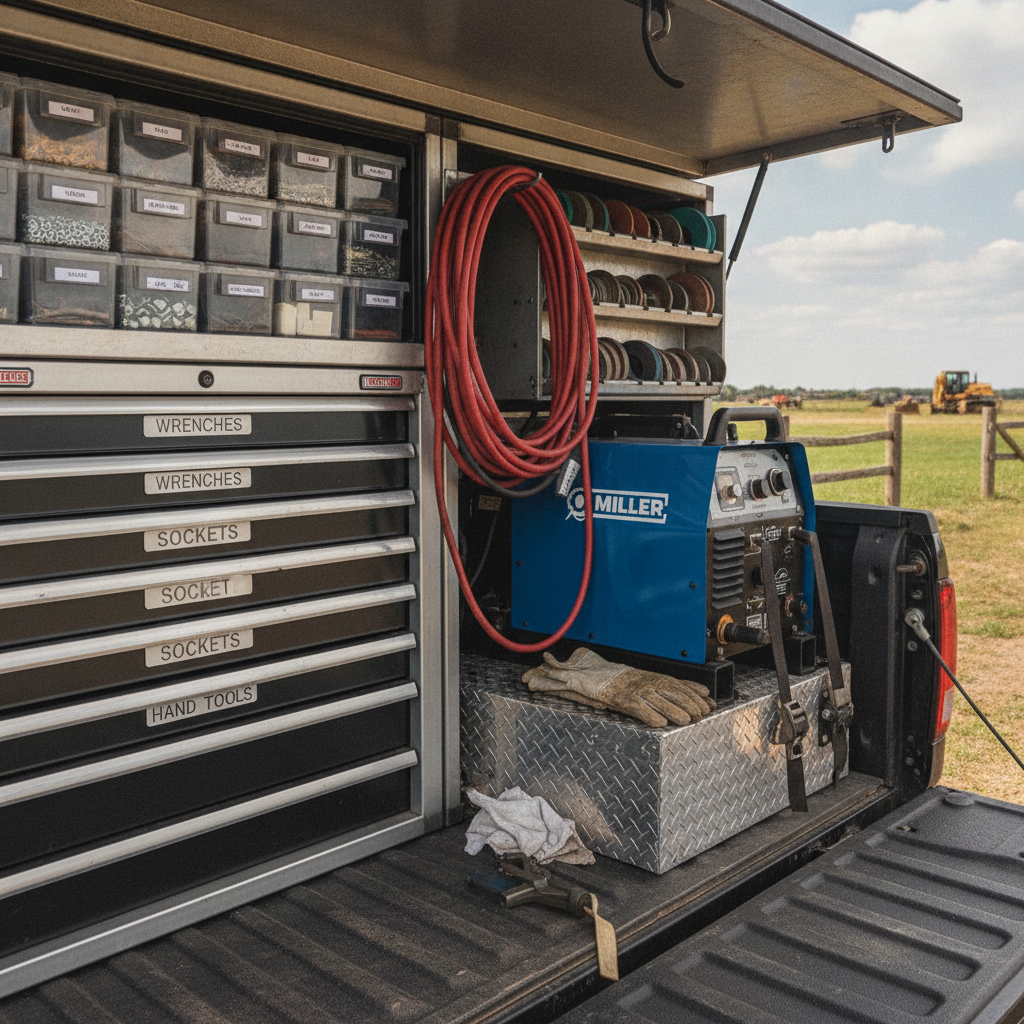
What Goes Where: A Basic Framework
Here’s a starting point. Adjust it for your rig and your process type. If you’re running multi-process out of the field, your layout will be different than a pure stick welder. For more on choosing the right machine for a field setup, this piece on field-ready multi-process welders is worth your time.
- Front of bed / cab-side: Machine, gas cylinders, regulators. Heaviest stuff, lowest center of gravity, secured tight.
- Mid-bed: Lead storage, ground clamps, stinger. Coiled properly, not wadded up like a garden hose.
- Tailgate side: Grinders, cutting wheels, wire brushes, slag hammers. The stuff you grab first and use constantly.
- Enclosed storage: Consumables by process. Rod cans or rod oven. Wire spools in sealed bins. PPE bag.
Mistake #3 — No System for Consumables
Running out of 7018 on a job is embarrassing. Running out because you didn’t check your stock before you left the house is a different level of problem. That’s a systems failure, not bad luck.
Every rig needs a restocking trigger. When a box of rod hits its last five sticks, it goes on the list. Not after it’s empty — when it hits the trigger point. Same with cutting wheels, wire, gas, everything. You set the trigger, you follow the trigger, you never show up short again.
A simple whiteboard or notepad mounted inside a cabinet door works fine. Some guys use a phone app. Whatever keeps you honest. The point is that you check it before every supply run and you don’t leave the shop until the list is cleared.
If you’re watching your business spending carefully — and you should be — this post on smart heat maps for startups has some interesting angles on tracking where your operational costs are actually going. Consumables add up faster than most guys realize.
Mistake #4 — Leads That Look Like a Pasta Disaster
Tangled leads are the number one time thief on a mobile rig. No debate. You can’t even argue with me on this one.
Long leads are necessary for mobile work. You need reach. But uncoiled, randomly piled leads are a nightmare every single time. The fix is a dedicated lead coiling method that you use every single time you pack up. Over-under coiling, figure-eight on a hook, whatever method works — pick one and make it non-negotiable.
A few anchor points in the truck bed for leads to hang or sit without sliding around makes a huge difference. Bungee hooks, D-rings, purpose-built brackets. Leads shouldn’t be free-floating in the bed. Ever.
Same applies to your ground cable. A dedicated mounting point for your ground clamp means it’s always in the same spot and never tangled with your stinger leads. Sounds minor. It’s not. Over a week of jobs, it adds up to real minutes back in your pocket.
Mistake #5 — Not Thinking About Job Flow
Here’s the one that separates the guys who’ve really thought this through from everyone else. Your rig isn’t just storage. It’s a workflow tool. The sequence in which you unload and set up should match the sequence in which you actually work.
Think about it. What do you grab first when you pull up to a job? Probably your leads and your ground. What do you grab last? Your grinder for cleanup. So why is your grinder right next to the cab and your leads buried at the back? That’s backwards.
Walk through your setup process mentally. Start to finish. What comes out in what order? Load your rig in reverse order of that sequence. Last out goes in first. First out stays accessible. It sounds obvious when you say it out loud, but most rigs aren’t loaded this way because nobody ever actually thought it through.
The Pre-Job Walkthrough Habit
Before you pull out of the yard, do a two-minute walkthrough. Not a formal checklist if that’s not your style, but a quick confirmation that everything is where it belongs and you’re not leaving without something critical. Machine secured. Gas on and checked. Leads coiled and hung. Consumables stocked. PPE bag in its spot.
Two minutes before you leave beats twenty minutes of scrambling on the customer’s dime. Build the habit and stick with it. This is the same discipline it takes to run a tight mobile business in any other area — whether that’s how you handle your startup operations or how you show up to a certification test. Process and preparation are what separate professionals from people who just own a welder.
Mistake #6 — Ignoring Your Rod Oven Situation
If you run 7018 in the field and you’re not running a rod oven, we need to talk. Beyond the quality issue, a rod oven that’s just sitting loose in your truck bed is a liability. It gets banged around, it draws power inconsistently if it’s not wired properly, and half the time it’s not even turned on early enough to matter.
Your rod oven needs a dedicated mount. Wired directly to your machine or to a proper power source. Turned on before you leave for the job, not when you get there. If you’re dealing with moisture-sensitive electrodes — which in mobile work, you almost always are — your oven should be part of your startup routine, full stop.
On longer structural jobs where weld sequencing and material prep matter, having your consumables in proper condition from the jump is non-negotiable. This deep dive on weld sequencing for structural frames gets into why your material and consumable prep directly affects your results on the ground.
Mistake #7 — A Rig That Was Set Up Once and Never Revisited
Your business changes. Your job mix changes. Your process mix changes. A rig you set up two years ago when you were doing mostly farm repairs might not serve you at all now that you’re doing structural work or pipeline maintenance. The layout that made sense then is probably hurting you now.
Every few months, take a serious look at your mobile rig setup and ask whether it still matches how you actually work. Not how you used to work. How you work right now. What are you grabbing constantly? What’s never getting used? What’s in a terrible spot that costs you time every single day?
This isn’t a big project. It’s an afternoon. Pull everything out, think it through, put it back in a way that makes sense for your current workflow. Do it quarterly if you’re busy and your job mix shifts regularly.
The Business Case Is Simple
Let’s put some rough numbers on this. Say a disorganized rig costs you twenty minutes per job. You run two jobs a day, five days a week. That’s over three hours a week of dead time. At a billing rate of even $100 an hour, that’s $300 a week you’re eating. Over a year, that’s north of $15,000 in lost billing time. All because your leads weren’t coiled and you couldn’t find your grinding discs.
That’s not a small number. That’s a truck payment. That’s equipment. That’s a real cost buried in your day-to-day chaos that most guys never even connect to their rig organization.
If you’re serious about running a tight mobile welding operation — and if you’ve read this far, you probably are — then your mobile rig setup deserves the same attention you give your welding technique. It’s part of the job. It affects your output, your professionalism, and your bottom line just as directly as your bead quality does.
If you’re still dialing in the business side of things alongside your rig, this post on strategic niches for mobile welders is worth reading. Knowing what kind of work you’re going after also informs how your rig should be set up — different niches, different load-outs.
Final Word
Fixing your mobile rig setup isn’t glamorous. Nobody’s going to write a magazine article about your perfectly coiled leads or your labeled consumable bins. But your customers will notice that you showed up, got set up fast, and got to work without the circus act. And you’ll notice it in your weekly hours and your billing numbers.
Stop losing money to a messy truck. Spend the afternoon. Fix the rig. Get back to making money the way you’re supposed to — with an arc, not a search party.