If you’ve ever spent twenty minutes on a job site digging through your truck bed looking for a #5 cup or your chipping hammer, you already know exactly what poor mobile rig organization costs you. It costs you money. It costs you credibility. And it costs you the kind of calm, professional first impression that turns a one-time call into a long-term account. Nobody wants to hire the guy who looks like his truck threw up on itself. Let’s talk about the mistakes most mobile welders make with their rigs — and more importantly, how to stop making them.
Why Mobile Rig Organization Is a Business Decision, Not a Tidiness Thing
Let me be clear right up front. This isn’t about being neat. I don’t care if your shop apron is folded or your gloves are color-coordinated. This is about money.
Think about it this way. You charge, say, $95 an hour. If you waste 20 minutes on every job just finding gear and getting set up, that’s roughly $32 you just handed back to the customer for free. Do that across four jobs in a day and you’ve lost over $125. Do it five days a week and you’re giving away $600+ a month just because your truck is disorganized.
That’s not a small number. That’s a truck payment. That’s a new machine. That’s a week of groceries. Mobile rig organization isn’t a luxury — it’s a profit strategy. If you’re still figuring out your pricing model alongside your setup habits, this post on pricing for certification services is worth a read for context on where your real margins live.
Mistake #1: No Zones, No Logic, No System
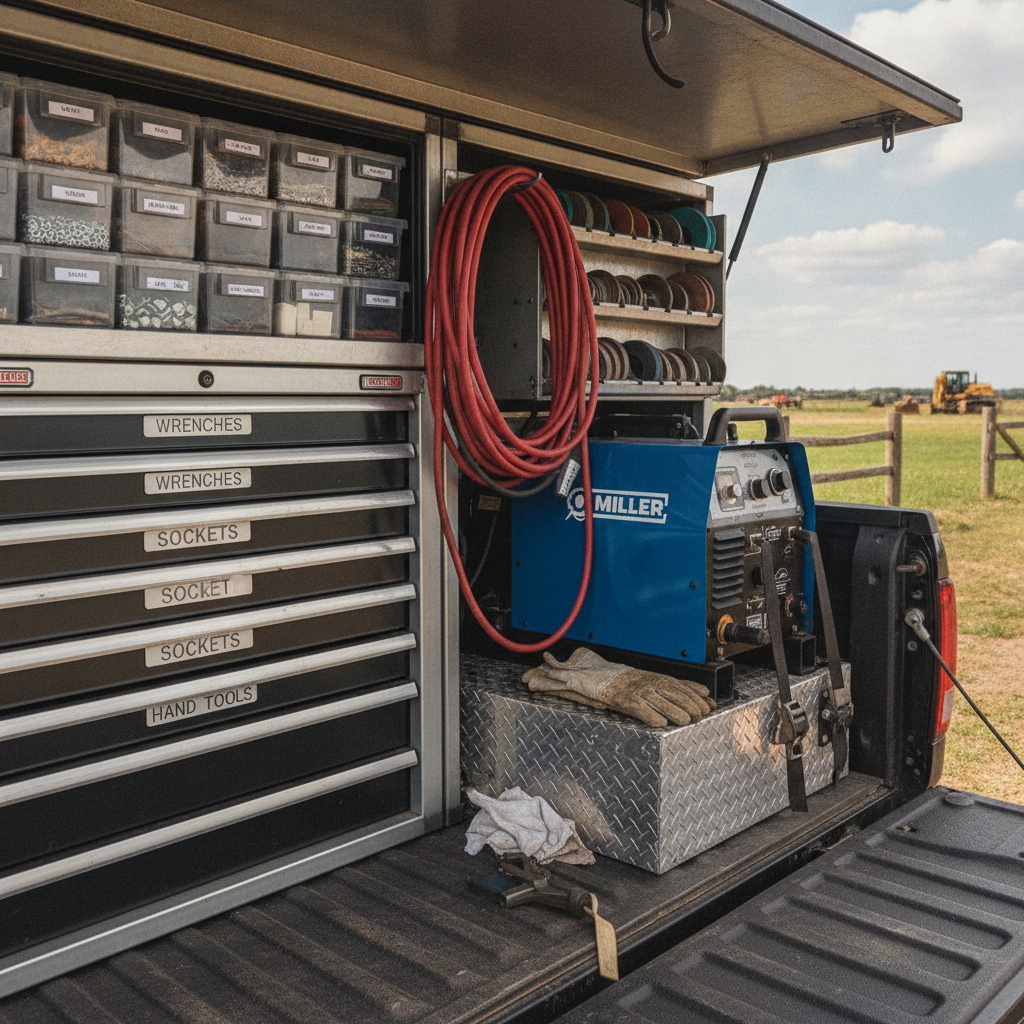
The number one mobile rig organization mistake I see is trucks with zero zoning. Everything is just… in there. Consumables mixed with hand tools. Safety gear buried under leads. Filler rod rolling around loose next to a rusty angle grinder.
Here’s the fix: treat your truck like a shop. Zones.
- Zone 1 — Power and Machine: Welder, leads, ground clamp, stinger or gun. Everything you need to get the arc going.
- Zone 2 — Gas and Consumables: Cylinders, regulators, filler rod, wire, cups, tips, diffusers.
- Zone 3 — Hand Tools and Prep: Grinders, discs, chipping hammer, wire brush, clamps, squares.
- Zone 4 — Safety Gear: Hood, gloves, jacket, glasses, ear protection, fire extinguisher.
- Zone 5 — Admin and Paperwork: Invoices, measuring tape, phone mount, keys, pens.
Label everything. I know that sounds like overkill until the third time you or a helper grabs from the wrong bin on a job with a tight deadline.
Mistake #2: Leads and Cables Living Wherever They Land
Tangled leads are the enemy of fast setup. And they wear out faster when they’re coiled wrong or crammed into a box. I’ve seen guys spend ten minutes just sorting out a rat’s nest of cable before they could even think about clamping up.
Get a lead rack or at minimum some heavy-duty hooks mounted on the inside wall of your truck. Coil your leads properly — over-under, not the death spiral most guys use. A 50-foot lead coiled right takes about 45 seconds to deploy. A 50-foot lead coiled wrong is a comedy routine nobody’s laughing at.
Color-code your leads if you run multiple processes. Red for one setup, black for another. Sounds extra, but when you’re switching between SMAW and GTAW on the same job, you’ll appreciate not guessing.
Speaking of running multiple processes in the field, if you haven’t looked at what modern multi-process machines can do for a mobile setup, check out this breakdown of field-ready multi-process welders. Having one machine that handles multiple processes means fewer cables and less gear to organize in the first place.
Mistake #3: Consumables Stored Like You Hate Money
Here’s a scenario. You’re on a job. You need a 3/32 6010. You know you have some. Somewhere. In the truck. Maybe in that bucket. Or that drawer. Or that toolbox in the corner. You dig. You find some 7018 that’s been wet and cracked for three years. You dig more. You find the 6010 — underneath a grinder that hasn’t worked since 2022.
Sound familiar? Yeah. Fix it.
Get a dedicated rod oven or at least a dry storage container for your electrodes. Label every compartment by rod type and size. Keep an inventory sheet inside the lid if you have to. When a box is running low, you restock it before you leave the shop — not on a job site 40 miles from the supply house.
Same goes for wire, tips, liners, and cups. Each process gets its own labeled bin. You should be able to reach in and pull what you need in under ten seconds. If it takes longer than that, reorganize.
A Quick Note on Gas Cylinders
Cylinders should be secured upright. Always. I know you know this, but I’ve seen rigs where a CO2 bottle is just rolling around in the bed like a grenade. Mount them. Strap them. Protect the valves.
Keep a valve cap on any cylinder not in use. Keep a current cylinder and a backup if you run gas-shielded processes regularly. Running out of gas mid-job because you forgot to check is an amateur move and your customer will notice. If you’re running shielding gas regularly in the field, this post on smart shielding gas management covers how to track usage and avoid getting caught short.
Mistake #4: Your Welder Is Accessible, But Nothing Else Is
A lot of guys spend real money on a good machine and then set up the rest of the truck like an afterthought. The welder is perfectly positioned, leads are right there — but the grinder is buried, the clamps are under everything, and the PPE is in a bag behind the seat.
Mobile rig organization means everything has a home, not just the expensive stuff. Your 4.5-inch grinder should be mounted or stored where you can grab it in five seconds. Your clamps should be on hooks or in a designated bin. Your hood and gloves should be in the same spot every single time.
Routine matters. When you always reach to the same spot for the same thing, you stop thinking about where things are. You just work. That’s the goal.
Mistake #5: No First-Arrive Kit
This one changed how I work. Create a “first-arrive kit” — a bag or tray of the things you need before you even plug in the machine. Think of it as your walk-up kit.
Mine has: measuring tape, soapstone or a Sharpie, a clamp or two, safety glasses, a pair of gloves, and my invoice book. It sits right inside the tailgate. When I pull up to a job, I grab that kit, walk the job, mark my measurements, talk to the customer, and assess the work before I’ve unloaded a single piece of equipment.
You look prepared. Because you are. And that matters to customers more than most welders realize.
Mistake #6: The Truck Itself Is Wrong for the Work
Sometimes the organization problem isn’t how you’ve loaded the truck — it’s the truck. A flatbed works great for some setups. A service body is better for others. A pickup with a toolbox on the back can work if you’re strategic about it.
Match your truck to your business model. If you’re doing a lot of structural or multi-material weld sequencing for structural frames, you need space for longer stock and bigger equipment. If you’re doing mostly maintenance and repair calls, a tighter, cleaner service body setup is more efficient.
Don’t try to force a setup that doesn’t work for your actual workload. I’ve watched guys try to run a complete fabrication operation out of a half-ton pickup. They spend more time problem-solving their own setup than they do welding.
Mistake #7: No Regular Reset Routine
Here’s the thing about having a great mobile rig organization system: it only works if you maintain it. A rig that’s perfectly set up on Monday will be a disaster by Friday if you don’t have a reset routine.
End of every day or every job, spend ten minutes putting things back. Not a deep clean. Just a reset. Everything back in its zone. Consumables checked. Gas levels noted. Leads coiled and hung. Tools back where they belong.
It feels like extra work at the end of a long day. But that ten minutes in the evening saves you twenty minutes every morning. Do the math — it pays.
Build a Restocking Checklist
Keep a simple checklist in your truck for restocking. When something runs low on a job, write it down. When you get back to the shop or supply house, you know exactly what needs to be replenished. Stop relying on memory. Memory is for knowing your trade. The checklist handles the admin.
If you’re building your business systems from the ground up, the principles in From Garage to Shop are directly applicable here. A mobile operation needs the same kind of systematic thinking as a shop — just packed into a smaller footprint on wheels.
The Time Math That Should Make You Take This Seriously
Let’s run the numbers one more time because this deserves to sink in.
Average mobile welder: 4-6 jobs per week. If disorganized setup costs 20 minutes per job, that’s 80-120 minutes per week lost. At $95/hour, that’s $127-$190 per week in wasted capacity. Over a 50-week year? You’re looking at $6,350 to $9,500 in lost billing potential.
That’s not theoretical. That’s real money sitting in a pile of tangled leads and misplaced consumables. Mobile rig organization is the cheapest efficiency upgrade you can make to your business because it costs mostly time and discipline — not equipment.
If you want to dig deeper into where you’re actually losing money in your operation, the smart heat maps for startups post has a solid framework for identifying your biggest time and revenue drains.
What a Well-Organized Rig Actually Looks Like
Here’s the short version of what a dialed-in mobile rig looks like in practice:
- Everything has a labeled spot. Nothing lives “roughly over there.”
- You can do a full gear check in under two minutes by walking the truck.
- Setup on a new job takes 10 minutes or less, including gas hookup and lead run.
- Your consumables are inventoried and you never run out mid-job.
- Safety gear is always accessible, not buried.
- Your welder is accessible from multiple sides of the truck if possible.
- You have a reset routine that happens after every job or every day.
None of this requires expensive gear. It requires thinking about your workflow and building your setup around how you actually work — not how you happened to load the truck one day three years ago.
Final Word: Your Truck Is Your Shop
When you run a mobile welding operation, your truck isn’t just your transportation. It’s your shop, your toolbox, your inventory system, and your first impression all rolled into one. How it’s set up either helps you or fights you on every single job.
The welders who build real businesses in this trade — the ones who get repeat calls and referrals — show up looking like they’ve done this before. Because they have. And part of that is having a rig that works for them instead of against them.
You want to be the guy who pulls up, grabs his kit, walks the job, talks to the customer professionally, and has an arc struck in twenty minutes. Not the guy rooting through a pile of junk hoping the right consumables are in there somewhere.
Fix your truck. Fix your time. Fix your business.
And if you’re thinking about the bigger picture of where your mobile business should be headed, it’s worth reading about strategic niches for welders — because a well-organized rig in the right niche is a combination that’s hard to beat.