If you’ve ever spent twenty minutes on a job site digging through a pile of leads, loose fittings, random grinder discs, and a coffee cup from three weeks ago just to find your striker — you already know what truck setup mistakes cost you. They cost you time. And time, on a flat-rate or hourly job, is the same thing as money walking out of your pocket. The guys who look like they’ve been doing this forever aren’t necessarily better welders. Half the time, they just know where their stuff is.
This post is about fixing that. Practical, no-nonsense rig organization that cuts your setup time, makes you look professional to the customer standing there watching you, and keeps your week from turning into an ongoing scavenger hunt. Small changes. Real results.
Why Truck Setup Mistakes Kill Your Hourly Rate
Let’s do some ugly math real quick. Say you waste fifteen minutes per job digging around your rig. If you’re running five jobs a week, that’s over an hour of unbillable fumbling around. At $100/hr — and you should be charging more than that — you’re handing back $100 a week, every week, just because your truck is a disaster.
That’s over $5,000 a year. Not from bad welds. Not from slow travel. Just from not knowing where your stuff is.
Beyond the money, there’s the perception problem. The customer is watching. The foreman is watching. You look disorganized, you look unprepared, and suddenly they’re second-guessing whether they want to call you back. A tight rig communicates competence before you ever strike an arc. It’s part of your professional image whether you think about it that way or not.
If you’re still figuring out how to price your services to account for real field efficiency, this post on pricing for certification services has some frameworks that translate directly to flat-rate and hourly field work.
The Most Common Truck Setup Mistakes Mobile Welders Make
1. No Dedicated Home for Consumables
This is the big one. Consumables — rods, wire, tips, nozzles, cups, tungsten — end up scattered everywhere. One pack of 7018 is under the seat. Another is in the toolbox. The rest got wet. Sound familiar?
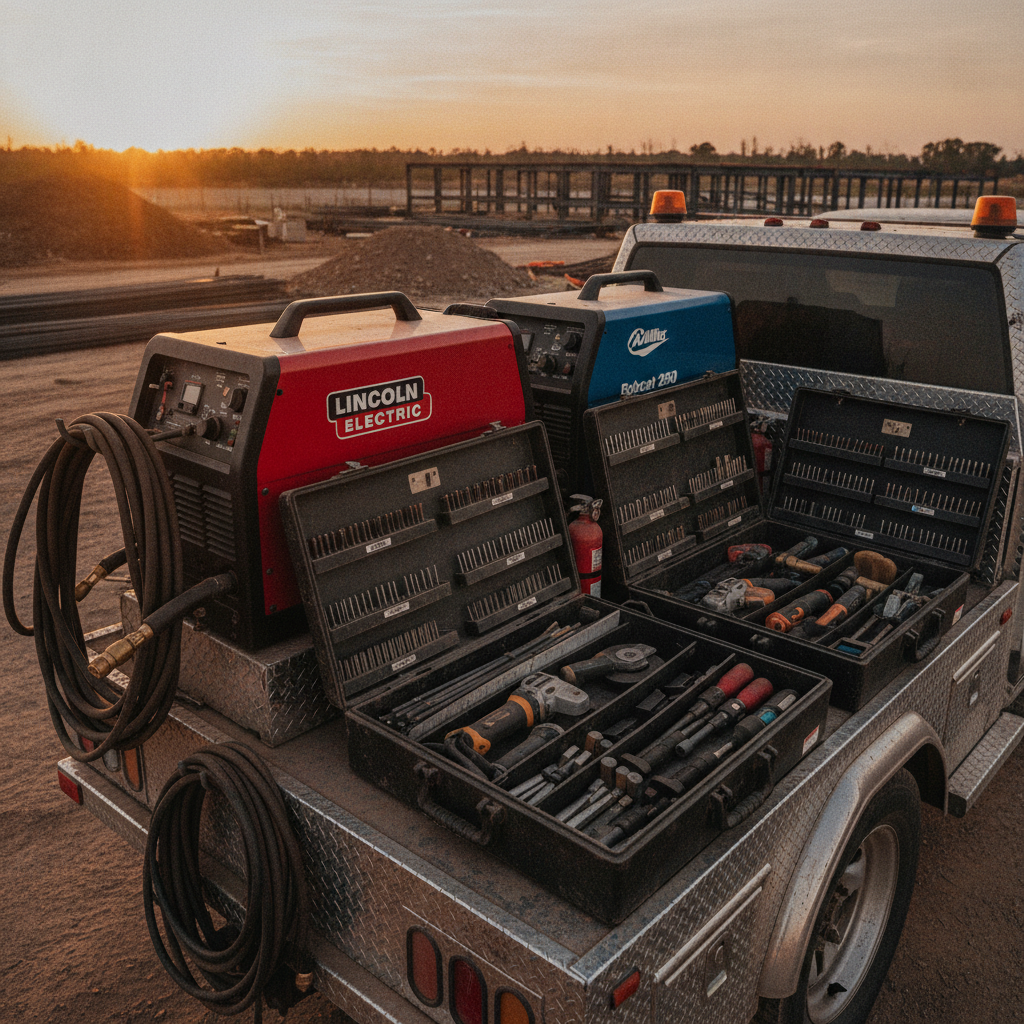
Pick one spot for consumables. One sealed container, one drawer, one location. That’s it. Every time you go to a supplier, everything goes to that one spot. When it’s not there, you know you’re out. Simple, but most guys never do it.
If you’re running multiple processes — which most of us are out in the field — this matters even more. Keeping your SMAW rods separated from your MIG consumables from your TIG supplies saves you from grabbing the wrong thing under pressure. For a breakdown of running multiple processes on one rig, check out this piece on field-ready multi-process welders.
2. Leads and Cables Thrown in a Pile
Nothing slows you down like tangled leads. You throw them in the truck at the end of a job because you’re tired and just want to leave. Totally understandable. Also completely self-defeating.
Coil your leads every single time. Same way. Same spot. Either use a proper lead caddy, build one out of pipe, or mount some hooks inside your compartment. The five minutes you spend coiling properly at the end of a job saves you ten minutes of untangling at the start of the next one. That math works in your favor.
Keep your work lead and your electrode lead coiled separately. When you grab one, you grab only one. No drama.
3. Tools That Move Around and Get Buried
Your angle grinders, your chipping hammer, your wire brush, your clamps — if they’re just rattling around loose in a bin, you’re going to spend time finding them. Every. Single. Job.
Mount what you can. There are cheap magnetic strips, foam-lined drawers, and simple brackets that keep your most-used tools in a fixed location. You reach for the grinder, it’s there. Every time. That consistency kills wasted motion.
Build your layout around your most-used tools being the most accessible. If you’re running a grinder on every job, it shouldn’t be buried behind your rod oven.
4. Gas Cylinders That Aren’t Properly Secured
This isn’t just an organization problem — it’s a safety problem that also wastes time. Cylinders that tip over, roll around, or take damage from rattling against other equipment cost you money in repairs, refills, and downtime.
Chain them upright. Every time. Mount your regulators so they’re not getting knocked around. Keep your hoses organized so you’re not untangling them from your leads at 7am when you’ve had half a cup of coffee.
If you’re running newer battery-backed or hybrid setups on your rig, proper cylinder placement becomes even more critical around that equipment. Worth reading up on hybrid battery-powered welders if you’re looking to modernize your rig layout.
5. No System for Job-Specific Gear
Different jobs need different stuff. Pipeline work has different requirements than structural repair, which is different from farm equipment calls. A lot of guys try to carry everything for every job, which means their truck looks like a welding supply store that got hit by a tornado.
Build a core kit that’s always on the truck. Then build job-specific kits in separate bags or bins that you add or swap out based on what’s on the schedule. You’re not pulling up to a fence repair with your full TIG setup rattling around in the back. You loaded what you needed the night before. That’s the move.
Building a Rig Layout That Actually Works
Start With Frequency of Use
Map out what you grab on every single job. Those things live in the most accessible spots — eye level, no digging, no opening secondary compartments. Everything else gets sorted by how often you actually need it.
Most guys do this backwards. They load the truck with what fits where, then complain about how long setup takes. Flip it. Design around workflow, not around available space.
Label Everything
Yeah, it sounds like something your shop teacher told you. Do it anyway. When you’re tired, when it’s raining, when you’re on a site you’ve never been to and the customer is standing over your shoulder — labels save you. Foam cutouts in drawers work even better because you can see at a glance what’s missing.
Keep a Restock Checklist
End of every week, run a quick check. What’s low? What’s missing? What needs to go back to the supplier? Five minutes of inventory discipline on Friday means you don’t show up to a Monday job short on consumables. This also feeds directly into how you manage overhead and job costing, which is worth getting right from the start — especially if you’re still scaling up. The Measure Twice, Invest Once post covers this kind of thinking well for early-stage mobile operations.
Protect Your Leads from Heat and Sharp Edges
Leads that get pinched, cut, or heat-damaged create problems that show up at the worst possible time. Grommets, edge protectors, and proper routing through your compartments add maybe an hour of one-time setup and save you from mid-job failures. Do it once, do it right.
Truck Setup Mistakes That Seem Small But Add Up Fast
Here are a few that guys overlook because they seem minor until they’re not:
- Keeping paperwork loose in the cab. Your invoices, material lists, and job notes need a dedicated folder or binder. Digging for paperwork in front of a customer is embarrassing and wastes time.
- No lighting in your compartments. LED strip lights in your tool compartments are cheap and they matter enormously on early morning or late afternoon jobs.
- Storing your PPE where you can’t grab it fast. Your helmet, gloves, and sleeves should be accessible in under ten seconds. Not buried under your ground clamp.
- Mixing clean and dirty gear. Used rags, spent wire spools, and general job site trash should have a dedicated spot — not mixed in with your actual tools. Keeps everything cleaner and faster to navigate.
- Not securing your welder itself. Vibration from road travel loosens connections over time. Check your machine mounts regularly. A welder that shifts or tips over isn’t just a setup problem — it’s an equipment damage problem.
The Real Cost of a Sloppy Rig in a Competitive Market
Mobile welding is competitive. There are more guys with trucks and machines than ever before. The ones who build lasting businesses aren’t always the best welders — they’re the most professional operators. That means showing up with a rig that’s ready to work, a truck that communicates competence, and a workflow that doesn’t waste anybody’s time including their own.
The guys who are picking up consistent work in strategic niches — specialized repair, structural field work, industrial maintenance — are expected to operate at a higher level. That starts with your rig. A customer paying premium rates for specialized work expects to see a professional setup. It’s part of what they’re buying.
Likewise, if you’re expanding into more complex field work involving dissimilar metals or multi-material repairs, your rig needs to support that work. Dig into dissimilar-metal welding mastery if you’re heading in that direction — and make sure your truck is actually set up to carry what you need for those jobs.
One-Time Setup Time vs. Daily Wasted Time
Here’s the perspective shift that makes guys actually go fix their rig instead of just nodding along and doing nothing: a proper rig organization overhaul takes maybe one full day of work. Call it eight hours. You pull everything out, you plan your layout, you mount your brackets and hooks, you label your compartments, you build your systems.
Eight hours. One time.
If you’re saving fifteen minutes per job and running five jobs a week, you recover that eight hours in roughly two weeks. Everything after that is pure profit. Time you’re actually billing instead of fumbling. That’s not a bad return on a Saturday afternoon in your driveway.
The guys who never get around to fixing their rig are the same guys who complain they’re not making enough money. Those two things are connected.
A Quick Starting Point If Your Rig Is a Mess Right Now
Don’t try to overhaul everything at once. Here’s a simple priority order:
- Fix your consumable storage first. One spot, sealed container, done. This alone cuts a meaningful chunk of daily search time.
- Sort your leads. Proper coiling, dedicated hooks or caddy, electrode and work lead separated.
- Mount your top three most-used tools. Grinder, chipping hammer, wire brush. Fixed locations, always there.
- Add lighting to dark compartments. LED strips, battery-powered if needed. Cheap and immediately useful.
- Build your restock checklist. Run it every Friday. Never show up short again.
That’s it. Do those five things and you’ll notice a difference by the end of the first week. Then you build from there.
Final Word on Truck Setup Mistakes
Nobody’s going to hand you an efficient rig. You build it yourself, same as everything else in this business. The guys running tight operations didn’t get lucky — they got organized and they stayed that way. Truck setup mistakes are entirely fixable, the fixes are mostly cheap, and the return on investment is immediate.
Your rig is a reflection of how you run your business. Make it look like you’ve done this before. Because you have.
If you’re building out your mobile operation from scratch or trying to professionalize a rig you’ve been running on pure hustle, the From Garage to Shop post covers the broader picture of scaling up a welding business the right way. Worth a read alongside whatever you’re doing with your truck layout.