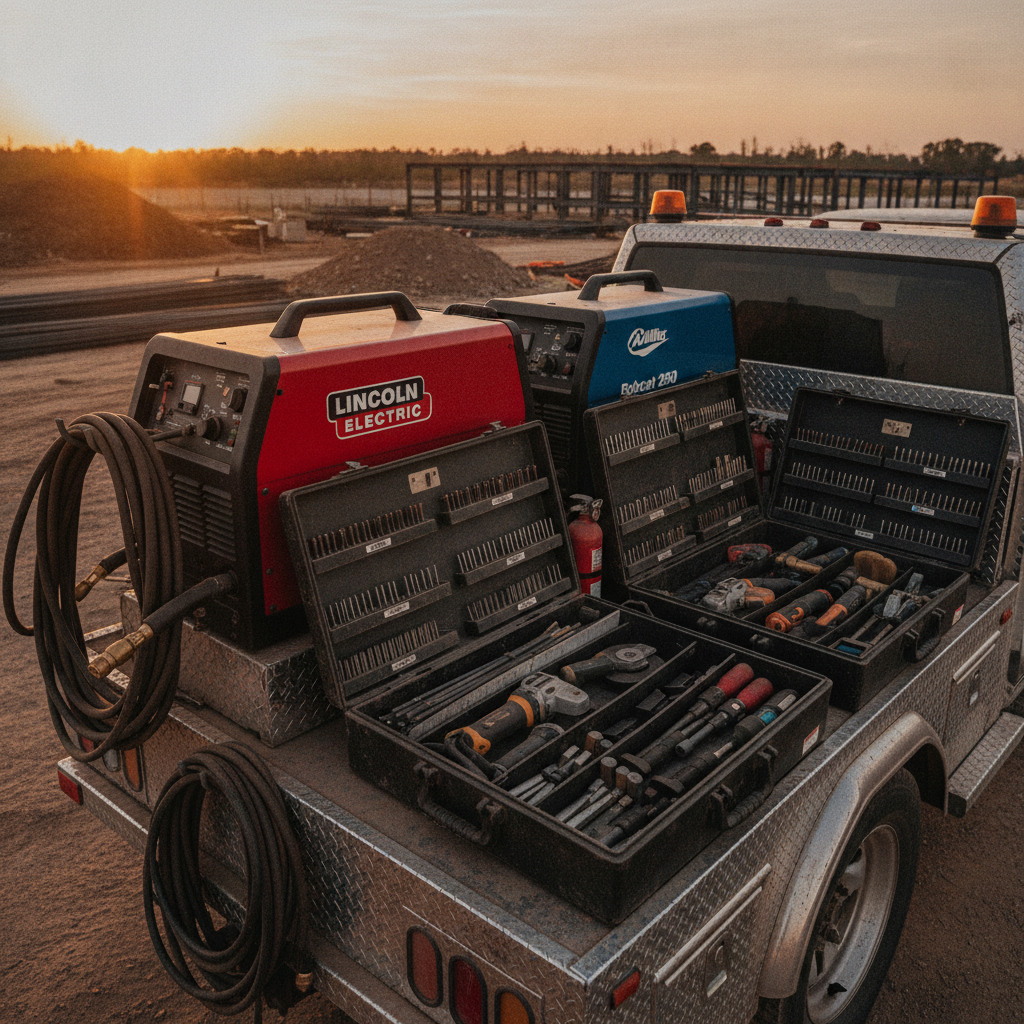
Let me paint you a picture. It’s 7 AM. You just pulled up to the job. The foreman is standing there watching you. And you spend the next twenty-two minutes digging through a pile of leads, random fittings, three grinders with no discs, and a half-empty bag of 7018 that got wet last Tuesday. That is not a good look. Worse, that wasted time comes directly out of your effective hourly rate. Mobile rig organization is not a nice-to-have — it’s the difference between running a tight operation and running a yard sale on wheels. This post is going to walk through the most common truck setup mistakes field welders make, and what to actually do about them.
Why Mobile Rig Organization Actually Affects Your Bottom Line
Most welders think about billing in terms of hours worked. But here’s the thing — you’re not billing for the twenty minutes you spent finding your .035 wire or your #2 tip cleaner. That time is invisible to the customer, but it’s very visible to your bank account.
Say you burn fifteen minutes per job on disorganized setup. You’re doing five jobs a week. That’s over an hour of dead time every week. At $100/hour, that’s $400 a month you’re eating. Multiply that by twelve months and you’ve lost nearly five grand just because your truck looks like a tornado hit it.
If you’ve been thinking about tightening up your pricing to account for real-world inefficiencies, check out this breakdown on pricing for certification services — a lot of the same time-value logic applies to mobile work.
The point is simple. A well-organized rig is a profit tool. Treat it like one.
Mistake #1: No Zones, No System
The single biggest mobile rig organization mistake is treating your truck bed like a storage unit. Everything just gets thrown in. Leads here, gas here, tools here, lunch here — it’s chaos.
Fix this by building zones. Think of your truck like a kitchen. Everything has a place, and that place makes sense based on how you work. Here’s a basic zone breakdown that works for most mobile setups:
- Zone 1 – Power and Process: Welder, leads, wire, consumables. This is your most-used stuff. It lives closest to where you work, easy to access, nothing blocking it.
- Zone 2 – Gas: Cylinders locked in upright, regulator accessible, hose coiled cleanly. Not buried under a tarp with a come-along on top of it.
- Zone 3 – Grinding and Prep: Grinders, discs, flap wheels, wire wheels, clamps, magnets. Together. Not scattered across three different toolboxes.
- Zone 4 – Safety and Consumables: PPE, extra lenses, gloves, anti-spatter, marking tools. Stocked, not empty.
- Zone 5 – Odds and Ends: Tie wire, soapstone, tape measure, levels, whatever doesn’t fit the other zones. This gets a dedicated spot, not just “wherever.”
Write it down, build the layout, and then stick to it. Every single time you come off a job, things go back where they belong. No exceptions.
Mistake #2: Leads That Look Like a Spaghetti Factory
This one drives me up a wall. You’ve got $15,000 worth of welding equipment on your truck and your leads look like somebody lost a fight with an extension cord. Tangled leads waste time, cause connection problems, and wear out faster.
Get a lead rack or a reel system. If your budget is tight, at minimum get some good hook-and-loop straps and a consistent coiling habit. The figure-eight coil is your friend — keeps the copper from kinking and unrolls smooth every time.
Label your leads too. Color tape or heat shrink at each end. When you’ve got multiple processes running or you’re working in a tight space, knowing exactly what’s what saves more time than you’d think.
This is also a good time to think about your machine selection. If you’re still running a single-process box on a multi-process job, you’re losing time on process transitions. The post on field-ready multi-process welders covers what to look for if you’re shopping for an upgrade that actually suits mobile work.
Mistake #3: Consumables That Run Out Mid-Job
Nothing kills momentum like running out of wire, tips, or grinding discs at 10 AM. You’re in the zone, the job is moving, and then you’re standing at your truck digging through a toolbox looking for one more contact tip.
Build a par system. Minimum stock levels for every consumable you use regularly. Before you leave for a job, you check the list. Not some mental list — an actual physical or digital checklist on your truck.
Here’s what should always be on your rig in multiples:
- Contact tips — at least a dozen per wire size you run
- Nozzles — two to three spares minimum
- Grinding discs — a full sleeve of each type you use
- Flap wheels — at least four to six on hand
- Wire — one full spool in your active size, one backup
- Stick electrodes — sealed containers, right rods for your common jobs
- Soapstone and markers — you’ll lose these constantly, keep a dozen
Do a truck audit every Friday afternoon. Restock over the weekend. Show up Monday ready to run. This habit alone will change how your mornings feel on the job.
Mistake #4: Your Gas Setup Is a Safety Hazard
Unsecured cylinders are not just an organization problem — they’re a liability problem. A cylinder falling over on a jobsite is the kind of thing that gets you banned from the site, or worse, gets someone hurt.
Every cylinder on your rig needs to be in a proper holder or chained upright. Period. Not bungee-corded, not leaning against the cab, not just kind of wedged in there. Secure. Upright. Valve cap on when not in use.
Also think about your gas management workflow. Are you keeping track of what’s in each bottle? Are you swapping partials out before they run dry mid-job? A little discipline here saves you from the nightmare of finding out your argon bottle is empty when you’re setting up a critical TIG root pass.
For a deeper look at managing shielding gas on mobile setups, the post on smart shielding gas management has solid practical guidance worth bookmarking.
Mistake #5: Tools You Can’t Find in Under 30 Seconds
If you can’t put your hand on any tool in your truck in under thirty seconds, your organization system is broken. That’s the benchmark. Thirty seconds. Eyes open, no digging, no moving other stuff out of the way.
This means dedicated spots for everything. Angle grinders hang on a rack or sit in foam-lined holders. Clamps are on a rail or in a clearly labeled bin. Hand tools are in a chest with foam cutouts or at minimum sorted by category. Your chipping hammer and wire brush live in one place, not wherever they landed last time you used them.
Shadow boards are underrated on welding rigs. If you’ve got a toolbox with a pegboard panel, outline each tool with a marker or paint. Missing tool is immediately obvious. New helper puts it back in the wrong spot and you’ll know before it becomes a problem.
Mistake #6: No Lighting, No Power, No Plan
You show up to a job in a covered structure, under a bridge, inside a tank, wherever — and you’re squinting in the dark trying to prep your joint. Or you need to charge something and your rig has no auxiliary power setup.
A basic lighting setup on your rig is not optional. A couple of good LED work lights, one mounted on a magnetic base for flexibility, one hung off the truck for general area lighting. This is a $150 investment that will pay for itself on the third dark job.
Auxiliary power — even a basic inverter or a small generator on a slide-out — gives you options. Especially if you’re looking at hybrid battery-powered welders as part of your setup. Having charging capability on the truck means you’re not dependent on site power for every tool you own.
Mistake #7: Not Thinking About Who Else Might Drive the Rig
This one trips up a lot of guys when they start growing. Your truck organization makes perfect sense to you because you built it. But the day you put a helper or second welder on that rig, they’ll have no idea where anything is.
Label everything. Even if it seems obvious to you. Bin labels, zone labels, drawer labels. Not for your benefit — for the next person who needs to find the 1/16 tungsten at 6:30 in the morning without waking you up to ask.
If you’re thinking about scaling past solo work, read through the from garage to shop post. A lot of the organization lessons from that transition apply directly to mobile rig systems when you start adding people.
Mistake #8: Forgetting the First-Strike Checklist
Every job should start the same way. Truck pulls up, you run your checklist, and you’re striking your first arc within a set amount of time. Not digging, not searching, not making three trips back to the truck — running.
Build a first-strike checklist for your rig. It doesn’t have to be fancy. A laminated card on the inside of your toolbox lid works fine. Cover the basics:
- Machine settings checked and set for the job
- Leads run and connected
- Gas on, flow checked
- Consumables staged at the work area
- PPE on and ready
- Work area prepped and safe
- Ground clamp positioned correctly
When you run the same checklist every time, setup becomes muscle memory. You stop forgetting things. You stop making extra trips. You start looking like you’ve done this before — because you’re actually running a system, not just winging it.
The Real Cost of a Disorganized Rig
Here’s the bottom line. Mobile rig organization is not about being neat for the sake of neat. It’s about running an efficient business where your time is actually worth what you’re charging for it.
If you’re billing $85 to $125 an hour as a mobile welder, every minute you spend looking for tools or consumables is money you’re donating to the customer. They didn’t hire you to dig through a pile of junk. They hired you to weld.
The welders who grow their mobile business fastest are usually not the best welders in the room. They’re the most organized and reliable ones. The ones who show up, get set up fast, run clean, and are ready for the next job before the current customer has finished writing the check.
If you want to look at the bigger business picture — how your rig setup fits into your strategic positioning as a mobile welding business — the post on strategic niches is worth the read. Your rig is part of your brand whether you think about it that way or not.
Start With One Change This Week
Don’t try to overhaul your entire rig in a weekend. Pick the one thing that costs you the most time right now and fix that first. If it’s tangled leads, fix the leads. If it’s consumables running out mid-job, build the par list. One change, implemented properly, sticks better than ten changes done halfway.
Get your mobile rig organization dialed in one zone at a time. Inside of a month, you’ll have a different rig and a different morning routine. Inside of six months, you’ll have measurably more billable time per week. That’s not a motivational poster — that’s just math.
Now go clean your truck. It’s probably embarrassing.