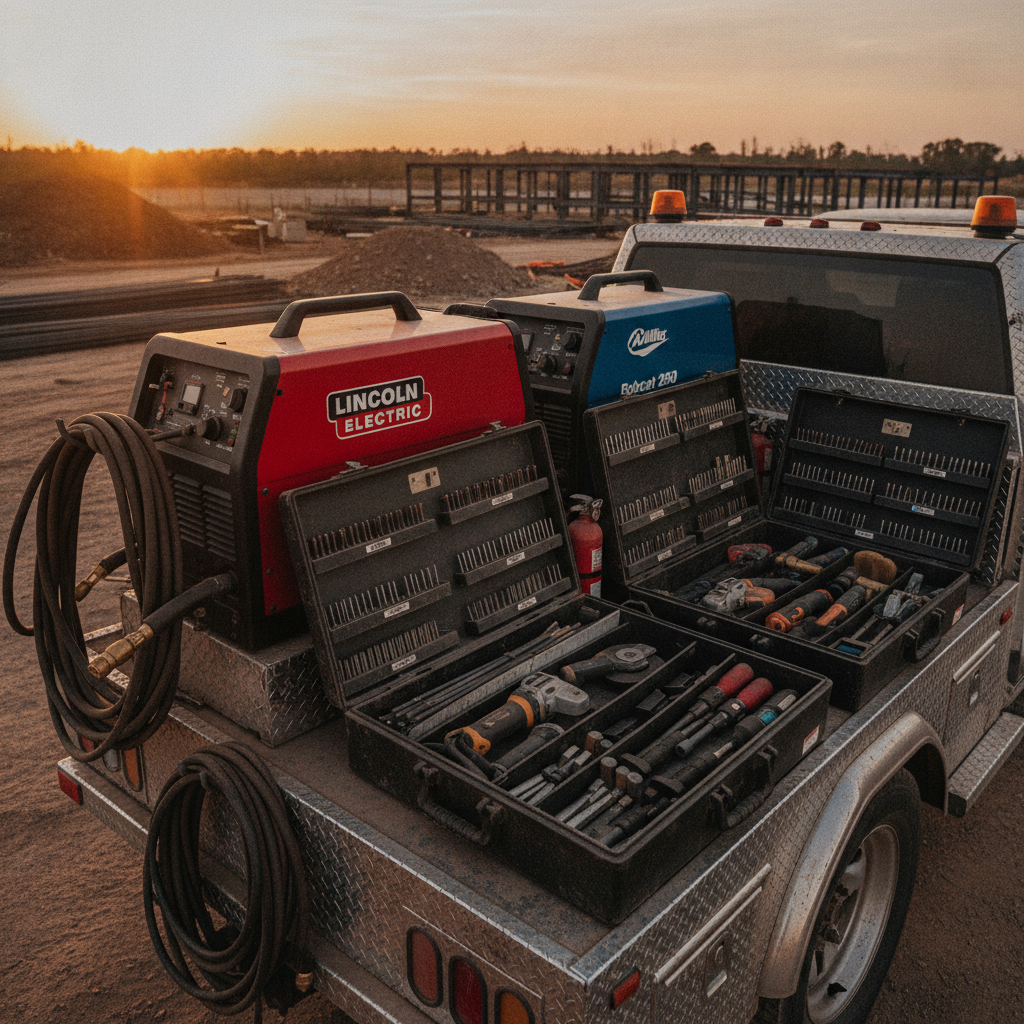
Let me paint you a picture. You pull up to a job site at 7 AM. The foreman’s watching. The other trades are already rolling. You pop open your truck boxes and spend the next twenty minutes digging through a pile of consumables, mystery cables, dead flashlights, and three grinders you forgot you owned. That right there? That’s your mobile rig organization problem. And it’s costing you money every single day. Not someday. Right now.
I’ve been running a mobile rig for over a decade. I’ve made every one of these mistakes personally. Learned some of them twice, like an idiot. This isn’t a theoretical post about “optimizing workflow.” This is the stuff that actually matters when you’re billing by the hour and every minute of fumbling around is coming straight out of your pocket.
Let’s get into it.
Why Mobile Rig Organization Actually Matters for Your Bottom Line
Here’s the math nobody tells you when you’re starting out. If you waste 25 minutes per job getting set up, and you run four jobs a week, that’s over an hour and a half of non-billable time. At $125 an hour, you’re throwing away nearly $200 every single week. That’s $10,000 a year you’re leaving on the table because your consumables drawer looks like a junk bin at a swap meet.
Good mobile rig organization isn’t about being neat for the sake of it. It’s about speed, professionalism, and not looking like a clown in front of a general contractor who’s deciding whether to call you back next month.
If you’re still figuring out how to price your time properly, this connects directly to how you structure your rates. Worth reading this breakdown on pricing for certification services — the same logic applies to how you value your setup time.
Mistake #1: No Zones in Your Truck Body
Most guys just throw stuff in. Grinders go wherever there’s room. Leads get stuffed in a corner. Rod goes wherever. Then you wonder why you can’t find anything.
The fix is zones. Simple concept. Pick a zone for each category of gear and never break the rule.
- Leads and cables: One dedicated compartment, always coiled the same way.
- Consumables: One drawer or bin, sorted by process. MIG wire, TIG filler, stick rod — separated.
- Hand tools and grinders: One zone. Hooks, clips, or foam cutouts. Whatever keeps them from rolling around.
- PPE: Right near the door. You should never have to dig for your hood.
- Gas and regulators: Locked down, same spot every time.
You don’t need a custom $15,000 truck body to do this. You need a label maker and the discipline to put things back where they go.
Mistake #2: Your Leads Are a Rats’ Nest
Tangled leads are one of the most time-consuming, most preventable problems on a mobile rig. You pull out what you need and three other things come with it. Then you spend ten minutes untwisting everything while the foreman checks his watch.
Here’s what works: coil your leads the same direction every time using the over-under method. Yes, it takes an extra 90 seconds when you’re packing up. No, it’s not optional. Velcro straps or bungees every two feet on longer leads. Store them in a dedicated tray or hang them on hooks if your truck body allows it.
Color code if you run multiple processes. Red for stick, blue for MIG, whatever. Sounds fussy. Saves you from grabbing the wrong lead in low light at 6 AM on a cold morning.
And while we’re talking about process-specific gear — if you’re running a multi-process machine on your rig, the way you organize around it matters. Check out the post on field-ready multi-process welders for a look at how different machines lay out in a mobile setup.
Mistake #3: No Consumables System
This one kills me. Guy shows up to a job, gets ready to weld, and realizes he’s got half a spool of .030 wire, a half-empty box of 7018 that’s been bouncing around for two months, and no idea if he has the right filler for the actual material in front of him.
You need a consumables inventory system. It doesn’t have to be fancy.
Here’s a simple version that works:
- Keep a minimum stock level for your most-used consumables written on the inside of the drawer.
- When you open the last of something, it goes on a restock list immediately. Not tomorrow. Right then.
- Restock before the weekend, not Monday morning when you’ve got a 7 AM job.
Keep your rods in a rod oven or sealed container if you’re working in humid environments. Moisture is the enemy of low-hydrogen electrodes and you already know that. Acting like you don’t is expensive.
If you’re doing work on mixed materials out in the field, your consumable selection gets more critical. The post on dissimilar-metal welding mastery gets into the filler selection side of that problem.
Mistake #4: Your Angle Grinders Are Everywhere
A mobile welder typically has at least two or three angle grinders on the truck. Cutting disc, grinding disc, flap disc — ideally you’re not swapping discs every five minutes. You’re pre-loading grinders for common tasks and grabbing the right one.
But only if you can find them. Which requires that they live in a fixed spot.
Grinder hooks or foam-lined drawers are both solid options. The point is every grinder has a home and every grinder goes back to it. Loose grinders rolling around in a truck box get damaged, damage other things, and disappear to the back of compartments where they’re useless to you.
While you’re at it, keep a dedicated spot for your wire brushes, chipping hammers, and weld cleaning gear. Post-weld cleanup is part of the job and scrambling for a wire brush makes you look disorganized.
Mistake #5: Gas Cylinders That Aren’t Secured Properly
This one isn’t just an organization issue — it’s a safety issue. An unsecured cylinder falling over in a moving truck is a real problem. Beyond the obvious hazard, a valve getting knocked off a high-pressure cylinder is the kind of thing that ends careers and lawsuits.
Cylinders go upright. Cylinders get chained or strapped every single time. This is non-negotiable. If your truck body doesn’t have proper cylinder mounts, that’s your next investment, not a new hood.
Keep a clear inventory of what cylinders you have and roughly how full they are. Running out of shielding gas mid-job is embarrassing and costs you travel time for a swap. Know what you’ve got before you leave the yard.
If you’re running battery-powered or hybrid equipment that cuts your gas dependency on certain jobs, your cylinder management changes. Take a look at the post on hybrid battery-powered welders for context on where that technology fits in a mobile setup.
Mistake #6: No Pre-Job Checklist
You know what separates guys who show up ready from guys who show up scrambling? A list. That’s it. A simple checklist they run through before leaving the shop or yard.
This doesn’t make you soft. It makes you professional. Pilots use checklists. Surgeons use checklists. You can use one too without losing your welder card.
A basic mobile rig pre-job checklist covers:
- Machine powered up and tested the night before or morning of
- Leads connected and coiled correctly
- Consumables stocked for the job material and process
- Gas cylinders secured and pressure checked
- PPE all present — hood, gloves, sleeves, safety glasses
- Grinders loaded with appropriate discs
- Any job-specific tooling or fixtures loaded
Tape it inside a truck box lid. Laminate it. Use it. You’ll show up ready every time instead of pulling into a job site and realizing your hood is sitting on your workbench at home.
Mistake #7: The Truck Body Itself Doesn’t Match How You Work
A lot of guys either inherited a truck setup or just threw drawers and bins in without thinking about their actual workflow. The result is a setup that makes zero sense for how a real job goes.
Think through your sequence of arrival. What do you grab first? That thing should be closest to the door and at a comfortable height. What do you grab last? That can live deeper or higher. Your most-used items should require the least movement to access.
If you’re doing a lot of structural fab work in the field, think about where your clamps, squares, and layout tools live versus your welding gear. Fabrication and welding are different phases of the same job and your truck should reflect that.
Building your business around a specific type of field work? The post on strategic niches is worth a read for thinking about how your rig layout should match the work you’re actually chasing.
Mistake #8: No Lighting in Your Truck Boxes
Small one. Huge impact. You’re working a dawn call in November and you’re digging through a black hole of a truck box with a phone flashlight in your mouth. This is dumb and also easy to fix.
LED strip lights inside your truck boxes cost almost nothing. Motion-activated or switched, either works. You’ll use them every single dark morning and every evening pack-up and wonder how you ever worked without them.
Mistake #9: Your Machine Isn’t Ready to Work
Good mobile rig organization extends to the machine itself. A welder that isn’t dialed in, isn’t clean, and isn’t maintained is a liability. Nothing slows down a job like troubleshooting a machine that should have been serviced last month.
Keep a basic maintenance log in the truck. Know when your machine last had a service. Keep spare contact tips, liners, and drive rolls on the truck so you’re not dead in the water when something wears out mid-job.
If you’re running older equipment and thinking about what a field-ready upgrade looks like, the post on field-ready battery welders covers some of the newer options that are worth knowing about for mobile work.
Putting It Together: The One-Week Fix
You don’t have to rebuild your entire rig over a weekend. Here’s a realistic one-week approach:
Day 1: Pull everything out of the truck. Everything. Throw away the junk you don’t use. Put back only what belongs on a working rig.
Day 2: Define your zones. Mark them with tape or labels if needed. Assign every item to a zone.
Day 3: Deal with your leads. Coil them right, store them right, label them if you run multiple processes.
Day 4: Set up your consumables system. Write your minimum stock levels, check current inventory, restock what’s low.
Day 5: Build your pre-job checklist. Laminate it. Mount it somewhere you’ll actually see it.
That’s it. Five days to a rig that works for you instead of against you. The time you save in week one alone will justify every hour of setup.
The Real Cost of a Disorganized Rig
Here’s the thing nobody wants to hear. When a contractor sees you fumbling around for twenty minutes before you strike your first arc, they’re not thinking “he’s just getting set up.” They’re thinking “this guy’s not coming back.”
Your truck is your shop. It’s your first impression, your tool storage, and your livelihood all in one. A well-organized rig tells everyone watching that you’re a professional who’s done this before and knows what he’s doing. A disaster truck tells a different story.
Mobile rig organization is one of the highest-return investments you can make in your business. It costs almost nothing. It saves you hours every week. And it makes you look like exactly the kind of contractor people call back.
If you’re still in the earlier stages of building out your mobile business and figuring out all the moving pieces, the post on going from garage to shop is a solid read for the bigger picture of how all this fits together.
Now go clean out your truck.