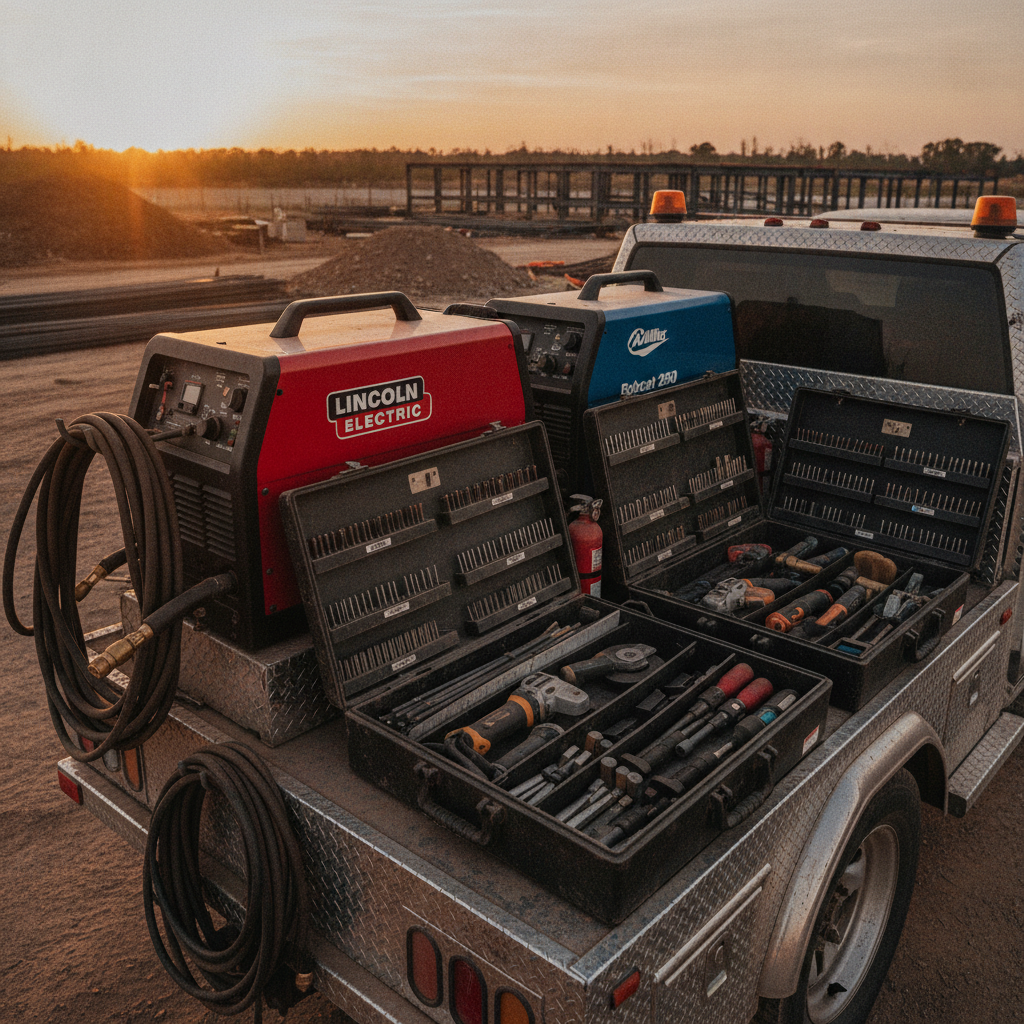
If you’ve ever spent fifteen minutes digging through your truck bed looking for a 4.5-inch grinding disc while a customer stands there watching you, you already know what truck setup mistakes cost you. It’s not just embarrassing. It’s money. Real, actual dollars bleeding out of your hourly rate while you move junk around looking for gear you swear you packed. After ten-plus years running a mobile rig, I’ve made every one of these mistakes myself — and watched plenty of other guys make them too. So let’s talk about what’s actually slowing you down and how to fix it before it becomes a habit.
Why Truck Setup Mistakes Are a Business Problem
Most guys think of rig organization as a convenience thing. A nice-to-have. Something you’ll get around to when you’re not busy.
That’s the wrong way to look at it.
Your truck is your shop. It’s your storefront, your toolroom, and your workspace all rolled into one. When it’s a disaster, every job costs you extra time before you even pick up your stinger. That time has a dollar value. If you’re billing $85 an hour and you waste 20 minutes per job digging through your rig, that’s nearly $30 gone before you’ve done a single thing for the customer.
Do that five days a week and you’ve burned through $150 in unbillable chaos. Per week. That’s $7,800 a year. For a disorganized truck. Let that sink in.
If you’re still trying to nail down what your time is actually worth, take a look at this breakdown on pricing for certification services — the math on time-wasting applies across the board.
Mistake #1: No Dedicated Spot for Consumables
This one kills more jobs than anything else on this list. You’ve got welding rods rattling around loose in a milk crate. Grinding discs stuffed in a bag with your PPE. Wire brushes mixed in with your clamps.
Here’s the thing about consumables — you need them constantly. Every single job. And when they’re not in a consistent location, you’re hunting every time.
Fix it simple: dedicate one drawer or one box exclusively to consumables. Rods in their tubes, standing upright or horizontal in a labeled slot. Grinding discs in a flat stack with a disc holder — the cheap plastic ones work fine. Cut-off wheels separate from grinding wheels because mixing those up in a hurry is how you have a bad day.
Every consumable gets a home. Every time. No exceptions. It sounds rigid, but your future self will thank you when it’s raining sideways at 6 AM and you need a 7018 right now.
Rod Storage Specifically
Low-hydrogen rods need to stay dry. That’s not news to anyone reading this. But a lot of guys store them in a tube or a can and throw that can wherever there’s space. That’s a truck setup mistake that bites you on structural jobs when you need dry rods and yours have been sitting in a wet compartment for three weeks.
Invest in a proper rod oven or at minimum a sealed rod canister with desiccant packs. Store it in the cab or in a dry, enclosed compartment. It’s a small thing that signals to customers — and to yourself — that you know what you’re doing.
Mistake #2: Cables and Leads Going Everywhere
Tangled welding leads are one of the most universally annoying things in mobile welding. You spend five minutes untangling cable before every job. You trip over it mid-job. You spend another five minutes recoiling it after.
That’s ten minutes per job, minimum, just dealing with cable management. Multiply that out and it’s ugly.
The fix is a dedicated cable reel or at least a consistent coiling and hanging system. A lot of guys swear by figure-eight coiling to prevent kinks and tangles — if you’re not doing that, start. Others use simple hooks welded to the truck body or bolted to the service body walls to hang leads in a way that lets them unspool without tangling.
The point isn’t which method you use. The point is that you pick one method and stick to it religiously. Consistency beats perfection every time when you’re working fast on a job site.
Mistake #3: Tools Mixed With Equipment
Hand tools should not live in the same space as your welding machine leads, your helmet, or your rod storage. This sounds obvious. And yet.
When your angle grinders, wire brushes, chipping hammers, and clamps are all cohabiting in one giant pile, everything takes longer. You can’t find what you need quickly, and you end up pulling out half the compartment to get to the one thing at the bottom.
Set up zones in your rig. Welding equipment stays in welding equipment zones. Fabrication and prep tools — grinders, files, brushes — get their own section. Measurement and layout tools get another. Fasteners, hardware, and misc get a catch-all bin, but even that should be contained.
If you’re running a service body truck, you’ve already got the compartments. Use them with intention instead of just throwing stuff in wherever there’s room.
Label Everything
Yes, including the stuff you think you’ll always remember. You won’t. Especially when you’re tired, rushed, or have a helper who doesn’t know your system. A label maker and thirty minutes of your time will pay for itself in the first week.
Mistake #4: Wrong Machine for the Job, or Worse — No Backup Plan
This isn’t strictly an organization problem, but it bleeds directly into your job-site efficiency. If you’re running a single-process machine and you show up to a job that needs something different, you’re done before you started.
The smart move is running a multi-process machine if your budget and rig layout allow it. The right machine mounted correctly in your setup means you’re adaptable without doubling your load. Check out our thoughts on field-ready multi-process welders if you’re evaluating what to run.
Some guys are also looking hard at battery-powered options right now, especially for jobs where generator noise is an issue or access is a problem. Worth knowing what’s out there — we covered hybrid battery-powered welders in depth if you want to see how that market’s shaping up.
Mistake #5: Safety Gear That’s Hard to Access
Your helmet, gloves, and sleeves should be the easiest things to grab on the truck. Not buried under leads. Not in a bag in the back corner. Right up front, accessible without digging.
This matters for two reasons. First, speed — you want to be suited up and arc-ready fast. Second, and more importantly, when gear is inconvenient to reach, people skip it. That’s how guys end up grinding without a face shield because it was “right there a second ago.”
Mount a helmet holder on the truck body or hang hooks near the primary work area for gloves and sleeves. Keep your PPE together and accessible. It’s not fancy. It just works.
Mistake #6: No System for Paperwork and Job Documentation
You might think this has nothing to do with truck setup. You’d be wrong.
If your work orders, invoices, and job notes are floating loose in the cab — or worse, just living in your head — you’re losing time and money in a different way. A small document organizer in the cab, or even a dedicated clipboard, keeps your job info in one place.
This gets more important as you start taking on more jobs and if you ever move into certified work. Keeping documentation organized in the field is a habit that pays off big when a customer asks for paperwork or when you need to reference what you did three weeks ago. We’ve talked about building those habits in the context of certification readiness — same principles apply to everyday field work.
Mistake #7: Overpacking and Under-Organizing
There’s a version of bad rig organization that’s actually caused by taking too much stuff. The logic sounds fine: “I want to be ready for anything.” But when you’ve got every tool you own on the truck, nothing has a proper place and you spend more time managing your own inventory than working.
Be ruthless about what actually goes on the truck. Build your loadout around the jobs you actually take. If you’re primarily doing agricultural equipment repairs and pipeline tie-ins, your loadout looks different than someone doing structural and ornamental.
Know your niche and load accordingly. If you’re still figuring out what work you want to focus on, this post on strategic niches is worth your time — knowing where you want to play makes it a lot easier to figure out what needs to be on the truck.
Mistake #8: Not Accounting for Ground and Gas
Your ground clamp should have a dedicated mount. Not wrapped around a handle somewhere. Not hanging off the back of the machine. A real, accessible mount that puts the clamp in the same place every time.
Same goes for your shielding gas. Cylinder secured properly, regulator protected, hose run cleanly so it doesn’t become a tripping hazard or get pinched under something. We’ve got a whole breakdown on smart shielding gas management if you want to go deeper on that side of things.
A loose cylinder in a truck bed is a lawsuit waiting to happen. Chain it, bracket it, secure it. Every time. Non-negotiable.
What a Good Rig Setup Actually Looks Like
There’s no one perfect layout. Trucks are different. Service bodies are different. The work you do is different. But there are some principles that hold across all of it.
Everything has a home. If you can’t say in three seconds where something is, it doesn’t have a home yet.
Most-used items are easiest to access. Things you grab on every job should be at hand level, near the primary work side of the truck. Things you use occasionally can live deeper or higher.
The system stays consistent. When you put something back in the wrong place once, it’s annoying. When everyone on the truck puts things back wherever, it’s chaos. Build the habit and enforce it if you’ve got help.
You can explain it to someone else. If your helper couldn’t find what you needed in under a minute because your system makes sense, it’s a good system. If only you can navigate your own truck, it’s not a system — it’s a mess with a familiarity bias.
The Business Case for Getting This Right
Everything about how you run your mobile operation either adds to or subtracts from your reputation. Customers notice whether you’re organized. They notice if you’re digging around for ten minutes before you start. They notice if your truck looks like it got loaded during an earthquake.
First impressions on job sites matter more than most mobile welders want to admit. An organized rig says you’ve been doing this long enough to figure it out. A chaotic one says otherwise, even if your welds are perfect.
And if you’re building a business — not just a side hustle, an actual business — then every efficiency improvement compounds. The time you save with a better-organized truck can go back into billable hours, more jobs, better service, or just getting home before dark. All of which are good things.
If you’re in the early stages of building out your mobile operation and figuring out how all the pieces fit together, this post on going from garage to shop covers a lot of the same thinking applied to the bigger picture of your business setup.
Start With One Change This Week
Don’t try to reorganize the entire rig in one afternoon. You won’t finish, you’ll get frustrated, and half of it will end up back where it started. Pick one area — consumables, cables, or PPE storage — and fix that one thing properly this week.
Then next week, pick the next thing.
Small, consistent improvements to how your truck is loaded add up fast. A few hours of focused effort will pay back in saved time every single job for the next year. That’s a better return than almost anything else you can do for your mobile welding operation right now.
Stop digging through junk before you strike your first arc. Fix the truck setup mistakes, protect your time, and look like you’ve actually been doing this a while. Because you have.