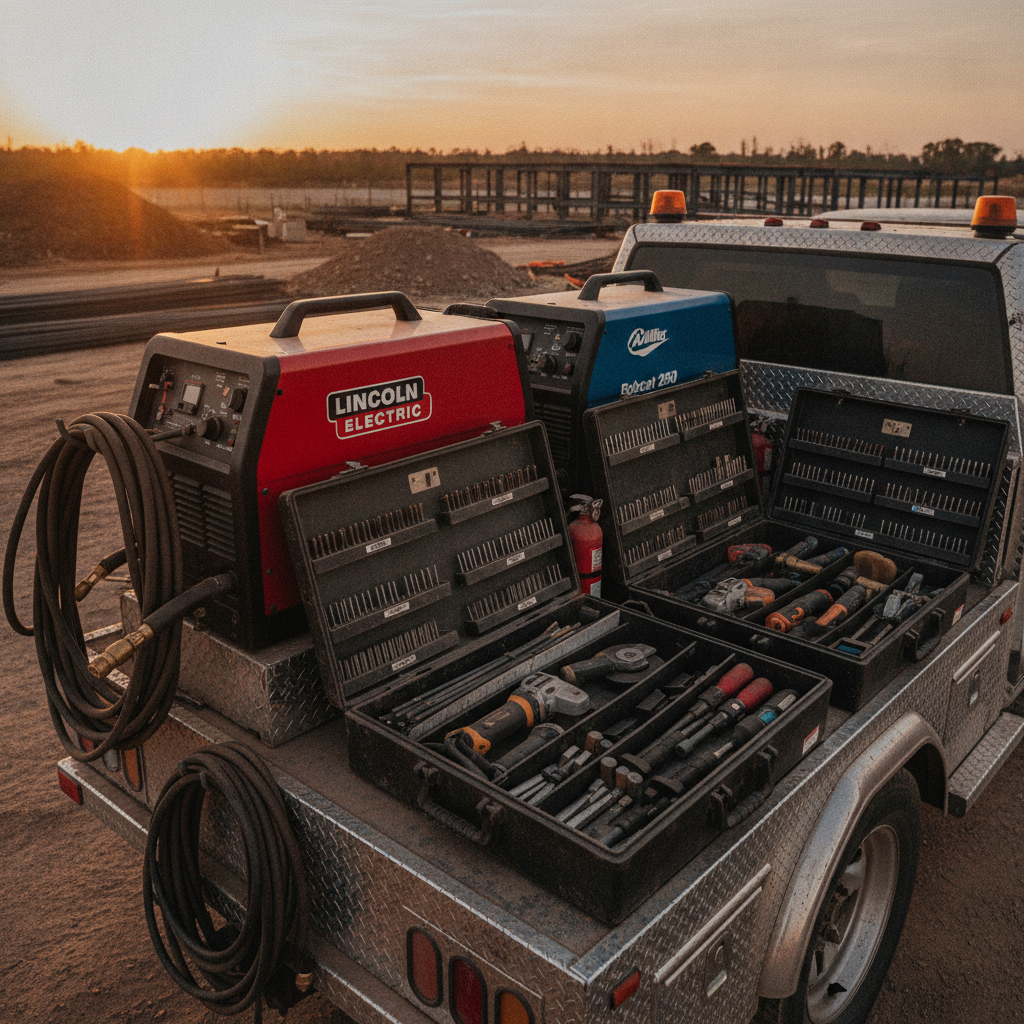
You want to know what’s actually killing your hourly rate on mobile jobs? It’s not slow travel time. It’s not the customer changing their mind halfway through. It’s you — standing at the back of your truck at 7 AM, digging through a pile of leads, fittings, and miscellaneous garbage trying to find one 1/4-inch fitting you swear you had last week. Mobile rig organization is the single most overlooked factor in how much money you actually take home as a mobile welder. Every minute you spend hunting for gear is a minute you’re not billing. And over a five-day week, those minutes stack up into real hours — real money — gone.
This isn’t a lecture about being neat. This is a hard look at the specific setup mistakes that are making you slower, making you look less professional, and quietly bleeding your profit margin dry. Let’s get into it.
Why Mobile Rig Organization Directly Affects Your Income
Here’s the math nobody wants to do. Say you lose 20 minutes per job messing around with your setup. You run four jobs a day. That’s 80 minutes — over an hour — of unbillable chaos every single day. At $100/hour, you’re leaving $130+ on the table before lunch. Every week. Every month.
And it compounds. A disorganized truck means you also forget things. You forget things and you either make a second trip or you improvise badly. Both of those options cost you more time, more money, or both. There’s a reason the most productive mobile welders out there treat their truck like a rolling shop. Because it is one.
If you’re still figuring out your rate structure around this, worth a read: Pricing for Certification Services covers how unbillable time eats into your real effective hourly rate.
Mistake #1 — Your Leads Are a Rats’ Nest
Tangled welding leads are probably the number one time waster on mobile rigs. It seems minor until you’ve spent ten minutes untwisting 50 feet of cable in the dark while the customer watches from the window. That’s not a good look, and it’s not efficient.
The fix is simple but you actually have to commit to it. Get proper lead hooks or cord reels mounted in a dedicated spot on your rig. Wrap your leads consistently every single time you pack up — doesn’t matter how tired you are, doesn’t matter how late it is. The guy who wraps his leads properly at the end of every job is the guy who’s striking an arc 10 minutes after arrival. The guy who doesn’t is the guy still untangling cable while his coffee goes cold.
Use different colored electrical tape on your work lead versus your stinger lead. Sounds ridiculous, but at 6 AM in low light, that two-second visual confirmation matters. Label everything. Seriously, label it.
Mistake #2 — No Zones on Your Truck
If everything has a spot, everything gets found fast. If nothing has a designated spot, everything ends up in one big drawer together and you’re archeologically sifting through layers of your own history every time you need a contact tip.
Zone your truck. It doesn’t have to be fancy. It just has to be consistent. Here’s a basic zone breakdown that works:
- Hot zone — things you grab on every single job, every time. Gloves, hood, angle grinder, leads, electrode holder. These live closest to the tailgate or access door. Zero searching required.
- Process zone — consumables and process-specific gear organized by process. Stick electrodes in one drawer. MIG wire and tips in another. TIG setup in its own designated spot. Don’t mix these.
- Fab zone — clamps, squares, levels, magnets, scribe tools. All in one place, all the time.
- Mechanical zone — gas fittings, hose repair stuff, spare parts for your machine. This is your “oh crap” zone. Keep it stocked and keep it organized.
Once you build this system, loading and unloading becomes muscle memory. You stop thinking about where things are and start thinking about the work.
Mistake #3 — Your Machine Isn’t Secured Properly
This one is both an organization problem and a liability problem. An unsecured machine slides around, damages itself, damages your other gear, and eventually damages your truck — or someone else’s property if it ends up in the road.
Your welder needs to be properly mounted or strapped with quality tie-downs rated for the weight. Not bungee cords. Not “it’s wedged in there pretty good.” Proper mounts or heavy-duty ratchet straps. Non-negotiable.
While you’re at it — think about accessibility. Your machine should be positioned so you can reach the panel controls without crawling halfway into the truck. If you’re adjusting your wire speed while contorted into a pretzel, you’ve set up your machine wrong. Small repositioning now saves significant frustration on every future job.
If you’re running multi-process capability in the field, your machine placement matters even more. Check out Field-Ready Multi-Process Welders for how pros configure their setups around access and portability.
Mistake #4 — Consumables Without a System
Running out of contact tips mid-job because you grabbed the wrong tray from the wrong drawer is the kind of thing that ages you prematurely. Consumable management is where a lot of guys fall apart. They have consumables, just not the right ones, in the right quantities, in the right place.
Build a restocking protocol. After every job, do a 60-second inventory of what you used. Keep a running list on your phone or a clipboard in the truck. Before every workweek starts, restock to par levels. This sounds obvious and tedious. It is. But so is apologizing to a customer while you drive to the supply house mid-job.
Organize consumables by size and process in labeled bins or drawers. Clear bins help — you can see at a glance whether you’re running low without pulling everything out. Spend $30 on proper small parts organizers and stop throwing contact tips into a pile at the back of a drawer where they all look the same.
Mistake #5 — Your Gas Setup Is an Afterthought
Gas cylinders rolling around loose in your truck is dangerous. Full stop. They also take up more space than necessary when they’re not properly mounted. A cylinder securing system — whether that’s a proper rack, a bolt-in holder, or quality chains — is mandatory for safety and mandatory for organization.
Beyond safety, think about your hose runs. Long hose runs that have to be uncoiled every job are more setup time wasted. Where your cylinder lives relative to where you typically work matters. Plan it out rather than just wedging the bottle wherever it fits.
If you’re managing multiple gas types for different processes, this gets complicated fast. Smart Shielding Gas Management breaks down how to handle multi-gas setups efficiently in the field.
Mistake #6 — Personal Gear Mixed With Work Gear
Your lunch, your extra jacket, your random personal items — these do not belong mixed in with your work equipment. It sounds petty but it causes real problems. Personal gear ends up covering work gear. You move work gear to get to personal gear. Things get lost. Things get damaged.
Give yourself a dedicated personal storage spot. A small box, a bag, whatever works. Keep it separate and keep it consistent. Same principle applies to paperwork, job folders, and invoices. If your job paperwork is floating around loose in the same drawer as your tip tool and your consumables, you will lose paperwork.
Running your business right means treating the administrative side with the same organization as the technical side. For newer operators still figuring out the business side, From Garage to Shop covers a lot of the foundational stuff worth getting right early.
Mistake #7 — Ignoring Lighting and Visibility
A lot of mobile work happens early or late. Digging through your truck in low light without proper lighting is slower, more frustrating, and how you grab the wrong thing or miss something entirely. Add a good LED strip light or two inside your truck bed and toolboxes. This is a $40 fix that will save you more time than almost anything else on this list.
Magnetic LED lights that you can reposition are especially useful. Park one on the inside of a toolbox lid, one in the main truck bed area, and you’ve got a usable workspace even in the dark. Stop squinting at your own equipment.
Building a Setup That Looks Like You Know What You’re Doing
Here’s the thing nobody tells young guys getting into mobile work: your truck is your first impression. The customer sees your rig before they see your welds. A chaotic, disorganized truck signals a chaotic, disorganized operation — even if your actual weld quality is excellent. An organized rig signals professionalism before you’ve said a word or struck a single arc.
This matters for repeat business. It matters for referrals. People notice the details even when they’re not consciously evaluating them. Show up with a clean, organized rig and you’ve already won half the confidence battle before the job starts.
If you’re building your mobile business from scratch and thinking about how to position yourself competitively, Strategic Niches is worth your time for thinking about differentiation in this market.
The Weekly Reset — 20 Minutes That Pay Back in Hours
The single best habit you can build is a weekly reset. Pick a day — Sunday night, Friday after your last job, whatever works. Spend 20 minutes doing the following:
- Restock consumables to par levels.
- Check and reorganize any zones that drifted during the week.
- Inspect your leads, hoses, and connections for wear.
- Confirm your gas levels.
- Clear out any garbage, personal items, or stuff that doesn’t belong.
That’s it. Twenty minutes on the weekend means Monday morning you roll out with a truck that’s ready instead of a truck that’s technically functional but quietly defeating you. Discipline here is what separates the guys who bill 40 clean hours a week from the guys who work 50 hours and bill 35 because setup waste ate the rest.
Practical Mobile Rig Organization Tools Worth Having
You don’t need to spend a fortune to get organized. Here’s what actually makes a difference in real-world mobile rig organization:
- Magnetic parts trays — cheap, versatile, stick anywhere metallic. Essential for small parts at a job site.
- Clear stackable bins with labels — consumables, fittings, hardware. See what you have without digging.
- Cord wraps or velcro straps — for keeping leads and hoses wrapped without the tape-and-hope method.
- Proper gas cylinder mounts — safety first, organization second, both at the same time.
- LED strip lighting — cheap, easy to install, transformative for low-light setup situations.
- A mounted clipboard or document holder — keeps job paperwork accessible and protected.
None of this is exotic. All of it compounds. Small, cheap improvements to your mobile rig organization add up to significant time savings across hundreds of jobs per year.
Stop Losing Money to Your Own Truck
Your rig is your shop. Treat it like one. The welders who run tight, organized setups aren’t the ones with the most experience or the best equipment — they’re the ones who decided that their time was worth the 20 minutes it takes to put a system in place and stick to it.
Every job you roll out on, your truck is either working for you or against you. Right now, if you’re being honest with yourself, you probably know which one it is. The fix isn’t complicated and it isn’t expensive. It just requires deciding to stop tolerating the chaos that’s costing you real money every single week.
Set your zones. Secure your gear. Restock your consumables. Do the weekly reset. Show up looking like a professional. Then weld something.