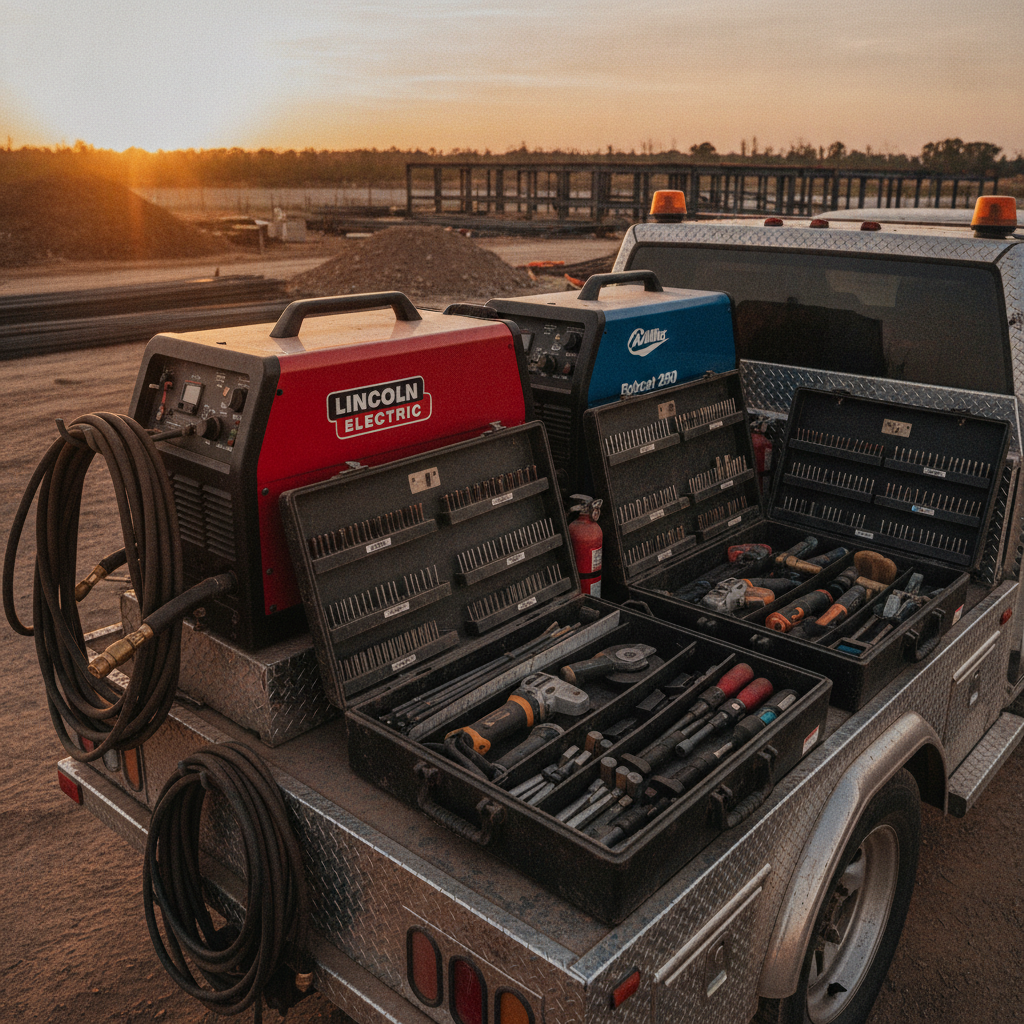
You know that guy who shows up to a job, drops his tailgate, and is striking an arc inside of ten minutes? That guy has his mobile rig setup dialed in. Then there’s the other guy — digging through a pile of cable, tripping over a grinder he forgot he even owned, spending twenty minutes finding the one rod he needs. That second guy is you, maybe. No judgment. We’ve all been there. But here’s the thing: every minute you spend fumbling around your truck is a minute you’re not billing for. And if you’re charging by the hour, that disorganization is coming directly out of your pocket.
This isn’t about having a pretty truck for Instagram. This is about running a tighter operation, looking like a professional when a new customer is standing right there watching you set up, and actually making the money your day rate is supposed to earn you. Let’s get into it.
Why a Bad Mobile Rig Setup Is a Business Problem, Not Just an Annoyance
Most welders think of truck organization as a personal preference thing. It’s not. It’s a revenue problem. Think about a typical work week. If you’re wasting fifteen to twenty minutes per job site just getting your act together, and you’re running four or five jobs a week, that’s over an hour of lost time every single week. Multiply that over a year and you’ve lost multiple full billing days to the inside of your truck bed.
It gets worse. A disorganized rig leads to forgotten consumables, which means emergency supply runs. Those cost you time and fuel. It leads to damaged equipment because nothing is secured properly. And it leads to mistakes — wrong filler, wrong shielding gas, wrong settings — because you’re rushing to catch up after a slow setup.
If you’re just getting your business off the ground, check out the post on going from garage to shop — a lot of the same organizational principles apply whether you’re building out a physical space or a mobile rig.
The fix isn’t complicated. It’s just intentional. Here are the mistakes I see most often and what to do instead.
Mistake #1: No Dedicated Spot for Anything
This is the big one. If nothing has a home, everything becomes a pile. You toss your stinger in after a job, throw the ground clamp on top of it, drop your hood wherever, and call it a day. Three jobs later you’ve got a rat’s nest back there and you can’t find anything without pulling the whole truck apart.
Fix this by assigning a physical location to every single piece of gear you carry. Not a general zone — an actual spot. Cables hang here. Hood goes here. Grinders live in this drawer. Consumables are in this bin, organized by process. Sounds obvious. Very few welders actually do it consistently.
Use hooks, magnetic strips, velcro straps, bin organizers, and drawer dividers. Spend a Saturday building out your truck bed properly. That one day of work will pay for itself in the first month.
Mistake #2: Cables Are Never Coiled Right
This one drives me insane. Tangled welding leads are a time thief and a tripping hazard. I don’t care how good of a welder you are — if you’re spending five minutes unraveling your leads at every job, you look like an amateur and you’re burning daylight.
Coil your leads the same way every single time you put them away. Use over-under coiling if you learned it, or just pick a method and stick with it. Bungee them or strap them so they stay coiled. Mount a proper cable holder or reel on your rig if you run long leads regularly.
Invest in a decent cable reel setup. It’s not glamorous but it might be the single highest ROI upgrade you can make to your mobile rig setup. I’ve seen guys spend thousands on a new machine and still run around with their leads in a pile. Get the basics right first.
Mistake #3: Your Consumables Are Scattered Everywhere
Rods in three different places. Tips in your jacket pocket. A half-used spool of wire rolling around loose. Wire brushes in four different locations. If this sounds familiar, you’re wasting time every single job.
Set up a dedicated consumables system. A portable organizer, a set of labeled bins, or a drawer specifically for consumables sorted by process and size. When you use the last of something, you write it on a restock list immediately — not when you’re standing at a job site realizing you’re out.
This also prevents the “wrong filler” problem. Grabbing the wrong rod or the wrong wire because everything’s mixed together is a real issue, especially if you’re doing multi-process work. Speaking of which, if you’re running multiple processes in the field, the guide on field-ready multi-process welders is worth a read for understanding how your equipment choices affect your setup time.
Mistake #4: Gas Cylinders Are an Afterthought
Unsecured cylinders are a safety issue first and an organization issue second. But beyond the obvious safety problem, a lot of mobile welders just don’t think strategically about their gas setup at all. They run one cylinder, they don’t track levels, and they end up mid-job with an empty bottle.
Mount your cylinders properly with chain brackets. Carry a second cylinder if you can — especially for TIG or MIG work where running out mid-job is a real possibility. Know roughly how many cubic feet you’re burning per job and track your levels. If you want to go deeper on gas management, the post on smart shielding gas management covers this in detail.
Also: label your regulators. If you carry multiple gas types, you do not want to be second-guessing which regulator is on which bottle when you’re setting up fast.
Mistake #5: Your Tools Are Buried Under Everything Else
Your angle grinder, your chipping hammer, your wire brush, your clamps — if these are buried under your welding leads and your jacket and a bag of rods, you’re going to be digging for them every single time. And you’re going to need them every single time.
The tools you use on every job should be the most accessible things on your rig. Not the most buried. Put them in a tray, a dedicated drawer, or a rail-mounted holder right at the tailgate level. Grab and go. Done.
Think about the sequence of your work. What do you grab first? Put that first. What do you grab last? That can live further back. Simple workflow thinking applied to your truck layout will cut your setup time more than any single piece of gear you could buy.
Mistake #6: No Pre-Job Checklist
I know. Nobody wants to hear the word checklist. But hear me out. A simple pre-job checklist is not about being a rookie — it’s about not showing up to a two-hour job and realizing you left your ground clamp at the last site. That has happened to every one of us at least once. A checklist makes sure it stops happening.
Keep it short. Ten to fifteen items max. Run through it before you leave each morning. Cables, consumables, gas levels, PPE, hand tools, documentation if needed. Thirty seconds to run the list saves you the time and embarrassment of a forty-minute round trip to go get something you forgot.
If you’re pricing your jobs properly, lost time like that is money you don’t recover. For a reality check on how to price so these inefficiencies don’t quietly kill your margins, the breakdown on pricing for certification services has some solid logic that applies to field work pricing too.
Mistake #7: The Machine Itself Is Poorly Positioned
Where your welder lives on the truck matters more than most guys think. You need access to the controls without climbing into the bed. You need the leads to reach the work without maxing out their length on every single job. You need airflow around the machine so it’s not overheating in a cramped corner.
Think about your most common job scenarios. Where do you typically need leads to reach? How long do they need to be? Position your machine accordingly and make sure the mounting is solid. A machine that shifts around while you’re driving is going to wear out faster and potentially damage connections.
If you’re evaluating machines for a new rig or a rig upgrade, the comparison of hybrid battery-powered welders is worth reading — some of those setups change the positioning math significantly compared to a traditional engine-driven setup.
The Layout That Actually Works
Here’s a simple framework for thinking about your truck bed layout. Divide it into three zones mentally.
Zone 1 — Immediate access (tailgate area): The things you grab at every single job. Ground clamp, stinger or gun, hand tools, PPE. These live at the back where you can grab them without climbing in.
Zone 2 — Mid-rig: Consumables, extra leads, smaller equipment, gas hose, spare parts. Accessible but not necessarily at your fingertips every single time.
Zone 3 — Deep storage: Spare parts you rarely need, backup equipment, documentation, anything job-specific that you pre-load for particular work. Out of the way, but organized so you can find it when you need it.
This isn’t revolutionary. But most rigs I’ve seen don’t follow any logical system at all. Just stuff gets thrown wherever it fits. A three-zone approach gives you a mental model so when you put something away, you put it in the right zone automatically.
Small Changes, Real Money
Here’s the honest truth about mobile rig setup: none of this is expensive to fix. Most of the changes cost you an afternoon and maybe fifty bucks in hardware. Cable straps, bin organizers, a few hooks, some labels. The return on that investment starts on your very next job.
The welders who run tight operations don’t necessarily have fancier equipment. They just have systems. And customers notice. When a customer watches you set up efficiently and professionally, it reinforces that they made the right call hiring you. That matters for repeat business and referrals.
If you’re thinking bigger picture about building a business that runs like a real operation instead of a one-man scramble, the post on finding strategic niches is worth thinking through alongside the operational stuff. A tight rig and a clear niche together are what separate a sustainable mobile welding business from a hustle that burns you out.
Get your truck organized. Stop digging. Start billing.
Quick Reference: Mobile Rig Setup Checklist
Before you leave every morning, run through this:
- Cables coiled and secured — both leads, ground and stinger/gun
- Consumables stocked — rods, wire, tips, nozzles for the day’s jobs
- Gas levels checked — don’t assume, actually look at the gauge
- Hand tools in their spot — grinder, chipping hammer, wire brush, clamps
- PPE accounted for — hood, gloves, sleeves, boots
- Machine secure and controls accessible — no shifting, no buried panels
- Job-specific gear loaded — anything special for today’s work
- Restock list updated — anything you’re running low on
Thirty seconds. Run it every morning. Thank yourself every time it saves you a trip back to the shop.
Your mobile rig setup is either working for you or against you every single day. It’s one of the few things in this trade you have complete control over. Take the afternoon, tear it down, and rebuild it right. You’ll wonder why you didn’t do it sooner.