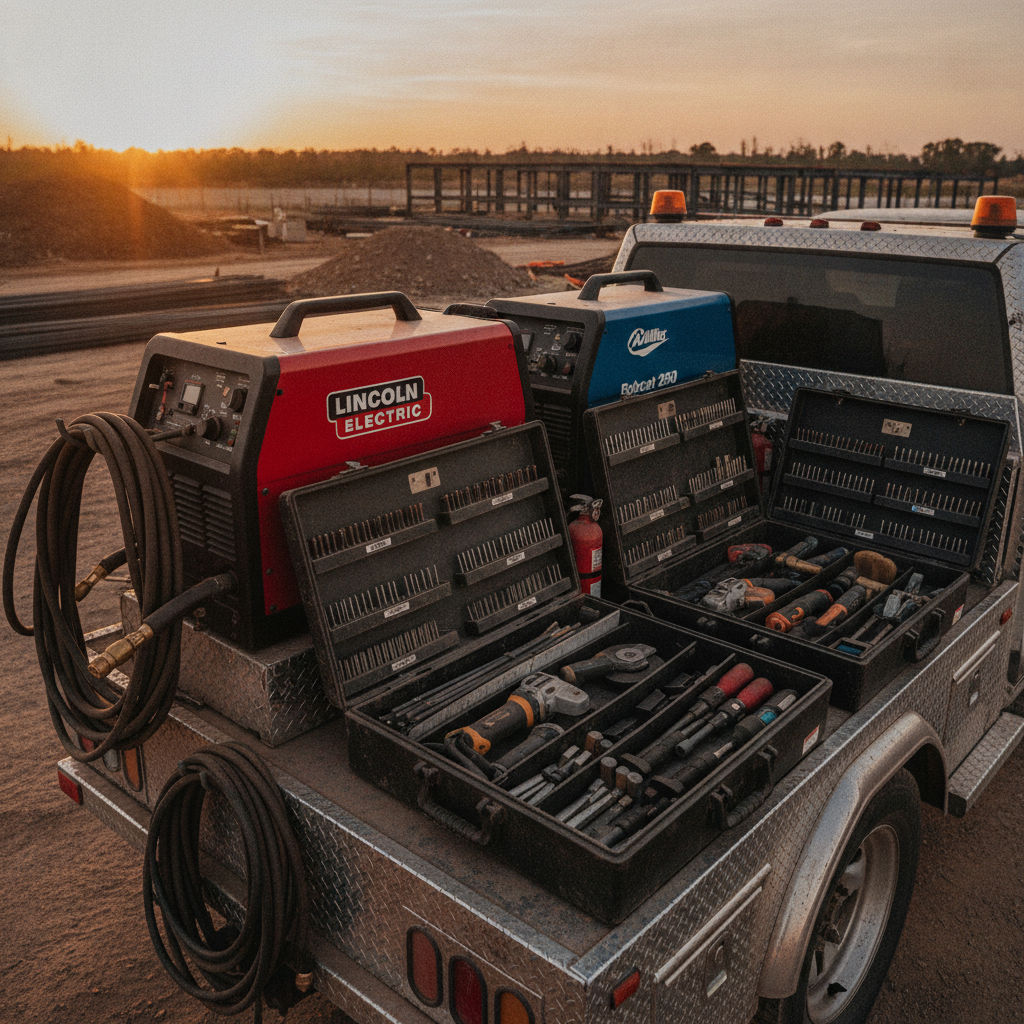
If your mobile rig organization looks like a hardware store exploded in the back of a truck, you already know the feeling. You pull up to a job, the customer is watching, and you spend the next twenty minutes digging through a pile of leads, fittings, grinders, and mystery bolts just to find your electrode holder. That time isn’t free. You’re eating it. Every single job.
This post is for the guy who’s done good work for years but whose truck setup still looks like day one. We’re going to talk about the specific mistakes that bleed time and money out of your operation — and what to actually do about it.
No fluff. No listicles from someone who’s never welded outside a shop. Just straight talk from someone who’s been there.
Why Mobile Rig Organization Is a Business Problem, Not a Comfort Problem
Let’s get one thing straight. This isn’t about being tidy. This is about money.
Say you waste 15 minutes per job digging around your rig. That’s nothing, right? Run five jobs a week and that’s over an hour of unbillable time gone. At $85 an hour — and you should be charging more than that — you just threw away $85 a week. That’s $4,400 a year. For being disorganized.
That number gets your attention, doesn’t it?
And that’s before you factor in the jobs where you show up and realize you left something critical at the shop. Or the time you spent buying a replacement fitting because you couldn’t find the one you already owned. Bad mobile rig organization compounds. It doesn’t just waste time — it makes you look unprofessional, which costs you repeat business.
If you’re trying to build a serious mobile welding operation, check out From Garage to Shop for a bigger picture look at how the little operational stuff stacks up into real business outcomes.
Mistake #1: No System for Your Leads and Cables
This is the number one time killer on most rigs. Welding leads piled in a heap, tangled around themselves, wrapped around a grinder cord, probably tied to a gas hose somehow. You know what I’m talking about.
Every time you go to pull your lead out, you’re fighting it. You lose five minutes just getting set up. Then at the end of the job, you throw it back in because you’re tired and you don’t want to deal with it. Next job, same fight.
Fix it with dedicated lead storage. That means a real coil system — over-under wrapping so it doesn’t kink — and a consistent place on the rig where it lives. Some guys use heavy-duty hooks bolted to the side wall. Some guys use a dedicated drawer or tray. Whatever works for your setup, commit to it and use it every single time.
Same goes for your ground cable. It doesn’t get to live on the floor. Give it a home and put it there after every job.
Mistake #2: Consumables Are Nowhere and Everywhere at Once
You’ve got three half-used boxes of 7018 in different spots. Your contact tips are loose in a cup holder. Your wire spools are rolling around in the back. And when you actually need a specific rod or tip size, you can’t find it quickly because there’s no logical system.
Consumables need a dedicated, labeled home. Period.
Get a small drawer unit — the kind that bolts down — and dedicate it entirely to consumables. One section for stick electrodes by type and size, stored in sealed containers if you’re in a humid area. One section for contact tips organized by size. One section for wire-related stuff. Label everything, even if it feels stupid. Future you at 7am on a cold morning will thank present you.
If you run multiple processes — and a lot of mobile guys do — being organized with your consumables is even more critical. The last thing you need is hunting for the right tip when you’re switching between processes mid-job. Speaking of running multiple processes out of one rig, the Field-Ready Multi-Process Welders post covers equipment choices worth knowing about.
Mistake #3: Your Gas Setup Is an Afterthought
Cylinders rolling around in the truck bed. Regulators banging against the toolbox. Hoses coiled on top of a gas bottle. This is how you damage expensive equipment and how you show up to a job with a regulator that leaks because it got whacked on the way over.
Secure your cylinders. Not “kind of” secure — actually secure with proper brackets or a chain system designed for the purpose. They shouldn’t move. They shouldn’t tip. They definitely shouldn’t be rolling loose in a truck bed.
Your regulator gets removed or protected during transport. Either take it off and store it in a padded case, or at minimum build a simple steel bracket that keeps it from getting hit. Five-dollar solution to a hundred-dollar problem.
Hoses get coiled and hung, not thrown in a pile. A few cheap hose hooks on the wall of your truck box solve this completely. If you want to get serious about gas management on a mobile rig, the Smart Shielding Gas Management post has some useful depth on this.
Mistake #4: PPE Has No Dedicated Home
Your helmet is on the seat. Your gloves are on the dash. Your grinding shield is somewhere. Your ear plugs are probably in your pocket from last week. You know this setup. We’ve all been there.
PPE needs hooks and spots, not random horizontal surfaces. A helmet hook — literally just a bolt with a large washer — takes ten minutes to install and means your helmet always lives in one place. Same for gloves: a simple clip or hook on the inside of the truck door. Grinding shield goes on its own peg.
When your PPE has a home, you stop doing the pre-job scramble. You reach, you grab, you’re ready. That’s the goal.
This also matters for the professional image piece. When a customer walks up and you’re organized — helmet on the hook, gloves ready, everything in its place — you look like someone who does this for a living. Not someone who does it as a side hustle between other things.
Mistake #5: Tools Are Thrown In, Not Organized Out
Most mobile welders carry way too many tools that they never use on the job, and the ones they use every day are buried under everything else.
Do an honest audit of what actually comes off your truck on a typical job. Angle grinders, wire brushes, clamps, chipping hammer, tape measure, square, marker, maybe a die grinder. That’s probably 80% of what you reach for. Those tools should be the most accessible things on your rig — front of drawers, top of toolboxes, easy grab.
Everything else — specialty tools, backup equipment, rarely used stuff — goes toward the back or bottom. Accessible, but not in the way.
Your grinders especially need dedicated spots. Most mobile welders use two or three grinders at a time with different discs set up. Give each one a spot. Don’t let them pile up in a bin where you’re pulling one out and three come with it.
Mistake #6: No Standard Setup Routine
This one’s less about the physical truck and more about habit. Even with a well-organized rig, some guys still waste time because they have no consistent setup sequence.
Build a mental — or physical — checklist for arriving at a job. Same order every time. Chock the wheels. Set the parking brake. Pop the truck box. Pull the welder forward. Set up gas. Run the lead out. Set up your work area. That sequence takes the same amount of time whether you’re thinking about it or not, but doing it in the same order every time means you never forget a step and you never backtrack.
Same thing at the end of a job. A shutdown sequence keeps you from leaving gear behind or throwing things back in without stowing them properly. Which brings you right back to organized for the next job.
If you’re thinking about the bigger business efficiency picture, Smart Heat Maps for Startups is worth a read for understanding where your time and resources are actually going in your operation.
Mistake #7: Your Truck Box Layout Has Never Been Intentionally Designed
This is maybe the root cause of everything else. Most guys load their truck based on what fits, not what makes sense. The first time they set up the rig, stuff went in wherever there was room. And it’s been that way ever since.
Spend a Saturday redesigning your layout from scratch. Seriously. Pull everything out, lay it on the ground, and think about workflow. What do you touch first when you arrive at a job? That stuff lives at the front, within easy reach. What do you touch last? It can be deeper in.
Think about weight distribution too. Heavy stuff low and toward the rear axle. Light stuff up top. This matters for how the truck handles, especially if you’re running a heavy welder and full gas bottles.
Install the right storage for what you actually carry. That might mean a drawer unit, wall-mounted tool holders, cylinder brackets, overhead shelf for lightweight stuff. Every piece of gear should have a designed spot, not just a place it ended up.
The Real Cost of Getting This Wrong
We already did the math on wasted minutes per job. But there’s a harder cost to think about.
When you look disorganized, customers notice. They might not say anything, but they’re forming an opinion about whether you know what you’re doing. A guy who shows up with a sorted rig, grabs what he needs without hunting, and gets straight to work looks like a pro. A guy who spends the first twenty minutes reorganizing his truck looks like he’s figuring it out.
In a service business, confidence and competence are the product. Mobile rig organization is part of how you communicate both of those things before you ever strike an arc.
If you’re still building out your mobile operation and thinking through what to charge, take a look at Pricing for Certification Services — some of the same logic about presenting value applies to everyday mobile work too.
Quick Wins You Can Do This Weekend
You don’t have to rebuild the whole rig in one shot. Here’s what actually moves the needle fastest:
- Install lead hooks. Two heavy hooks, fifteen minutes, done. Your leads stop living on the floor.
- Get a cylinder chain or bracket. Your bottles stop moving. Your regulators stop getting beaten up.
- Buy one small drawer unit and dedicate it to consumables. Label it. Fill it organized. Stick to it.
- Put a helmet hook on the wall inside your truck box. Helmet has a home. You stop sitting on it.
- Audit your tools and pull out everything you haven’t used in six months. Less junk means faster finds.
None of that costs more than a hundred bucks total. All of it saves you time on every job you do from here on out.
If You’re Just Starting Out
If you’re still in the early stages of setting up your mobile operation, do yourself a favor and get the rig organized before bad habits set in. It’s ten times easier to build a good system from scratch than to fix years of chaos.
Think about your equipment choices too. The right welder for a mobile rig — one that’s compact, multi-process capable, and reliable in field conditions — makes mobile rig organization easier because you’re not compensating for equipment limitations. The Field-Ready Battery Welders post is worth a look if you’re evaluating your power options for remote work.
And if you haven’t figured out your niche yet — meaning you’re trying to do every job for every customer — that’s worth sorting out too. A defined service focus means more predictable equipment needs, which means a more organized rig. Check out Strategic Niches for a starting point on that conversation.
Bottom Line
A disorganized rig is a self-imposed tax on every job you run. It costs you time, it costs you money, and it costs you the professional image that gets you repeat business and referrals.
Mobile rig organization isn’t complicated. It’s just not a priority for most guys until they do the math and realize how much it’s actually costing them. Now you’ve done the math.
Spend a weekend sorting it out. Build a system. Stick to it. Then show up to the next job and actually get to work instead of doing a treasure hunt through your own truck.
Your hourly rate will thank you.