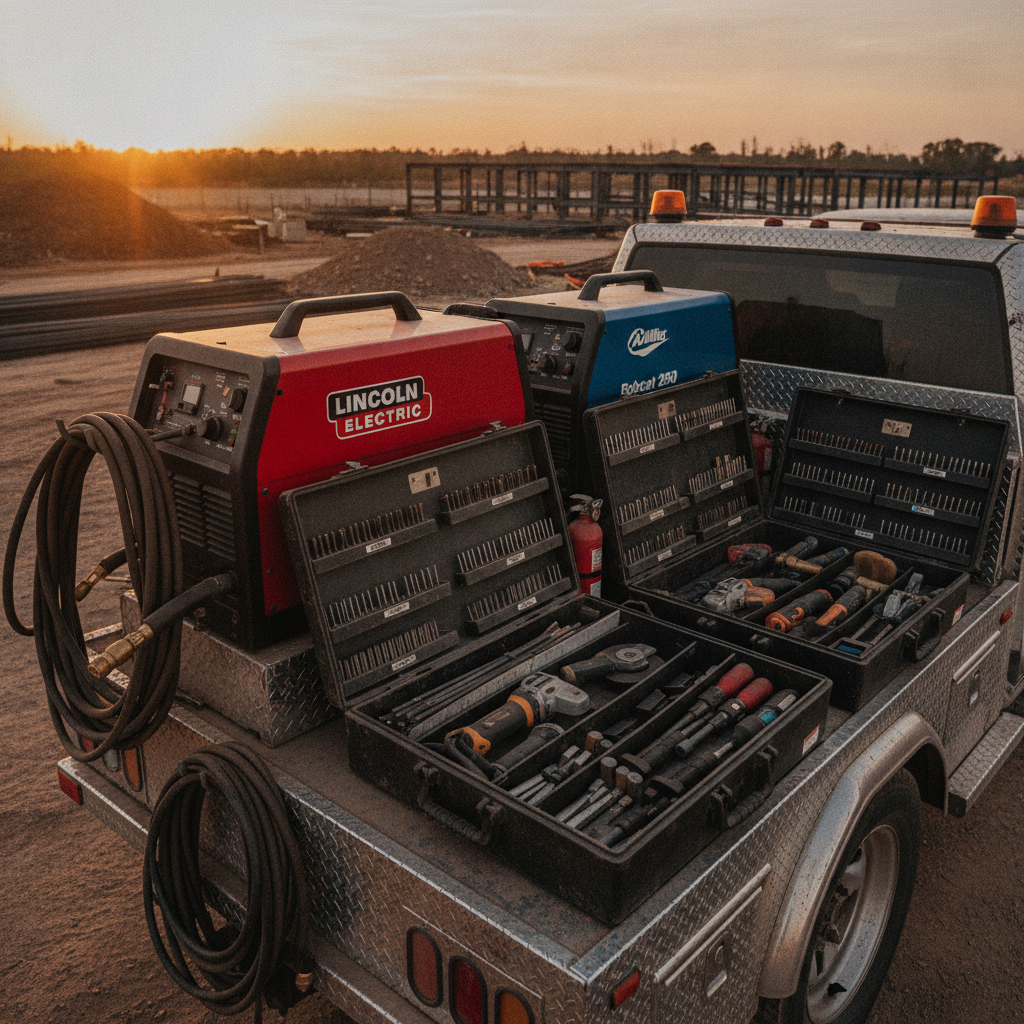
If your mobile welder truck setup looks like a hardware store threw up in the back of a flatbed, you’ve got a problem. Not a “someday I’ll clean that up” problem. A real, dollars-out-of-your-pocket problem that’s hitting you every single day you work. You’re digging through a pile of fittings, grinding discs, and mystery wire for twenty minutes before you strike your first arc — and that time isn’t billable. It’s just gone. This post is about fixing that. Practical changes to how your rig is loaded, organized, and maintained so you stop bleeding time before the job even starts.
Why Mobile Welder Truck Setup Actually Matters
Here’s the thing most guys won’t admit: a messy truck is a business problem, not just an annoyance. When you show up to a job and spend the first half hour wrestling with your equipment, the customer sees that. They’re watching. And what they’re thinking isn’t “oh, he’s a real working welder.” What they’re thinking is “why does this guy look like he doesn’t know where anything is?”
First impressions on a jobsite are brutal. You either look like someone who has done this a thousand times, or you look like a guy who just bought a welder last month. The difference usually isn’t skill. It’s preparation.
Beyond appearances, there’s the pure math of it. If you lose 30 minutes per job to setup inefficiency, and you run four jobs a week, that’s two hours of lost time every week. At $100 an hour, that’s $200 a week evaporating. Over a year? You just handed over ten grand because your truck is disorganized. That math should bother you.
If you’re still figuring out your pricing structure for mobile work, take a look at this breakdown on pricing for certification services — the same logic about protecting your billable hours applies directly to field work.
Mistake #1: No Dedicated Spots for Consumables
This is the big one. Consumables — tips, nozzles, wire, electrodes, grinding discs — have a way of ending up everywhere. In the toolbox, on the floor of the cab, wedged behind the gas cylinders, rolling around loose in the truck bed. Then when you need a fresh tip mid-job, you’re tearing the whole rig apart.
Fix it with dedicated storage. Get a drawer unit or a compartmentalized box that lives in the same spot every single time. Label it if you have to. The point is that your hand should be able to go directly to what you need without your brain having to engage. That’s muscle memory, and it’s worth building.
Organize consumables by process if you run multiple. Field-ready multi-process welders are more common than ever, which is great for versatility — but it also means you’ve got twice the consumable inventory to manage. Keep it separated. MIG stuff in one section, Stick gear in another. Don’t mix them unless you enjoy frustration.
Restock as part of your end-of-day routine, not when you’re already at a job and short on supplies. Run out of a tip on a customer’s site and you look like a rookie. It doesn’t matter how good your bead is.
Mistake #2: Gas Cylinders That Aren’t Secured Properly
This one is both a safety issue and an efficiency issue, so it gets its own section. Cylinders rolling around in your truck bed or slapping against your equipment is a problem on about five different levels. The obvious one is safety — a valve gets knocked off and you’ve got a rocket. The less obvious one is that unsecured cylinders damage your equipment, your truck, and your professional reputation.
Get proper cylinder racks or mounts that are bolted to the truck bed. Chain everything. Every single time. This isn’t the place to cut corners because you’re in a hurry. It takes thirty seconds to chain a cylinder and it can save your life, your truck, and the lawsuit that follows a preventable accident.
Also, know what you have. Keep a running inventory of your cylinder status — full, partial, empty — and rotate them properly. Running out of shielding gas at a job because you grabbed the empty cylinder by mistake is a completely avoidable disaster. If you want to get smarter about gas management in the field, smart shielding gas management is worth a read.
Mistake #3: Your Leads Are a Disaster
Tangled leads are the tax you pay for not coiling them properly the first time. Every time. Without exception. You know the feeling — you pull one end and the whole thing just locks up into a knot that takes five minutes to sort out. Meanwhile the customer is standing there watching you fight your own equipment.
Coil your leads correctly after every job. Use the over-under method if you don’t already. Hang them on proper hooks or racks on the truck, not just thrown in a pile. Velcro straps or cable ties can help keep things together if you’ve got multiple leads.
Check your lead connections regularly. A loose or corroded connection at the stinger or ground clamp is a voltage drop waiting to happen. Your arc suffers, you start chasing problems that aren’t actually in your machine settings, and you waste time troubleshooting something that should have been caught during a thirty-second pre-job check.
Length matters too. Carry what you need, not every lead you own. Too much lead on the ground is extra resistance and extra trip hazard. Know the typical distances at your common job types and size accordingly.
Mistake #4: Tools With No Home
Your angle grinder, your chipping hammer, your wire brush, your clamps — every single tool on your truck needs a designated spot. If it doesn’t have a home, it will end up somewhere different every day and you will spend time finding it every day. That’s the deal.
Shadow boards work great for this if you’ve got a proper enclosed setup. Pegboards inside a utility bed are popular and cheap. The key is that you can look at the board and immediately see what’s missing. That’s faster than digging and faster than trying to remember where you put something.
Think about frequency of use when you’re assigning spots. Tools you reach for ten times a day should be at arm level, easy to grab. Tools you use once a month can go deeper in the storage. This sounds obvious, but most guys don’t actually think it through — they just shove things wherever they fit.
Mistake #5: No Pre-Job Checklist
This is the one that separates the guys who’ve been doing this a few years from the guys who’ve been doing it seriously. A pre-job checklist isn’t bureaucracy. It’s the thing that keeps you from driving forty minutes to a job and realizing you left your ground clamp at the last site.
Your checklist doesn’t have to be complicated. It should cover the basics: machine settings verified, consumables stocked, leads connected and checked, gas cylinder secured and on, all required tools present, PPE accounted for. Run it before you leave the shop or driveway, not when you’re already at the customer’s location.
If you’re building out a mobile welding business from the ground up, the same discipline that goes into a job checklist applies to your business planning. Starting from a garage operation requires that kind of systematic thinking from day one.
A checklist also helps at the end of a job. Pack-out list, basically. Did you leave anything? Did you take anything that belongs to the customer’s site? Did you leave the work area cleaner than you found it? These things matter for repeat business.
Mistake #6: The Truck Itself Is the Problem
Sometimes the rig is just not set up right for the work you’re doing. The wrong truck, the wrong bed configuration, storage that doesn’t match your workflow. This is a harder problem to fix because it usually involves money, but it’s worth being honest about.
If you’re running a flatbed and doing a lot of tight site work, you might need a utility bed. If you’re running a utility bed and doing a lot of pipe work, maybe you need more horizontal storage. The point is that your truck should be set up around what you actually do, not just whatever you happened to start with.
If you’re at the stage where you’re thinking about upgrading your equipment to match the work you want to be doing, it’s worth reading about strategic niches for mobile welders — because the work you specialize in should absolutely drive how your rig is configured.
Battery-powered machines are also changing what’s possible for mobile setups. No generator, lighter load, more flexibility on placement. Field-ready battery welders have come a long way and might be worth considering if your current power setup is giving you headaches on site.
Mistake #7: Maintenance Gets Ignored Until Something Breaks
Your mobile welder truck setup is only as reliable as the equipment in it. Running a machine that skips, a truck that rattles, or leads that are cracked and patched together is borrowing against future downtime. Eventually it comes due, usually at the worst possible time.
Build a simple maintenance schedule. Machine serviced on a regular interval. Truck maintained before problems develop. Leads and clamps inspected weekly. Cylinders swapped on a rotation. None of this is complicated, but it does require the discipline to actually do it instead of pushing it off.
Downtime on a mobile welding rig isn’t just inconvenient — it’s expensive. You miss jobs, you let customers down, and you scramble to rent equipment or borrow from someone else. Preventive maintenance is always cheaper than emergency repairs. Always.
What a Good Setup Actually Looks Like
A well-organized mobile welder truck setup isn’t fancy. It’s functional. Everything has a spot. You can find what you need in the dark. The machine is mounted securely and accessible. Cylinders are chained and labeled. Leads are coiled and hung properly. Consumables are stocked and organized. Tools are in their places.
When you show up to a job with a rig like that, you pull up, unload what you need efficiently, and you’re ready to work in under ten minutes. That’s what professional looks like in the field. Not a shiny truck. Not the most expensive machine. A setup that works, run by someone who respects their own time enough to stay organized.
If you’re serious about building a mobile welding business that lasts, the truck setup is where the rubber meets the road. Literally. Investing carefully in your setup from the start saves you from expensive fixes and lost time down the road.
The Bottom Line on Mobile Welder Truck Setup
None of what’s covered here is difficult. That’s kind of the point. The mistakes that slow down your jobs aren’t technical mysteries — they’re just habits you haven’t fixed yet. A place for everything. Leads coiled right. Consumables stocked. Cylinders secured. Checklist run before you leave.
You spent years getting good at welding. Don’t let a messy truck be the thing that makes you look like you don’t have it together. Your time is valuable. Your reputation is valuable. Treat them both like it.
The welder who shows up organized, works efficiently, and leaves the site clean gets called back. The guy digging through junk for twenty minutes before he starts? He might do great work too — but nobody’s sure of that yet because they’re too busy watching him search for his ground clamp.
Get the truck right. The rest gets easier from there.