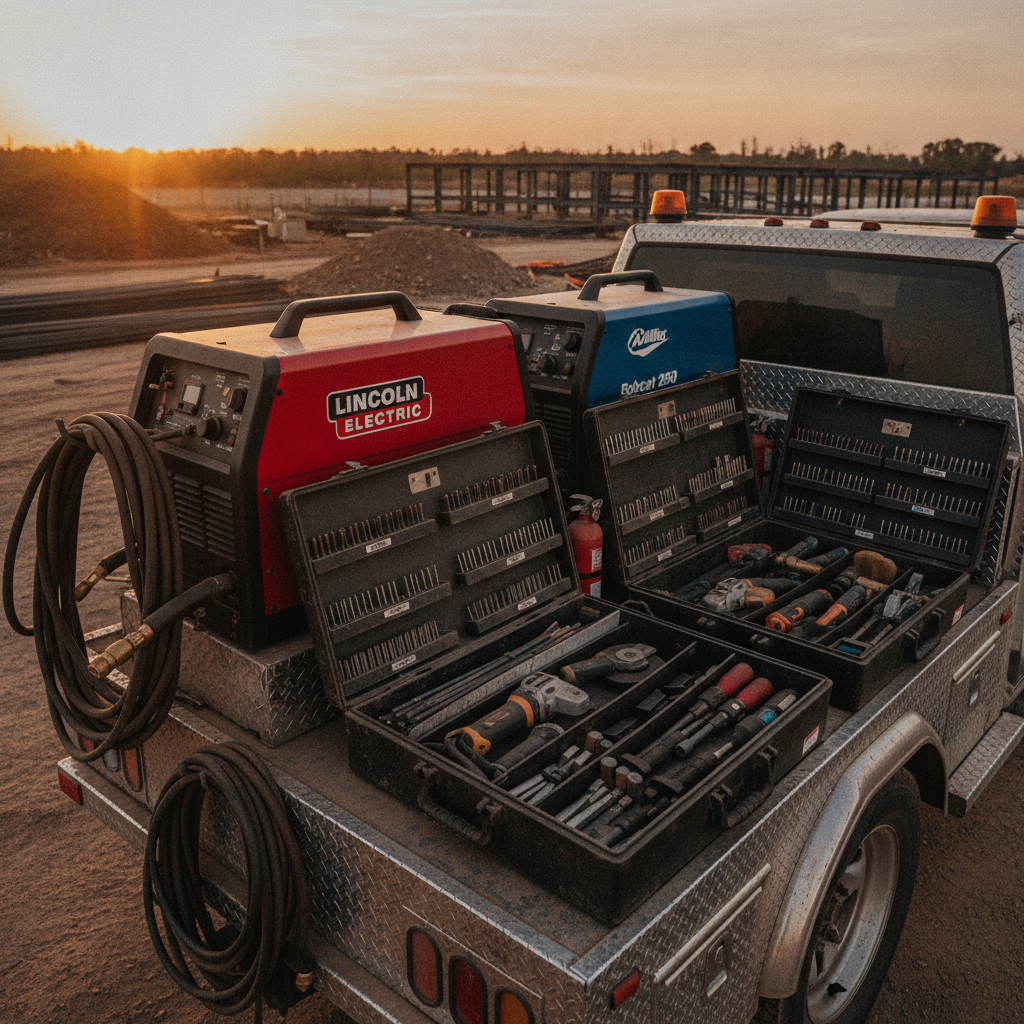
Here’s a scenario you’ve probably lived: you pull up to a job, the customer’s standing there watching, and you spend the next fifteen minutes digging through your truck bed like you’re looking for lost luggage. Your mobile rig setup has you completely defeated before you’ve even touched a stinger. That wasted time isn’t just embarrassing — it’s coming directly out of your hourly rate. If you’re billing $125 an hour and you’re burning 20 minutes every morning fumbling around your rig, that’s money you’re handing back to the customer for free. Nobody’s paying you to excavate your own truck.
I’ve been running a mobile welding operation for over a decade. I’ve made every one of these mistakes personally. Some of them I made for years before I got tired of losing money. This post is the conversation I wish someone had with me back when I was still using my truck bed as a rolling dumpster. Let’s get into it.
Why Your Mobile Rig Setup Is Costing You More Than You Think
Most guys think of a messy truck as just an inconvenience. It’s not. It’s a billing problem. Every minute you’re not welding on a time-and-materials job is a minute you either absorb into overhead or try to bill for — and good luck billing a customer for the time you spent searching for your wire brush.
On flat-rate jobs, it’s even worse. You quoted that job assuming a certain labor time. When your mobile rig setup adds 30 to 45 minutes of friction per day, your effective hourly rate drops fast. If you want to run a real business — not just a job where you own the tools — you need to treat setup time like it’s billable. Because in a sense, it is.
Think about it this way: if you’re running five jobs a week and wasting 20 minutes per job digging around your rig, that’s over an hour and a half of lost productivity weekly. That’s close to 75 hours a year. At even $100 an hour, you’ve just left $7,500 on the table because you couldn’t find your contact tips.
If you’re still figuring out how to price your services to account for real overhead like this, take a look at this breakdown on pricing for certification services — the same logic applies to how you price everyday field work.
Mistake #1: No Dedicated Home for Every Single Item
This is the big one. If something on your truck doesn’t have a fixed, permanent home, it will end up somewhere random. Every time. That’s just physics. The solution isn’t to “be more organized.” The solution is to engineer your rig so that every piece of equipment, every consumable, and every tool has one place it always lives.
Start with your most-used items. Contact tips, wire, grinding discs, chipping hammer, wire brush, clamps — these things should be reachable in under ten seconds without looking. If you’re digging through a toolbox drawer for your chipping hammer on every job, you’re doing it wrong. Mount a magnetic strip. Add a small tray. Do something intentional.
Dedicated storage isn’t about being fancy. It’s about removing decision-making from your morning routine. When everything has a home, you stop thinking about where things are. You just grab them and go.
What to Prioritize First
Break your equipment into three categories:
- Every-job items: These need to be the most accessible. Wire, consumables, leads, PPE, angle grinder.
- Most-job items: Clamps, squares, magnets, marking tools. Dedicated drawer or tray.
- Occasional items: Specialty tools, backup parts, less-common consumables. These can be deeper in the rig.
This three-tier system alone will cut your average setup time significantly. Stop treating your truck like a storage unit and start treating it like a workspace.
Mistake #2: Leads Thrown in Loose
You already know what happens. You throw the leads in at the end of the day because you’re tired and just want to go home. Next morning, you’ve got a tangled mess that takes five minutes to sort out before you can even set up. Multiply that by 250 working days and you’ve got a genuine time-theft problem.
Coil your leads properly and hang them. Every time. Yes, even when you’re tired. Install lead hooks or a lead rack on your rig — they’re cheap, they take an afternoon to set up, and they pay for themselves in the first week.
Proper lead storage also extends the life of your cables. Bent, kinked leads develop internal wire breaks. That means resistance problems, heat buildup, and eventually a failed lead mid-job. If you want to understand more about how cable quality affects your weld arc, this piece on smart arc monitoring is worth a read — it gets into the technical side of arc consistency in field conditions.
Mistake #3: Gas Cylinders Not Secured or Organized
Unsecured cylinders are a safety issue first and an efficiency issue second. If you’re still just laying a cylinder in the truck bed and hoping it doesn’t roll around, you’ve already lost the argument on this one. Get proper cylinder holders — welded to the truck or bed-mounted. Period.
Beyond safety, organize your cylinders by use. If you run multiple processes or gases, label everything clearly and keep full cylinders separated from empties. There is nothing more aggravating than dragging out a cylinder, hooking it up, and realizing it’s empty. If you’re managing multiple gas types across jobs, this guide on smart shielding gas management has some genuinely useful field-level strategies.
Mistake #4: Your Welder Is Buried
Your welding machine is your moneymaker. It should be accessible, protected, and ideally the centerpiece of your rig layout — not the thing you have to move three other things to get to. If you’re fighting your own rig to access your machine’s settings, wire feed, or polarity switches mid-job, your layout is backwards.
Think about what you access on your machine most often. Control panel, wire compartment, polarity connections. All of that needs to be reachable without climbing into the truck bed or moving gear. If you’re spec’ing a new machine for field work, this post on field-ready multi-process welders breaks down what to look for in a unit that’s built for mobile use.
Machine Positioning on the Rig
Most guys put the welder at the front of the truck bed for weight distribution — and that makes sense. But make sure you’ve got clearance to open the wire compartment, access polarity terminals, and read the control panel without contorting yourself. If your current layout forces you to do a yoga pose to check your wire feed tension, rethink the position.
Also consider your power source access. Whether you’re running off a generator, a welder/generator combo, or a hybrid battery-powered setup, that power source needs to be just as accessible as the machine itself.
Mistake #5: Consumables Scattered or Understocked
Running out of contact tips on a job is embarrassing. Finding out your wire spool is almost empty when you’re 45 minutes from the nearest supply house is worse. Your rig should carry enough consumables to finish any standard job without a supply run. That means:
- At least one full spare spool of your most common wire
- A full box of contact tips in every size you run
- Spare nozzles, liners, and diffusers
- Extra grinding and cutting discs
- Backup PPE — at minimum, spare lenses and gloves
Keep a restock checklist in the truck. Every Friday, or after every large job, run through it. This isn’t complicated. It’s just the habit of treating your rig like a professional operation instead of winging it every morning.
Mistake #6: No System for Job-Specific Prep
Here’s one most guys overlook. When you know what’s on tomorrow’s schedule, your mobile rig setup should reflect that before you go to bed. If you’re doing aluminum tomorrow, your 4043 wire and argon cylinder should be ready to go tonight — not something you’re reconfiguring in the customer’s driveway at 7am.
This gets especially relevant if you’re doing multi-material work or switching between processes frequently. The more variety in your work, the more intentional your pre-job prep needs to be. If you’re branching into dissimilar metal work, check out this post on dissimilar-metal welding mastery for process-specific considerations that affect how you configure your rig.
A two-minute end-of-day review of tomorrow’s jobs and what needs to be staged differently can save you significant time the next morning. Write it down. Make it a habit.
Mistake #7: No Visual System on the Truck
Labels sound boring. Veteran welders will tell you they don’t need labels because they know where everything is. And then they spend three minutes looking for the extra tip adapter they swear they put right there. Labels, color coding, and visual organization aren’t for beginners — they’re for anyone who wants to run a tight, efficient operation.
Label your drawers. Label your bins. Color-code your leads if you run multiple machines. Put a laminated checklist inside a cabinet door. These are the kinds of systems that take an hour to implement and save you time every single day afterward.
If you’re thinking about growing beyond a one-truck operation or bringing on help, a visual system becomes even more critical. A helper can’t learn your system if your system only exists in your head. For more on scaling a mobile welding business intelligently, this piece on strategic niches is worth your time.
The Bottom Line on Mobile Rig Setup
Your truck is your shop. The difference between a guy who shows up and immediately looks competent versus a guy who looks like he’s still figuring it out is almost always the condition and organization of his rig. Customers notice. They may not say anything, but they notice.
More importantly, you notice. When your mobile rig setup is tight, you feel different pulling onto a job. You’re not stressed before you start. You’re not burning time you’re not getting paid for. You’re just ready to work.
None of this requires a huge investment. A few afternoons of rethinking your layout, some hooks and brackets, a labeler, and a restocking habit. That’s it. Small changes to how your truck is loaded will absolutely shave real hours off a week’s worth of jobs — and every one of those hours goes right back into your pocket.
Fix the rig. Stop digging. Go weld.