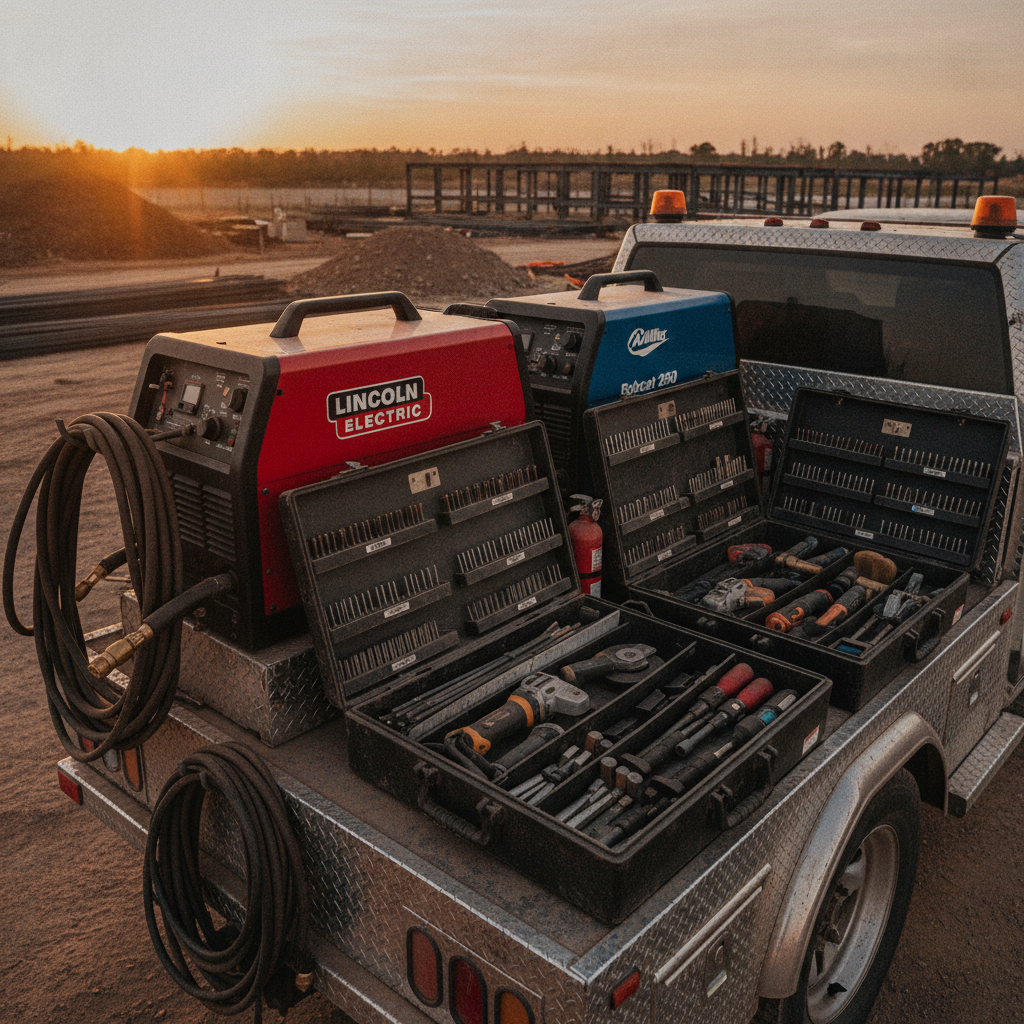
Let me paint you a picture. You pull up to a job, customer’s standing there watching, and you spend the next twenty-five minutes digging through your truck bed like a raccoon in a dumpster looking for your 4.5-inch grinding wheel. Your mobile welder truck setup just cost you money — again. Not because the job was hard. Because you couldn’t find your stuff. If that sounds familiar, this post is for you.
I’ve been running a mobile rig for over a decade. I’ve made every one of these mistakes personally. Some of them more than once, which is embarrassing to admit but useful for you to hear. The good news is that rig organization isn’t complicated. It just takes some intentional thought, a Saturday afternoon, and the willingness to stop pretending your current system is working.
Small changes to how your truck is loaded can shave real hours off a week’s worth of jobs. That translates directly to more billable time, or just getting home before dark. Both are wins.
Why Your Mobile Welder Truck Setup Is Costing You More Than You Think
Here’s the math nobody wants to do. You charge $95 an hour. You waste 20 minutes per job digging around for gear. You run 4 jobs a day. That’s 80 minutes of unbillable fumbling. At your rate, that’s roughly $127 a day. Five days a week, that’s over $600 a week walking out the door because your rod cans are buried under a come-along and two lengths of half-inch pipe.
And that’s just the time cost. There’s also the credibility cost. Customers notice. They don’t say anything, but they notice. A guy who rolls up and has his rig dialed in looks like he’s done this before. A guy who’s pulling tarps off a pile of mismatched junk looks like a gamble.
The goal of good rig organization isn’t to be pretty. It’s to be fast and to look like you’re worth what you’re charging. If you’re still figuring out your rates, by the way, there’s a solid breakdown worth reading over at pricing for certification services that covers how to think about what your time is actually worth.
Mistake #1: No Zone System
This is the big one. Most guys just load their truck based on what fit where when they were in a hurry. Over time it becomes a geological record of every job they’ve worked — layers of wire, tools, filler metal, and random hardware with no logic to any of it.
A zone system means your truck has defined areas for defined categories of gear. Here’s a simple version that works on most pickups or flatbeds:
- Zone 1 — Daily drivers: The stuff you touch on every single job. PPE, angle grinders, tape measure, soapstone, clamps. This lives closest to you, most accessible, ideally right at the tailgate or in a side-opening box.
- Zone 2 — Process-specific gear: Your MIG guns, TIG torch, stick leads, and consumables for each process. Organized by process, not thrown together.
- Zone 3 — Heavy and rarely moved: Machines, gas cylinders, heavy toolboxes. These live toward the cab, low, for weight distribution and because you don’t grab them every ten minutes.
- Zone 4 — Job-specific materials: Steel, pipe, odd stock. This changes job to job. Give it a designated spot so it doesn’t sprawl into your other zones.
Once you have zones, everything has a home. When something isn’t in its home, you know immediately. That’s the whole game.
Mistake #2: Cables Stored Like Spaghetti
Welding cables are a recurring nightmare on most rigs. They tangle, they kink, they hide under everything else, and then you’re standing there in the mud wrestling with 50 feet of 2/0 like it personally wronged you.
Fix this with dedicated cable storage. A few options that actually work in the field:
Cable reels: Mounted to the side of the bed or a rack, these are ideal if you can swing it. You pull what you need, you reel it back. Clean, fast, no tangles.
Large figure-eight coils on hooks: If reels aren’t in your budget right now, train yourself to coil cables properly and hang them on dedicated hooks. Not draped over the machine. On hooks. Every time.
Separate bags by process: Keep your MIG cable, your stick leads, and your TIG torch in separate bags or boxes. When you know you’re running stick all day, you pull that bag. You’re not untangling TIG leads to get to your electrode holder.
This one change alone probably saves most guys 10 minutes a day. Over a work week, that’s almost an hour back in your pocket.
Mistake #3: Consumables Scattered Everywhere
I’ve found 6011 in three different spots on a rig before. That’s not a storage system. That’s a treasure hunt.
Filler metal and consumables need a single, dedicated location. A rod oven if you’re doing structural work and need to keep low-hydrogen electrodes dry. A labeled metal box or drawer system if you’re running a variety of processes and filler types. The key is that when you need 0.035 ER70S-6, you go to one place. You don’t check four spots and then remember you left it in the cab.
Label everything. I know that sounds like something your shop teacher said, but it works. When you’re dealing with multiple wire diameters, multiple alloys, and multiple rod types across different jobs, labels save you from expensive mistakes. Running the wrong filler on the wrong material is a bad day, and it’s exactly the kind of thing that happens when your consumables are a mess.
If you’re working across different materials regularly, the principles in dissimilar-metal welding mastery are worth a read — and having your consumables properly sorted makes switching between them a lot less painful.
Mistake #4: Machines Not Secured or Positioned Right
Your welder is the most expensive thing on your truck. Treating it like it’s just sitting there is how you end up with a cracked case, a damaged wire feeder, or worse — something that shifts and damages something else in transit.
Machines should be bolted down or strapped down. Every time. Not just when you remember. If your current setup doesn’t have a clean mounting solution, that’s worth fixing before anything else on this list, because a $3,000 machine bouncing around is a bigger problem than cables being tangled.
Beyond security, think about positioning for workflow. Where does your machine need to be so that pulling lead is fast? So that you’re not walking back and forth more than necessary? On most rigs, having the machine accessible from the side of the truck — not buried behind everything else — cuts setup time significantly.
If you’re running a multi-process machine, make sure you’ve thought through how you access the different process connections. The field-ready multi-process welders post covers what to look for in machines built for this kind of work, which is relevant if you’re due for an upgrade.
Mistake #5: No Pre-Job and Post-Job Routine
Even a perfectly organized rig falls apart without a routine to maintain it. The guys who stay organized aren’t just naturally tidy people. They have a system they actually run.
A pre-job check takes five minutes. You walk the rig, confirm your consumables are stocked for today’s work, your PPE is where it belongs, your cables are ready, and your machine is set for the process you’re running. You do this in the driveway before you leave, not in the customer’s parking lot after they’ve walked out to meet you.
A post-job reset takes maybe ten minutes. Everything goes back to its zone. Cables get coiled and hung. Consumables get restocked from your backup supply. Notes get made on anything running low. You leave the job with a clean rig, not a rig that’s one more job away from chaos.
This is the same logic that applies to any well-run operation. Structure upfront saves scrambling later. If you’re building out your business systems and want to think bigger picture about where your time goes, the smart heat maps for startups post has a different angle on tracking where your hours actually end up.
Mistake #6: Gas Cylinders Handled Wrong
Cylinders are heavy, awkward, and dangerous if they’re not handled right. On a mobile rig, they also need to be secured for transport — this isn’t optional, it’s legally required in most places and just common sense in all of them.
A few things that make cylinder management less of a headache:
Dedicated cylinder rack or mount: Cylinders should be chained or strapped in a fixed position. They shouldn’t be rolling around the truck bed. A simple fabricated rack keeps them upright and secure without taking up more space than necessary.
Know your quantities: Running out of shielding gas mid-job is an amateur hour problem that happens to plenty of experienced guys. Check your cylinder levels before you leave for the day, not when you’re 45 minutes from the shop and halfway through a root pass. There’s a full breakdown on managing shielding gas more efficiently at smart shielding gas management that’s worth bookmarking.
Regulator protection: Regulators are expensive and fragile relative to everything else on the rig. Make sure yours aren’t getting banged around. A simple cover or a position that keeps them away from other equipment makes a real difference over time.
Mistake #7: Ignoring Weight Distribution
This one doesn’t affect how fast you find your grinder, but it affects how your truck drives, how your tires wear, and whether you’re overloading an axle without knowing it. It’s also a DOT issue if you’re over certain thresholds on a commercial vehicle.
Heavy gear — cylinders, machines, toolboxes — should be positioned over or forward of the rear axle, low, and centered side to side as much as possible. Tail-heavy loading makes your truck handle like garbage and puts stress on components it wasn’t designed to handle that way.
If you’ve never actually thought about your rig’s weight distribution, spend twenty minutes with a tape measure and a rough estimate of your gear weights. It matters more than most guys realize, especially if you’re running a 3/4-ton truck that’s loaded close to its limit most of the time.
The Payoff for Getting This Right
A dialed-in mobile welder truck setup isn’t about impressing anyone. It’s about running an efficient operation that respects your time and your customer’s time. When you pull up, pop open a box, grab exactly what you need, and start working — that’s the version of you that gets referrals. That’s the version that can take on more jobs without burning out.
The guys who’ve been doing this a long time all figure this out eventually. Some of them figure it out by watching years of wasted time add up. Others get intentional about it early and keep more of what they earn.
If you’re in the early stages of building your mobile welding business and thinking through bigger picture strategy, strategic niches for mobile welders is a good read for figuring out where to focus your energy. And if you’re thinking about what equipment belongs on your rig for the future, the hybrid battery-powered welders post is worth a look — battery technology is changing what’s practical to run mobile.
For now, take one Saturday and reorganize your rig with the zone system. Pick up some cable hooks. Label your consumables. Build the pre- and post-job routine. Give it two weeks. You’ll wonder why you waited this long to fix it.
Time you’re not wasting is money you’re actually keeping. That’s the whole point.