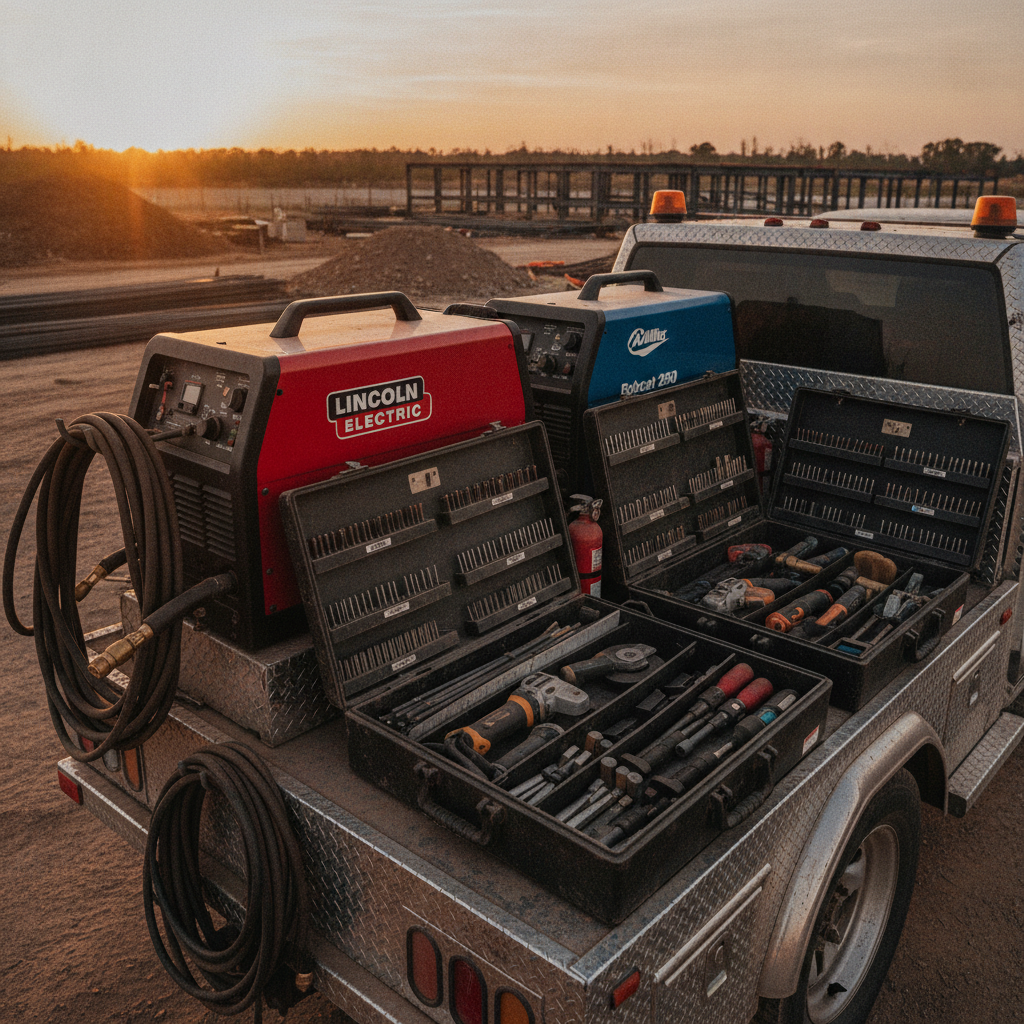
You know what’s a great way to lose money before you even burn a rod? Spend twenty minutes at a customer’s property digging through a pile of crap in the back of your truck trying to find your chipping hammer. Mobile rig organization — or the complete lack of it — is one of the fastest ways to bleed your hourly rate dry. And the worst part? Most guys don’t even notice it’s happening. It’s just “part of the job.” It’s not. It’s a habit, and habits can be fixed.
I’ve been running mobile welding rigs for over a decade. I’ve seen my own truck go from a rolling dumpster fire to something I can actually be proud to open in front of a customer. The difference wasn’t expensive. It wasn’t even that complicated. It was just intentional. This post is about the specific mistakes that slow you down, what to do instead, and why fixing your rig setup is one of the highest-return investments you can make in your business.
Why Your Truck Setup Is a Business Problem, Not Just an Annoyance
Let’s be honest with each other. If you’re running a mobile welding operation, your truck is your shop. It’s your first impression, your workspace, your parts department, and your mechanical support system all in one. When it’s disorganized, every single job pays the price.
Think about this: if you spend an average of 15 minutes per job hunting for gear, and you run 5 jobs a day, that’s 1.25 hours of lost time. At $100/hour, you just handed $125 back to the universe for free. Every day. That adds up to over $600 a week. Do that math over a month and you’ll feel sick.
Poor mobile rig organization doesn’t just cost you time. It costs you credibility. Customers notice when you’re fumbling around. They notice when your truck looks like a tornado hit a hardware store. And whether it’s fair or not, they make judgments about the quality of your work based on what they see before you even strike an arc.
If you’re in the process of building a business, or thinking about where your money and effort should go, check out the post on strategic niches for mobile welders — because your rig setup is directly tied to how well you can serve whatever niche you’re targeting. A cattle ranch emergency call and a structural repair job need different things immediately accessible.
Mistake #1: No Zones, No System
The biggest mobile rig organization mistake I see is the absence of any logical zone system. Everything just gets thrown in wherever it fits that day. Consumables mixed with hand tools. Cables tangled around cylinders. Safety gear buried under scrap metal from the last job you forgot to drop off.
Fix it by treating your truck bed or service body like a shop floor. Assign zones:
- Zone 1 — First Touch: The stuff you grab on every single job. Helmet, gloves, chipping hammer, wire brush, angle grinder. These live at the back edge, accessible in under 10 seconds.
- Zone 2 — Process Specific: MIG wire, stick rod, TIG filler — stored by process. You know what you’re running before you leave. That box should be pre-staged.
- Zone 3 — Support Equipment: Grinders, clamps, magnets, squares. Used often but not always the first thing you touch.
- Zone 4 — Deep Storage: Rarely used tools, spare parts, backup cables. Bottom drawer, back corner. You shouldn’t be digging through Zone 4 on a normal job.
This sounds obvious. I know. But I promise you, most guys reading this don’t actually have this. They have vibes and guesses. Build the zones once, maintain them daily, and your setup time drops immediately.
Mistake #2: Cables and Leads That Take 10 Minutes to Untangle
Welding leads are the worst offenders on a disorganized rig. You throw them in the truck after a job because you’re tired and you’ll “deal with it later.” Later never comes. Now they’re a knotted mess of copper and rubber that takes longer to sort out than the actual weld job.
There are a few simple fixes here that cost almost nothing:
First, get in the habit of coiling your leads properly — over-under method, not the death spiral that creates kinks. Second, use dedicated hooks or cord reels mounted inside your service body. Third, label your leads. Seriously. If you’re running multiple processes, knowing which lead is which before you grab it saves you from the stupid “wrong polarity” moment in front of a customer.
If you’re running a multi-process machine on your rig — and if you’re not, you should read about field-ready multi-process welders before your next equipment decision — then lead management becomes even more critical. You may have Stick leads, a MIG gun, a TIG torch, and a plasma lead all living in that truck. Without a system, it’s a nightmare.
Mistake #3: Consumables Stored Like an Afterthought
I’ve seen guys show up to a job and realize their 6010 rods got wet because they were rattling around the open truck bed all week. I’ve seen MIG wire spools corrode because they were stored loose in a toolbox with the lid that doesn’t seal right. I’ve seen flux-core wire pick up moisture and porosity become a customer complaint.
Consumable storage is not glamorous. Nobody talks about it at welding shows. But it directly affects your weld quality and your rework rate.
At minimum:
- Keep low-hydrogen electrodes in a rod oven or sealed rod canister in the truck — not loose in a box.
- Store wire spools in sealed plastic bins with a desiccant pack. Cheap and effective.
- Run a first-in, first-out system for consumables. Rotate stock like a grocery store. Old stuff gets used first.
- Keep a running inventory checklist on a clipboard or phone app so you know what you’re low on before you’re on a job 40 miles from the supply house.
If you’re doing specialty work — dissimilar metals, exotic alloys, anything outside basic carbon steel — your consumable storage game needs to be even tighter. The post on dissimilar-metal welding mastery covers why the right filler at the right time matters, and that only works if you can actually find the right filler in your truck.
Mistake #4: Gas Cylinders That Are a Hazard Waiting to Happen
Unsecured cylinders in a truck are not just an inconvenience. They’re a genuine safety issue and a liability problem. If you get rear-ended with an unsecured oxygen cylinder rolling around your truck bed, you are going to have a very bad day.
Beyond safety, loose cylinders that rattle around damage regulators, damage valves, and create leaks. And a leaking cylinder is either costing you money in wasted gas or, in the worst case, building up a dangerous concentration in an enclosed space.
Get proper cylinder racks welded or bolted into your service body. Chain them. Every time. This is not negotiable and it’s not complicated. If you’re managing multiple gas types — CO2, argon/CO2 mix, straight argon, oxygen, acetylene — label the racks clearly and keep gas types consistently in the same spot. You don’t want to be second-guessing which cylinder you hooked up when you’re under a piece of equipment in low light.
For smart thinking around shielding gas management on the road, there’s a good breakdown in this post on smart shielding gas management that’s worth the read.
Mistake #5: Your Machine Placement Is Killing Your Efficiency
Where your welder sits on the rig matters more than most guys think. If you have to climb into the truck to adjust settings, unplug anything, or check your machine status mid-job, you’ve got a problem with your machine placement.
The goal is: machine accessible from the ground, controls facing outward or upward, leads able to deploy without dragging over sharp edges. If you’re using a newer multi-process or battery-assisted unit, think about the cable routing before you bolt it down permanently. Some of these newer machines have control panels that make remote adjustment easier, but only if the machine is mounted where you can actually see the panel.
Think about airflow too. Machines generate heat. If yours is crammed into an enclosed compartment with no ventilation, you’re going to be dealing with thermal shutdowns on hot days, which is the most frustrating way to slow down a job.
Mistake #6: No Dedicated Spot for Safety Gear
Your helmet should never be under a stack of clamps. Your fire-resistant jacket shouldn’t be balled up next to an oil-soaked rag. Your gloves shouldn’t be mixed in with your grinding discs.
This sounds like basic stuff, but when you’re in a hurry at the start of a job, and your PPE is buried, you make shortcuts. Those shortcuts eventually become incidents. And incidents on a customer’s property are business-ending problems.
Dedicate a specific, easy-access spot for your PPE. Some guys use a hanging hook system on the back of the cab or inside the service body door. Others use a designated bin that only holds safety gear. The point is: you should be able to put your hands on your helmet, gloves, and jacket without looking. Every time.
Mistake #7: No Pre-Job Checklist Routine
Even with a perfectly organized rig, you can still waste time if you don’t have a pre-job routine. A quick 5-minute check before you leave the yard or the previous job is worth more than you think.
What you’re checking:
- Gas levels on all cylinders
- Consumables staged for the specific job
- Machine in the right process and polarity
- Leads in the right spots and untangled
- PPE accessible and in the right spot
- Any specialty tools needed (pipe clamps, purge equipment, etc.) actually in the truck
This isn’t a military inspection. It’s a habit. Takes five minutes. Saves twenty. If you’re scaling your business and running multiple crews or thinking about growth planning, the post on smart heat maps for startups has some good thinking around operational efficiency at scale that applies beyond just equipment.
The Compound Effect of Getting This Right
Here’s the part nobody talks about: mobile rig organization isn’t just about saving time on individual jobs. It’s about the compound effect over weeks and months. When your rig is dialed in, you arrive looking professional. You start jobs faster. You finish jobs faster. You fit more jobs into a day. You reduce mistakes caused by using the wrong consumable or the wrong setup. And you go home less exhausted because you spent the day working, not hunting.
That last one matters more than people admit. Decision fatigue is real. When you spend mental energy on stupid organizational problems, you have less left for the actual welding. And the actual welding is what you’re getting paid for.
If you’re building a business and trying to figure out where to invest your time and money first, organization isn’t as exciting as a new machine or a new truck. But the return on investment is faster and more reliable. Before you go shopping for new equipment, make sure you’ve got your current gear working for you instead of against you. The post on measuring before you invest covers that mindset in more detail.
A Note on Truck and Body Selection
If you’re in the market for a new rig or building one from scratch, everything above should inform your choices. Service bodies with proper drawer configurations, tie-down points, cylinder racks, and ventilated compartments exist because people figured out what works in the field. Don’t buy a flatbed and expect to bolt your way to organization later. Build the organization in from day one.
The investment in a well-configured service body pays back in daily efficiency for as long as you run that truck. If you’re early in your business journey and trying to figure out the full picture of what a field operation costs and requires, the from garage to shop post lays out a lot of that groundwork.
Final Word
Your rig is your business on wheels. Treat it like one. A solid mobile rig organization system isn’t complicated, it isn’t expensive, and it isn’t a one-time project. It’s a daily discipline that pays you back every single time you open those doors on a job site.
Stop digging. Start welding. That’s the whole point.
Take an hour this weekend. Look at your truck honestly. Find the three worst problems and fix them. Then fix three more next weekend. Two months from now, your rig will be a different machine — and so will your bottom line.