If you’ve ever spent twenty minutes digging through your truck looking for a 7/8 wrench before you could strike your first arc, congratulations — you’ve already made the most common truck setup mistakes in the mobile welding business. That time isn’t free. It’s coming straight out of your effective hourly rate, and your customer is watching every second of it. Nothing kills your credibility faster than looking like you’re rummaging through a yard sale before you even touch their equipment.
This isn’t about having a pretty rig for Instagram. This is about making money. A well-organized mobile welding truck is a profit tool. A disorganized one is a handicap you’re dragging to every single job. Let’s go through the real mistakes guys make, why they matter, and exactly how to fix them without spending a fortune.
Why Truck Setup Mistakes Cost You More Than You Think
Here’s the math nobody talks about. Say you’re charging $95 an hour. You waste 25 minutes per job on setup fumbling — finding gear, untangling leads, hunting for consumables. That’s roughly $40 lost before you’ve done a single thing. Five jobs a week, that’s $200 gone. Over a year? You just handed back over $10,000 in labor because your truck was disorganized.
That’s not an exaggeration. That’s just arithmetic.
And it’s not just the money. It’s the perception. When a plant maintenance supervisor watches you dig through a pile of junk for ten minutes, he’s already mentally filing you under “probably not calling again.” Your work quality doesn’t matter if your professionalism tanks in the first five minutes on site.
If you’re still building out your business model and wondering where efficiency fits into pricing, check out this breakdown on pricing for certification services — the same logic applies to field work rates.
Mistake #1 — No Zones, Just Chaos
The single biggest truck setup mistake is treating your service body like a storage unit. Everything gets thrown in, nothing has a home, and you end up playing hide and seek every morning.
Fix this with zones. It sounds obvious. Almost nobody actually does it.
Break your truck into dedicated areas:
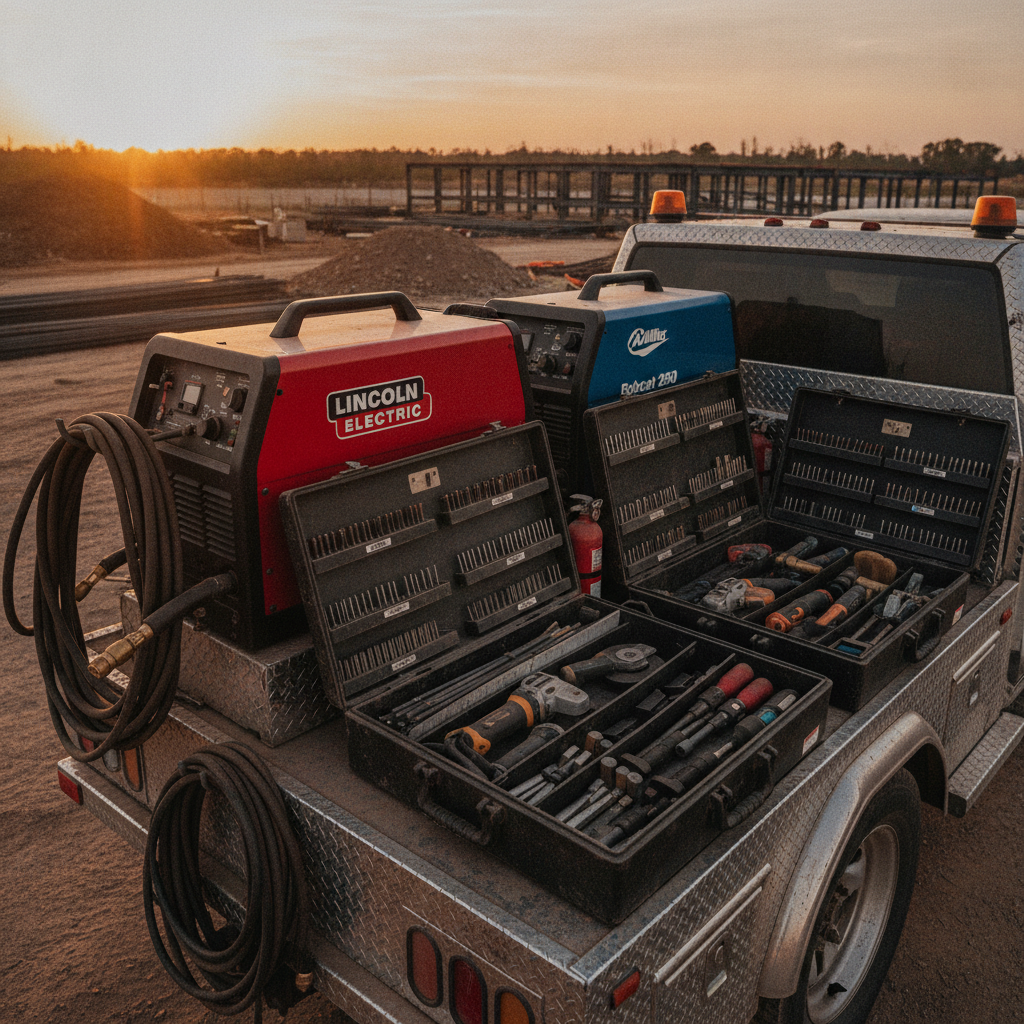
- Hot zone: Everything related to welding — machine, leads, ground clamps, stingers, wire, rod. This stuff gets used on every single job. It lives closest to the work side of the truck.
- Cutting zone: Plasma cutter, torch, tips, strikers, extra hoses. Separate from welding gear so you’re not tangling leads.
- Hand tool zone: Grinders, wire brushes, chipping hammers, clamps, squares. Mounted or racked, not loose in a bin.
- Consumables zone: Electrodes, wire spools, tips, nozzles, anti-spatter, PPE. Organized by type, labeled, and stocked consistently.
- Misc/hardware zone: Chain, binders, tie-downs, hardware, rags, marking tools. This is the junk drawer — keep it contained to one spot.
When every item has a zone, you stop searching. You reach. That’s the difference.
Mistake #2 — Leads and Hoses Everywhere
Tangled welding leads are the bane of every field welder’s existence. You pull one thing and four other things come with it. Leads get kinked, hoses get cracked, and you spend half your setup time doing a knot-untying ceremony in the parking lot.
Get yourself a proper lead management system. That means:
- Lead reels mounted on the truck or inside the compartment
- Leads coiled properly — not wrapped around the machine handle
- Hoses on separate hooks from leads
- Velcro straps, not zip ties, so you can undo them without a knife every time
Yes, lead reels cost money. They cost a lot less than the hour you waste every week untangling junk. Mount them where you can deploy leads without pulling everything else with it.
This also protects your investment. Kinked leads fail early. Cracked hoses leak. Replacing them is expensive. Proper storage pays for itself fast.
Mistake #3 — Consumables You Can’t Find When You Need Them
Running out of 6011 in the middle of a repair job because you didn’t know what was on the truck — that’s an embarrassing problem to explain to a customer. Worse is having the consumables but not being able to find them because they’re buried under a tarp in the back corner.
Build a consumable system that works like a tool crib. Small drawer units bolted to the truck wall work great. Label everything. Keep a minimum stock level in your head — when something drops below that level, it goes on the order list that day, not when you run out mid-job.
Organize consumables by process:
- Stick rod sorted by type and diameter in labeled tubes or dry rod storage
- MIG wire spools racked so you can see what’s there at a glance
- Plasma tips and electrodes in a small parts organizer
- TIG tungsten in a dedicated case, not rattling around loose
Running a multi-process setup? Even more reason to stay organized. If you’re not sure which machine to spec for field work, this post on field-ready multi-process welders is worth a read before you commit to a rig layout.
Mistake #4 — The Machine Is Loaded Wrong
Where you put your welder on the truck matters more than most guys think. Common mistake: the machine ends up in the back corner because it was the last thing loaded and there was space there. Now you’re dragging leads across the entire truck to get to the work.
Your welding machine should be positioned for lead deployment, not convenience of loading. Think about which side of the truck you typically work from. The machine should be on that side, with leads that can run directly to the work without crossing the truck.
Weight distribution matters too. A truck that handles badly because everything is loaded on one side is a safety issue, not just an annoyance. Spread heavy equipment — machines, cylinders, toolboxes — to keep weight balanced side-to-side and front-to-back.
Gas cylinders need to be secured upright in proper racks with chains. Not strapped to the tailgate. Not rolling around in the bed. Proper racks keep them safe, make them easy to swap, and keep regulators from getting knocked off.
Mistake #5 — No System for Personal Protective Equipment
Your helmet, gloves, jacket, and safety glasses should not be the last thing you look for before every job. They’re not optional, and fumbling for them in front of a safety-conscious customer makes you look like an amateur.
Designate a specific spot for every piece of PPE. Helmet hangs on a hook — same hook, every time. Gloves go in the same pouch. Jacket in the same bin. When you pack up at the end of a job, everything goes back to its spot before you close the truck. No exceptions.
Keep a spare set of gloves in a separate location. Gloves disappear on job sites. Having a backup set takes ten seconds to grab and saves the awkward moment of asking a customer if they have any spare welding gloves. Trust me, they don’t.
Mistake #6 — Your Grinders Are a Disaster
Most field welders carry two or three angle grinders. That’s fine — you probably need them. The problem is they end up in a pile with discs, guards, wrenches, and random hardware all mixed together.
Mount your grinders. There are purpose-built grinder racks and magnetic mounts that work well in a service body. Each grinder has its spot, its guard stays on when not in use, and the flap disc wrench lives on a hook right next to it.
Keep your grinding discs organized by type — cutting discs, grinding discs, flap discs, wire wheels. A simple small parts drawer or stackable bin system works perfectly. When you need a 4.5-inch cutting disc, you reach for it. You don’t sift through a pile hoping to find the right one before it snaps in half because it got damaged loose in a box.
Mistake #7 — No Job-Specific Pre-Load Checklist
This is the one that separates guys who’ve been doing this a while from guys who haven’t. A checklist sounds like paperwork busywork. It’s not. It’s the thing that keeps you from driving 45 minutes to a job site and realizing you forgot your filler rod or your gas bottle is empty.
Build a basic pre-job checklist based on job type. Structural repair looks different than pipeline maintenance looks different than farm equipment. Have a template for each type of job you commonly run.
It doesn’t need to be fancy. A laminated card on the visor works. An app on your phone works. The point is you run through it before you leave the shop, not when you’re standing in a field realizing you’ve got a 75% full bottle and a six-hour job ahead.
If you’re still figuring out which niches to target with your mobile rig, this post on strategic niches for welding businesses breaks down where the money actually is in mobile work.
Mistake #8 — Ignoring the Electrical and Gas Setup
Running a generator on the truck and not having a clean power distribution setup is asking for problems. Extension cords daisy-chained to run your grinder, your machine, and a work light simultaneously — that’s a fire waiting to happen and a frustration every single time.
Invest in a proper power panel on the truck. Breakers, dedicated outlets for each piece of equipment, and a clean cable run. It costs more upfront and it saves you headaches and potential hazards for the life of the truck.
Same principle applies to gas. If you’re running shielding gas, your regulators, hoses, and connections should be in good shape and easy to access. Leaking connections waste gas and money. A well-organized gas setup also makes cylinder swaps fast — which matters when you’re mid-job and running low. For a deeper dive on managing gas efficiently, this post on smart shielding gas management is solid reading.
Mistake #9 — Never Reviewing the Setup
Here’s the last one, and it’s the one most guys skip. You built out your rig once, you got used to it, and you stopped thinking about whether it actually works well. Every few months, spend thirty minutes walking through your truck critically.
Ask yourself:
- What did I dig for this week that took too long to find?
- What did I reach for and grab immediately without thinking?
- What’s taking up space that I never actually use on site?
- What do I wish I had on the truck that I keep leaving at the shop?
Your rig should evolve with your work. The setup that made sense when you were doing mostly farm equipment repair might not work when you pivot to industrial maintenance. Adjust accordingly.
If you’re scaling up and thinking about the business side of things more seriously, this post on going from garage to shop covers a lot of ground on growing past the one-truck operation.
The Bottom Line on Truck Setup Mistakes
None of this is complicated. That’s actually the point. The truck setup mistakes that cost field welders the most money aren’t technical — they’re organizational. They’re fixable in a weekend with some rack hardware, a label maker, and a couple hours of thought.
A well-organized rig tells customers you’re a professional before you’ve said a word. It cuts your setup time, protects your equipment, and keeps you from losing an hour of billable time every week to searching for stuff you already own.
Take a hard look at your truck. If you’re honest with yourself, you probably already know which of these truck setup mistakes you’re making. Fix the worst one first. Then the next one. You don’t need a perfect rig — you need a better one than you had last month.
That’s how you stop bleeding time and start banking it.