You ever show up to a job, customer standing there watching, and spend the first twenty minutes digging through your truck like you’re looking for a lost sock? Yeah. That’s not a good look. More importantly, that’s your money burning while you root through a pile of leads, scrap rod, and that grinder wheel you’ve been “meaning to organize” since March. If your mobile rig setup is a disaster, every single job costs you more than it should. This post is about fixing that — practically, without spending a fortune, and without me pretending I’ve never had a messy truck myself.
Why Your Mobile Rig Setup Is Your Hourly Rate in Physical Form
Think about it this way. You’re billing $85 an hour. You waste 20 minutes on setup and teardown per job because nothing has a home. That’s $28 gone before you strike your first arc. Do that five days a week across two or three jobs a day, and you’ve just given away over a thousand bucks a month. To your own disorganization. Brutal, right?
The time you waste isn’t just frustrating — it’s a direct tax on your business. And it compounds. A slow setup leads to a rushed job. A rushed job leads to mistakes. Mistakes lead to callbacks. Callbacks are free work. The whole thing snowballs from a messy truck bed.
If you’re still figuring out how to price your work to account for your actual time, take a look at this breakdown on pricing for certification services — the same logic about valuing your hours applies hard to field work.
Organization isn’t just about looking professional. It’s about running a tighter operation that makes you more money. Full stop.
Mistake #1 — No Defined Zones on the Truck Bed
This is the big one. Most guys load their truck like they’re playing Tetris with their eyes closed. Everything just kind of goes wherever it fits that day. The problem is that “wherever it fits” changes every day, so you never know where anything is.
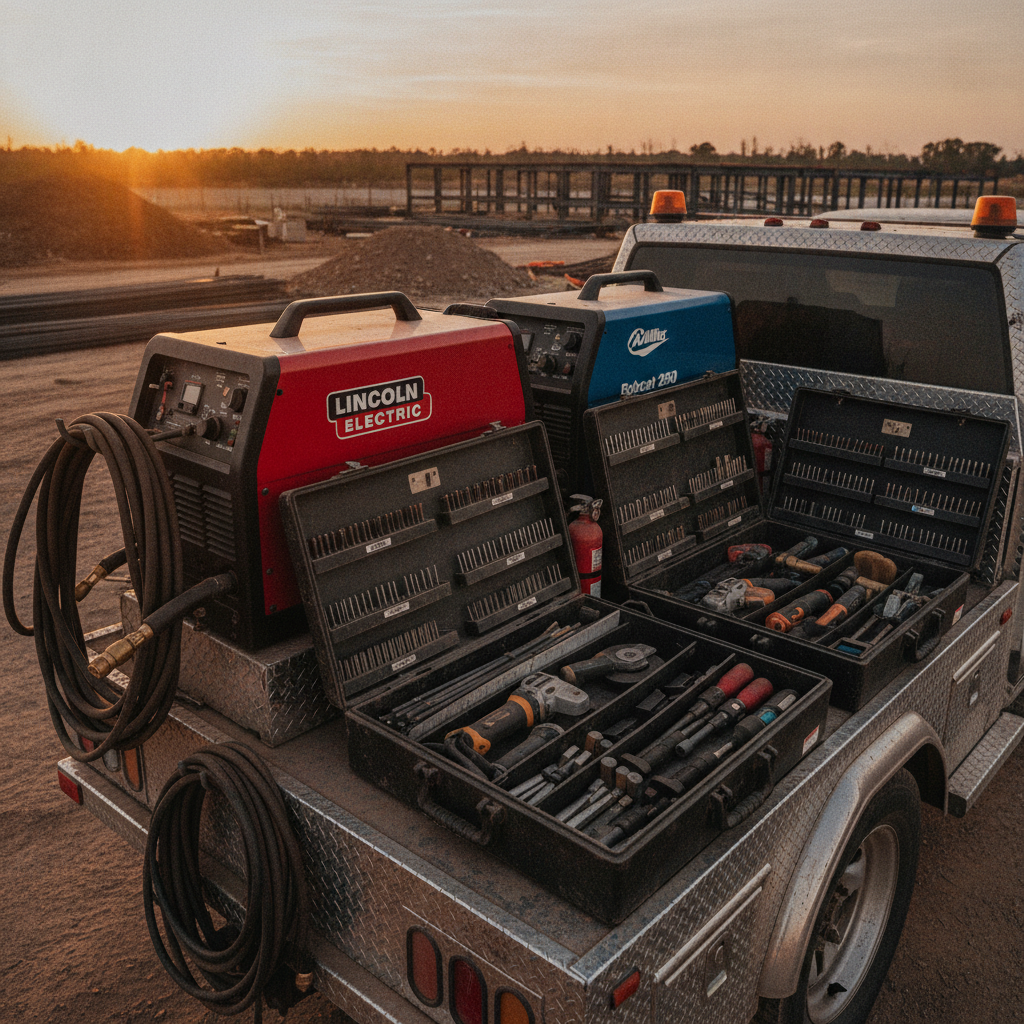
The fix is dead simple: zones. Your truck bed needs three basic zones and you need to respect them every single time you pack up.
- Power zone: Your welder, leads, ground clamps, and stingers. Everything that connects to the machine lives here.
- Consumables zone: Rod, wire, tungsten, tips, nozzles, anti-spatter. The stuff you burn through daily.
- Hand tools zone: Grinders, wire brushes, chipping hammers, clamps, squares, and measuring tape.
Simple. Once you build that habit, you reach for things automatically. No hunting. No second-guessing. You walk up, you work, you get paid.
If you’re running a multi-process rig and juggling processes on a single job, having your equipment zoned out is even more critical. Check out the details on field-ready multi-process welders to see how equipment choice plays into your setup efficiency.
Mistake #2 — Cables and Leads Living Everywhere
Leads thrown in a heap are basically a trap. They tangle. They snag on everything. You pull one end and the whole pile comes out at once like a bowl of spaghetti. Then you spend five minutes unfurling cable while the customer watches you lose your mind.
Get a cable management system. This doesn’t have to be fancy. A few options that actually work on a working truck:
- Cable reels: Best for guys who run long leads regularly. Mount them on the side of the truck or on a swing-out bracket. Pull out what you need, reel it back. Done.
- Figure-eight coiling: If you’re not ready to spend on reels, at least coil your leads properly. Figure-eight keeps them tangle-free. Learn it, use it, never go back.
- Velcro straps or cam buckles: Cheap. Effective. Strap your coiled leads to a designated hook or bracket every single time.
The goal is that when you grab a lead, you grab just that lead. Nothing else comes with it. That’s the whole deal.
Mistake #3 — Gas Cylinders Just Riding Loose
This one is both a time problem and a “don’t die” problem. Cylinders that aren’t properly secured are dangerous. But they’re also a setup nightmare when they’ve tipped over, rolled around, and your regulator has taken a shot to the gauge.
Mount your cylinders. This means a proper cylinder rack, a tube holder welded to the truck frame, or at bare minimum heavy-duty straps rated for the job. They shouldn’t move. Not at all. When you get to the job, you walk up, open the valve, hook up your hose, and you’re running. No adjusting, no checking if something got dinged in transit.
While we’re on the subject of gas — if you’re not tracking your shielding gas usage and it’s costing you on estimates, this post on smart shielding gas management is worth your time. Efficiency in the bottle means efficiency in the budget.
Mistake #4 — Consumables Stored Like a Junk Drawer
You’ve got six different rod sizes rattling around the same tube. Wire spools sitting without covers. Tips loose in a coffee can with everything else. You need a specific 3/32″ 6010 rod, so you dump the whole collection out and sort through it on the tailgate.
Sound familiar? Yeah. Fix it.
Dedicated storage for consumables doesn’t have to cost much. A few ideas:
- PVC tubes with end caps: Sort rods by type and diameter. Label the outside. Stack them vertically in a holder or horizontally in a rack. Pull the right cap, grab what you need, done.
- Small plastic bins with lids: For MIG tips, nozzles, and contact tips. Sorted by size. Labeled. Stacked in a drawer or toolbox.
- Wire spool covers or sealed bags: Moisture is the enemy of wire. Keep it covered between jobs.
The rule is: one hand goes in, the right thing comes out. No digging, no dumping.
Mistake #5 — Tools That Have No Home
Every tool needs a spot. If a tool doesn’t have a dedicated home on your rig, it will end up somewhere random, and you will not find it when you need it. That’s not a theory. That’s physics.
This is where a good toolbox setup pays off. Not the most expensive one — the most organized one. Drawers labeled or color-coded by tool type. Grinders in one spot, clamps together, hand tools together. Foam inserts cut to fit if you want to get serious about it. At minimum, everything should have a general drawer or bin it lives in.
The test is simple: can you find any tool on your truck in under 30 seconds, in the dark, without looking? If not, you’ve got organizing left to do.
This mindset matters even more as your business grows and you’re making bigger equipment investments. Before you drop money on new gear, read through Measure Twice, Invest Once — spending smart on your rig starts with knowing what you actually use.
Mistake #6 — No Pre-Job Checklist
Even a perfectly organized truck will let you down if you’re leaving jobs without restocking. You get to the next job and you’re out of the rod you used up, or your grinder wheel is shot, or you left a clamp at the last site.
A pre-job checklist takes about two minutes and saves you the embarrassment — and cost — of running to the supply house mid-job. Yours doesn’t have to be complicated. Something like:
- Leads and ground clamp — check
- Consumables for today’s process — check
- Gas pressure — check
- Grinder wheel condition — check
- Safety gear — check
- Job-specific tooling — check
Run it before you leave the yard. Run it after every job to restock. That’s it. Two minutes, every time. You will not regret it.
Mistake #7 — Your Welder Is Not Secure or Accessible
This one cuts both ways. If your machine is buried under gear, setup takes forever. If it’s not secured properly, you’re one hard corner away from a very expensive repair bill or a very bad day.
Your welder should be on a proper skid or in a dedicated mount. Accessible from the side or rear without moving six other things first. Cables should exit in a direction that doesn’t require you to reroute everything on-site.
If you’re weighing options on machines for your mobile setup, this post on hybrid battery-powered welders covers some of the newer options worth looking at for guys who need flexibility in the field. Machine choice affects how you build your setup.
The Real Cost of a Slow Setup — Adding It Up
Let’s be honest about the math. You’re not just losing setup time. A disorganized mobile rig setup eats into your mental energy too. You start every job a little irritated, a little scattered. That affects your work quality whether you want to admit it or not.
Clean setup = clean mindset. You walk up to the job looking like you know what you’re doing — because you do, and your truck shows it. Customers notice. Repeat customers and referrals come from the whole package, not just your welds.
If you’re building your mobile business from scratch and thinking about what niche to focus on, this post on strategic niches is worth reading alongside this one. How you position your business should match how you operate it — and a sharp setup is part of the brand.
Quick Reference — Mobile Rig Organization Wins
Here’s the short list. Do these, and your mobile rig setup will run tighter almost immediately:
- Define and stick to three zones on your truck bed.
- Get your cables on reels or coil them properly every single time.
- Mount your gas cylinders — no exceptions.
- Sort and label every consumable. Use PVC tubes for rod.
- Every tool has one home. Always put it back.
- Run a pre-job checklist before you leave the yard.
- Mount your welder on a skid with clean cable exit points.
None of this is rocket science. It’s just discipline applied to your truck. The guys who run the tightest operations in this trade aren’t necessarily the best welders. They’re the ones who show up ready to work, not ready to search.
One More Thing — Build Your Rig for the Work You Actually Do
The best mobile rig setup for a pipe welder looks different from the best setup for a guy doing structural repair on farm equipment. Don’t copy someone else’s layout wholesale. Look at what you actually use every day. The gear you grab first goes in the most accessible spot. The stuff you use once a month can live in the back corner.
Build your rig around your workflow, not around what looks good in a YouTube video. Function over form. Every time.
If your business is growing and you’re starting to take on more complex work — dissimilar metals, multi-material jobs — your rig needs to grow with it. This post on dissimilar-metal welding mastery covers the technical side, and your truck organization needs to support the extra consumables and tooling those jobs demand.
Bottom Line
A poorly organized rig is a slow rig. A slow rig costs you money, makes you look like an amateur, and adds unnecessary stress to every job. None of those are things you want when you’re trying to build a mobile welding business that actually makes you a living.
Fix your mobile rig setup. Spend a Saturday doing it right. You’ll make that time back inside of a week, and your jobs will run better every single day after that.
You’re already doing the hard part — showing up and laying good weld. Don’t let a messy truck be the thing that slows you down.