You want to know what really eats into your hourly rate? It’s not the drive time. It’s not the material cost. It’s the fifteen to twenty minutes you spend every morning digging through a pile of leads, stepping over your angle grinder, and hunting for a tip you swore you packed yesterday. A bad mobile rig setup is a slow tax on every single job you run. And the worst part? Most guys don’t even realize they’re paying it.
I’ve been running mobile welding rigs for over a decade. I’ve made every one of these mistakes personally. Some of them twice. This isn’t theory from a guy who read a blog post — this is what I learned the hard way, mostly while standing in a muddy field at 7 AM cursing at a tangled lead.
Let’s fix your rig. For real this time.
Mistake #1: No System for Your Leads and Cables
This is the number one time killer on any mobile setup. Leads that aren’t stored the same way every time become a bird’s nest inside of two days. You go to grab your stinger lead, and instead you’re pulling out your ground, your TIG torch hose, and somehow a bungee cord that has no business being there.
The fix is dead simple: dedicated hooks or reels for every lead, mounted in a consistent spot. Not just “somewhere in the bed.” A specific, labeled, always-the-same spot. Every time you break down a job, the lead goes back on that hook. No exceptions. It takes an extra ninety seconds at teardown and saves you ten minutes at the next setup.
Some guys use retractable cord reels mounted to the side of a service body. Some use fixed hooks welded to a rack. Doesn’t matter what system you pick — what matters is that you actually use it every time. Consistency is the whole game here.
Also, stop running leads that are too long for most of your jobs. If ninety percent of your work is within fifty feet of the truck, carrying two hundred feet of lead means you’re coiling up twice as much rope for no reason. Match your lead lengths to your actual work, not your theoretical worst case.
Mistake #2: Your Consumables Are Buried
If your tips, nozzles, wire, and electrodes are sitting loose in a toolbox under three other toolboxes, you’ve already lost. Consumables need to be front-facing, easy to grab, and organized by process. You should be able to reach in with one hand and pull exactly what you need without looking.
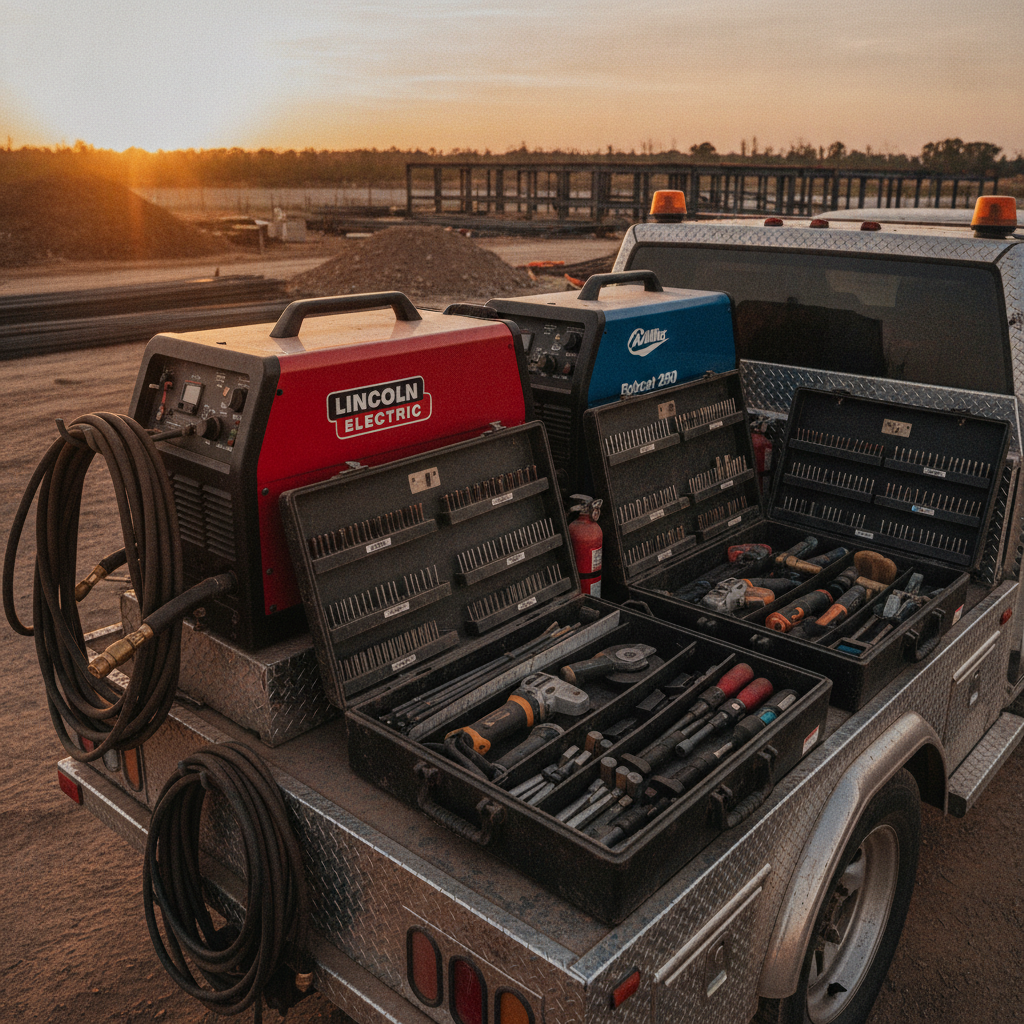
A lot of service body trucks have shallow drawers near the top of the compartments. Those are gold for consumables. Label them. MIG tips, nozzles, and anti-spatter in one. Stick electrodes by rod type in another. TIG tungstens and filler in a third. Whatever your process mix looks like — set it up so it mirrors how you actually work.
While we’re at it: stop buying consumables in quantities so large they won’t fit in organized storage. I know the bulk pricing looks good. But if your answer to “where are the .035 tips” is “somewhere in that big box,” then the bulk savings already got eaten by time loss.
This also ties into your broader business efficiency. If you’re still figuring out which processes you run most, take a look at what a well-built field setup looks like for multi-process work — the post on field-ready multi-process welders breaks down what equipment decisions make the most sense when you’re running multiple processes out of a single rig.
Mistake #3: Your Grinders and Hand Tools Have No Home
The angle grinder is the most used tool on most mobile welding jobs. It should have one of the easiest spots to access on your truck. Instead, on most rigs I’ve seen, it’s shoved in a back corner, wrapped in its cord, on top of a bunch of other stuff.
Grinders need a dedicated mount or drawer. Period. The cord needs to be coiled and secured — not wrapped around the grinder handle like some kind of cursed pretzel. Discs need to be stored flat, in a labeled sleeve or case, so you’re not fumbling through loose discs trying to figure out what grit you’re grabbing.
Same logic applies to wire brushes, chipping hammers, and your soapstone holder. These are small, they get lost easily, and losing them wastes time. Magnetic strips on the inside of compartment doors work great for small metal tools. Velcro pouches work for brushes and markers. Do something intentional with the small stuff — it adds up.
Pro Tip: The “Pre-Job Box”
Some of the most efficient mobile welders I know keep what they call a pre-job box — a single tote or drawer that has everything they touch in the first ten minutes of every setup. PPE, soapstone, a tape measure, a speed square, a marker, a handful of consumables for the day’s process, and a couple of common fittings. When you pull up to a job, you grab that one box and go. The rest of the truck stays closed until you actually need something specific.
It sounds almost too simple. But when you standardize the first ten minutes of every job, you eliminate the most chaotic part of your day.
Mistake #4: Gas Bottles That Move Around
An unsecured cylinder is a safety issue first and an efficiency issue second. But let’s talk about the efficiency part too, because it matters. Bottles that aren’t in a fixed, labeled spot mean you’re checking connections every time, wondering if you grabbed the right gas, and sometimes finding out mid-job that a fitting is loose because it got banged around in transit.
Every bottle on your rig should have a dedicated mount with a chain or strap. The regulator should stay on the bottle when possible, protected from impact. If you’re running argon, CO2, and oxygen, each bottle needs its own clearly marked spot. Not just for safety — for your sanity at 6:30 in the morning.
If you’re running a hybrid or battery-assisted setup and thinking about reducing your dependence on engine-driven power, the breakdown on hybrid battery-powered welders is worth reading. It changes some of the space and weight calculations on your rig.
Mistake #5: No Thought Given to Load Order
This one takes more thinking upfront, but it pays off every single day. Load order means putting things in your truck based on when you need them, not based on what fits where.
Think about your typical job sequence. You pull up. You assess the job. You grab your PPE and marking tools first. Then you pull leads and set up the machine. Then you grab your prep tools — grinders, wire brushes. Then you start welding. Then you inspect and clean up.
Now look at your truck. Are the things you need first actually the easiest to access? Or is your PPE buried behind the grinder drawer, which is behind the electrode box, which is behind the machine itself?
Reorganize your truck around your actual work sequence. It feels weird the first week because you’re used to where things were. But within two weeks, your setup time will be noticeably shorter. This is not a small deal — shaving ten minutes off every job setup means an hour saved on a six-job week. That’s real money.
Mistake #6: The Truck Itself Is the Wrong Tool
Sometimes the problem isn’t how the truck is loaded. It’s the truck. A standard pickup bed without any organization infrastructure — no service body, no rack, no drawer system — is a hard thing to keep organized. Stuff slides around. Stuff gets buried. You end up with a pile instead of a rig.
If you’re serious about mobile welding as a business, a proper service body is one of the best investments you can make. Aluminum service bodies with compartmentalized drawers and lockable doors aren’t cheap, but they turn your truck into a functional mobile shop. Everything has a place, everything is secure, and you look like a professional when you pull up instead of looking like you packed your truck in the dark.
If a full service body isn’t in the budget yet, truck bed organizers, cargo slides, and drawer systems designed for truck beds can get you most of the way there at a fraction of the cost. The key is structure — give every tool and piece of equipment a defined, fixed home and make sure it goes back there every single time.
If you’re in the early stages of building a mobile welding business and trying to figure out where to put your money, the post on measuring your investments before you make them is a good sanity check before you go spending money on truck infrastructure.
Mistake #7: You’re Running the Wrong Machine for Field Work
I know, I know — this feels like a separate topic. But your machine choice directly affects your rig setup. A machine that’s too large, too heavy, or not designed for field use creates logistical problems that no amount of organization can fully solve. Weight distribution gets weird. Power management becomes a headache. The machine ends up parked in the one spot it can physically fit, which may not be the most functional spot.
Field welding demands machines that are built for it — compact, durable, multi-process capable where possible, and easy to run off a generator or engine drive. If you’re still running a shop machine strapped into a truck bed, that’s worth revisiting. The field-ready battery welders post covers some of the newer options that are genuinely changing what’s practical for mobile work.
Mistake #8: No Maintenance Schedule for the Rig Itself
Your rig is your business. The truck, the welder, the gas system, the leads — all of it. If any part of it fails on a job, you’re done for the day. And a lot of field failures are predictable and preventable.
Set a weekly check. Leads inspected for damage. Ground connections cleaned. Gas fittings checked for leaks. Consumables restocked. Machine checked for error codes or unusual behavior. Truck fluids and tires checked. It takes twenty minutes if you have a checklist and you actually do it.
This is also where smart monitoring tools start paying for themselves. If you want to understand how real-time arc data can flag problems before they become job-stopping failures, the post on smart arc monitoring for weld technology covers the current state of that tech in plain terms.
The Bottom Line on Mobile Rig Setup
A good mobile rig setup doesn’t happen by accident. It takes intentional thought about how you actually work, what you actually need, and in what order. The guys who show up to a job and are welding in ten minutes didn’t get there by luck. They built a system and they work the system every single day.
The cost of a disorganized rig is real and it compounds. Ten minutes per job, five jobs a week, fifty weeks a year — that’s over forty hours of lost time annually. More than a full work week, gone. Just from a messy truck.
You’re running a business, not just swinging a stinger. The business side means treating your time like money. Because it is. Fix the rig, fix the wasted time, and put that money back in your pocket where it belongs.
If you’re still figuring out the business side of running mobile work — pricing, niche selection, how to position yourself — the post on strategic niches for welding businesses is worth a read. And if you’re thinking about how to price the more specialized work you can offer with a well-equipped rig, the breakdown on pricing for certification services covers the numbers side of premium service offerings.
Now go clean out your truck. You know it needs it.