You want to know what’s actually eating your profit on mobile jobs? It’s not material costs. It’s not drive time. It’s those first twenty minutes on every single job site where you’re digging through a pile of cables, cursing at a gas fitting you swear you just saw yesterday, and trying to remember where you threw your second ground clamp. Truck setup mistakes like these aren’t small inconveniences — they are a direct tax on your hourly rate, paid by you, every single day. If you’re billing $95 an hour and you waste 25 minutes before you strike your first arc, you just handed the customer roughly $40 worth of your time for free. Multiply that across a five-day week and you’re looking at serious money walking out the door. Let’s fix that.
Why Truck Setup Mistakes Cost More Than You Think
Most guys who are starting out — or even guys who’ve been running their own rig for a year or two — don’t think of truck organization as a business problem. They think it’s just a mild annoyance. It’s not.
Every minute you spend fumbling around your truck is a minute you’re not billing. And unlike a shop environment where you might recover that time during a long production run, mobile work is almost always flat-rate or hourly with a cap. You eat the inefficiency. The customer doesn’t.
Beyond money, there’s the professional image thing. Customers are watching you from the moment you pull up. If it takes you half an hour to get your act together before you do anything useful, they notice. They don’t say anything, but they notice. And that feeds directly into whether they call you back or whether they call somebody else next time.
If you’re serious about building a sustainable mobile welding business, organization isn’t optional. It’s part of the job. If you haven’t thought through your business model yet, this post on strategic niches for mobile welders is worth your time — because a tight niche makes it much easier to standardize your rig load.
Mistake #1: No Zones, No System
The single most common truck setup mistake I see is the total absence of a zoning system. Everything just goes wherever it fits when you’re packing up. That sounds fine until you’re on a job site at 6:45 in the morning trying to find your flow meter.
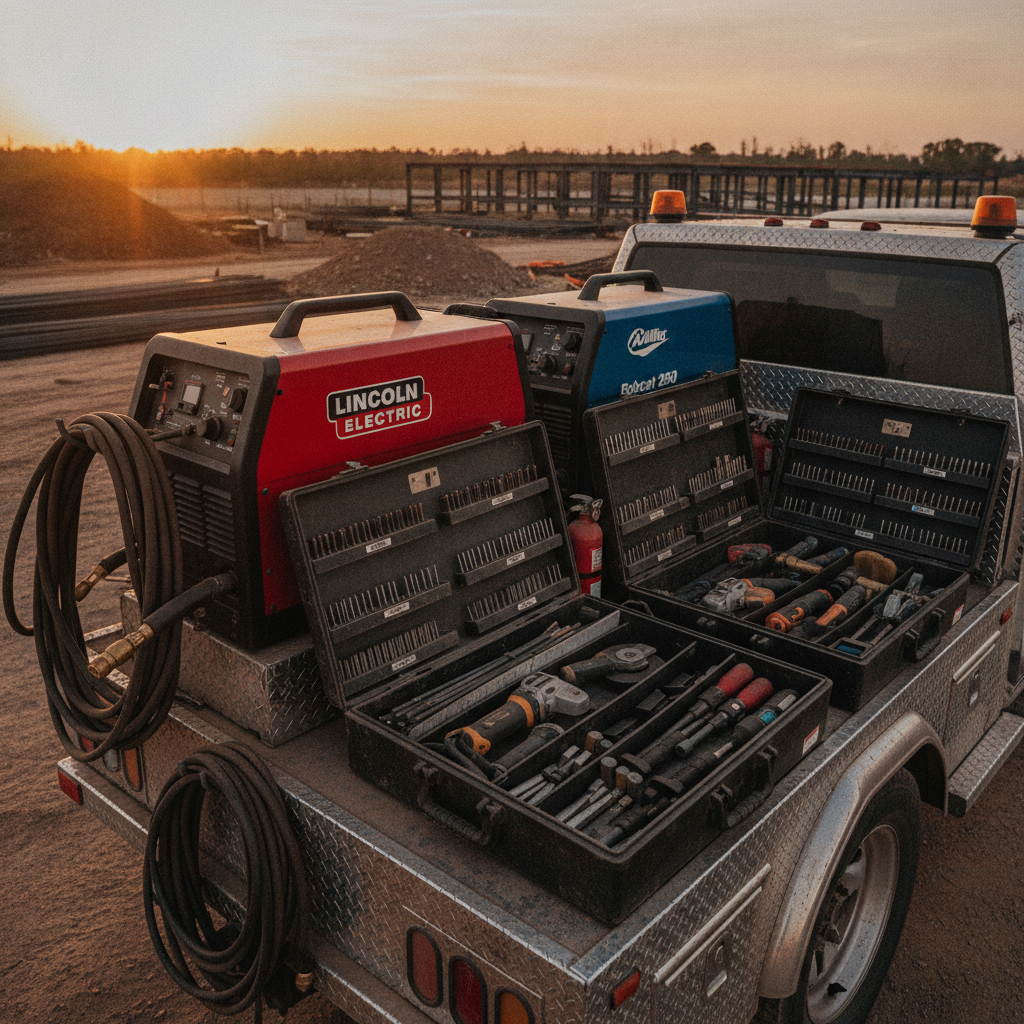
Here’s the concept: your truck bed or service body needs to be divided into functional zones. Every zone has one job.
- Power zone: Your welder, leads, electrode holder, ground clamp. Everything that touches the arc lives here.
- Gas zone: Cylinders secured upright, regulator, hose, fittings, extra tips. Nothing else.
- Consumables zone: Rod, wire, tips, nozzles, anti-spatter — organized by process if you run more than one.
- Hand tools zone: Grinders, brushes, chipping hammer, clamps, squares. Stuff you grab constantly.
- Safety and misc zone: PPE, rags, fire blanket, first aid. Stuff you hopefully don’t need but should find instantly when you do.
The goal is that you can walk to a specific location on your truck without thinking about it. Muscle memory. The same way a surgeon doesn’t have to hunt for a scalpel mid-operation, you shouldn’t have to hunt for a tip cleaner mid-job.
Mistake #2: Loose Gear That Moves Around in Transit
You loaded the truck perfectly on Monday. By Thursday, everything has migrated. Your angle grinder is under the rod box. Your ground clamp is wrapped around your gas hose. Nothing is where it started.
This happens because nothing is actually secured. Everything is just stacked.
Fix this with mounts, hooks, clips, and drawers. Milkwaukee and DeWalt make tool organizer systems, but honestly a few strategically placed hooks and some bungee spots go a long way. Service body trucks have built-in compartments — use them consistently. Don’t let a tool “ride loose” in the bed.
Heavy items especially need to be anchored. A bottle of shielding gas rolling around in your bed is a safety problem before it’s an organization problem. This is also a good time to make sure you’ve thought through your shielding gas management setup — having the right gas for the job and knowing where it is are two different problems that are easy to solve at the same time.
Mistake #3: Running the Wrong Machine for the Job
This one stings because it’s not always obvious until you’re already on site. You show up with your stick machine because that’s what you mostly run. Turns out this is a stainless repair on thin wall tube. Now you’re either improvising or driving back to the shop.
The solution isn’t necessarily to carry every machine you own. It’s to qualify your jobs better before you load the truck. Ask the right questions when you’re booking the work. Find out the material, thickness, position, and access situation before you commit to a load-out.
That said, a lot of mobile guys are moving toward multi-process machines specifically to avoid this problem. If you haven’t looked at what’s available, the breakdown on field-ready multi-process welders is a solid starting point. The right machine means you’re not gambling on job-day surprises.
Also worth noting: if you’re doing any work that involves mixed metals or repairs on newer fabricated equipment, understanding dissimilar-metal welding and having the right filler on the truck can save you a callback and a bad reputation.
Mistake #4: Consumables You Can’t Find or Don’t Have
Running out of .035 wire mid-job. Showing up without the right tip size. Grabbing a nozzle that’s three-quarters plugged with spatter because you never cleaned it after the last job. These are consumables mistakes, and they all kill time.
The fix is a standing inventory system. It doesn’t have to be fancy — a whiteboard on the inside of a compartment door works fine. The rule is simple: when you use the last of something on the truck, it goes on the restock list before you leave the job. Not when you get home. Not the next morning. Right then.
Keep a small “emergency kit” of the most common consumables in a clearly labeled bag or box. Contact tips in the sizes you run most. A spare nozzle. A couple of feet of wire pre-loaded on a small spool if you work MIG mostly. Spare electrodes in the rod sizes you use 80% of the time.
This little kit lives in the same spot every single day. You check it every morning before you leave. That’s it. That’s the whole system.
Mistake #5: Your Leads and Cables Are a Rats Nest
Tangled leads are probably the most universally hated part of mobile welding. They take forever to sort out, they wear faster when they’re coiled wrong, and they make your setup look like a disaster zone.
A few rules that actually work:
Always coil the same direction. Doesn’t matter which direction — pick one and stick with it. Cables have a natural twist from the factory. Work with it, not against it.
Use velcro straps, not wire ties. Wire ties either break or have to be cut. Velcro lets you recoil quickly without digging for new fasteners every time.
Hang leads, don’t stack them. A couple of large hooks in the power zone lets you hang coiled leads so they stay organized and don’t get buried under other gear.
Label both ends of every lead. Sounds basic. Most guys don’t do it. When you’re running multiple leads for different processes or machines, you’ll thank yourself every single time.
Mistake #6: No Pre-Job or Post-Job Checklist
You know what separates the guys who always seem ready from the guys who are always hunting for something? The ready guys have a checklist. Not because they’re overly organized by nature — usually because they got burned enough times that they made one out of self-defense.
A pre-job checklist takes five minutes and covers:
- Machine settings verified and leads connected
- Gas on and flow rate set
- Consumables stocked for this specific job type
- PPE accounted for (helmet, gloves, sleeves, boots)
- Ground clamp accessible and in good condition
- Fire safety gear on hand
A post-job checklist is just as important. Before you leave a site:
- Gas off and hose depressurized
- Leads coiled and hung
- Used consumables noted for restock
- All tools back in their zones
- Machine settings reset to your baseline
This is also the moment to document anything unusual about the job. Material surprises, fit-up issues, anything that would affect how you price a similar job next time. If you’re still figuring out pricing structures, the post on pricing for certification services has some solid thinking that applies broadly to how mobile work gets valued.
Mistake #7: The Truck Itself Is the Wrong Tool
This is a harder one to fix, but it’s worth saying out loud. Some guys are trying to run a professional mobile operation out of a half-ton pickup with a standard bed and no service body. It works, barely, until it doesn’t.
If you’re doing this full time, a service body truck — or at minimum a well-built utility body in the bed — is not a luxury. It’s infrastructure. Compartments, drawers, locking storage, and a stable platform for your machine make every single job faster. The return on that investment is measured in time, and time in this business is money.
If you’re not there yet financially, that’s fine — start building toward it deliberately. Map out what you’d need to make the jump and start treating it like a real business expense, not a dream purchase. The post on measuring your investments before you make them is worth reading before you commit to any major rig purchase.
Making the Changes Without Overhauling Everything at Once
Here’s the practical reality: you probably can’t stop working for a week to reorganize your rig from scratch. So don’t try to.
Pick one mistake from this list — the one that costs you the most time right now. Fix that one thing this week. Then next week, pick the next one. Six weeks from now you’ve addressed six problems, and you’ve done it without disrupting your work schedule.
The guys who try to fix everything at once usually fix nothing. They start the project, a job comes in, and the half-reorganized rig becomes the new normal.
Small, consistent changes beat big overhauls every time. That’s true for rig organization and it’s true for your business overall. If you’re in the early stages of building out your mobile operation, the post on going from garage to real shop covers a lot of the same thinking applied to your workspace setup.
The Bottom Line on Truck Setup Mistakes
None of this is complicated. That’s almost the annoying part. Truck setup mistakes aren’t technical failures — they’re habit failures. You know you should have a system. You just haven’t built one yet, or you built one and let it slide.
The mobile welders who consistently make good money aren’t always the best welders on a technical level. But they are almost always the most efficient ones on site. They show up, they get set up fast, they do the work, and they clean up and leave. No drama, no hunting, no wasted time.
That reputation — the guy who shows up ready — is worth more than any piece of equipment you can buy. And unlike new equipment, it doesn’t cost you anything except discipline.
Fix your rig. Stop leaving money on the ground. You’ve got work to do.