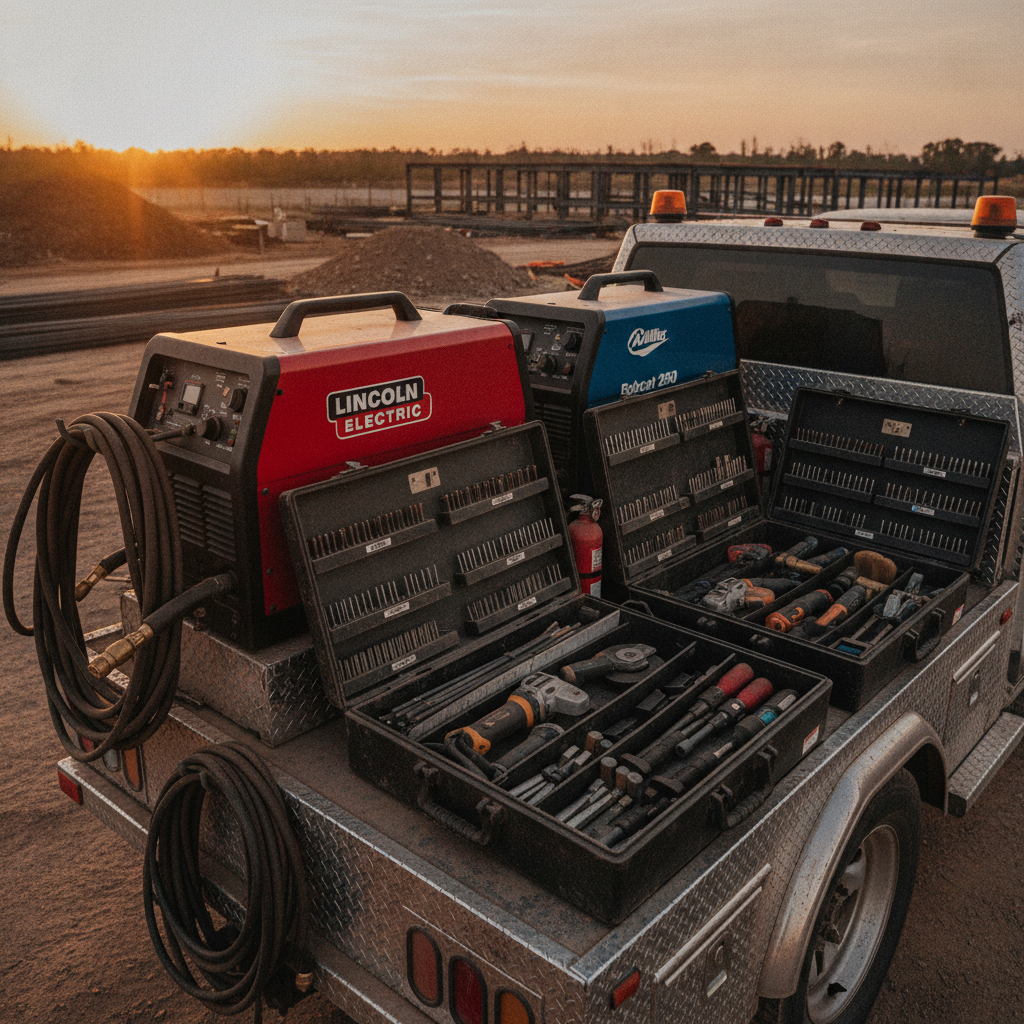
Let me paint you a picture. You pull up to a job site at 7 a.m. The foreman is watching. The crew is waiting. And you spend the next twenty minutes crawling through your truck bed like you lost your wallet in there. That right there is a truck setup mistake, and it’s costing you money before you’ve even struck your first arc. If you’re running a mobile welding operation and your rig looks like the inside of a junk drawer, we need to talk.
This isn’t about having a pretty truck. Nobody cares if your service body looks like a showroom floor. This is about time. Your time. Every minute you spend hunting for a contact tip, untangling a lead, or moving three things to get to the one thing you actually need is a minute you’re not billing for. Multiply that across a week’s worth of jobs and you’re basically donating hours to the customer for free.
Let’s fix that.
Why Truck Setup Mistakes Kill Your Hourly Rate
Here’s the math nobody talks about when they’re dreaming about going independent. If you charge $95 an hour and you waste 30 minutes per job on setup and dig-around time, you’re actually earning closer to $63 per effective hour on a two-hour job. Do that five days a week and you’ve given away roughly $800 a month in lost productivity. That’s not a rounding error. That’s a truck payment.
And it’s not just money. It’s reputation. Customers notice when you look disorganized. They start second-guessing whether you know what you’re doing. First impressions on a job site are made before you ever light the torch. The way you walk to your truck and come back with exactly what you need in under two minutes tells a story. A good one.
So where does it go wrong? In a few very predictable places. Let’s go through them one by one.
Mistake #1 — No System for Consumables
Consumables are the biggest time sink on a disorganized rig. Contact tips, nozzles, wire, rod, flap discs, cut-off wheels — these are small, they get mixed up, and they disappear into the black hole of your truck bed faster than anything else.
Most guys just throw them in a box or a bucket. Then every time they need a specific rod size or a fresh tip, it’s an archaeological dig. You’re pulling out stuff you don’t need to find the stuff you do need. Stop it.
Get a dedicated consumables system. This can be as simple as a divided parts organizer bolted to the inside of a compartment door. Label everything. Keep sizes separated. Run first-in, first-out so you’re not burning old rod from the bottom of the pile. When you finish a job, restock before you leave. Do it when it’s fresh, not at 6 a.m. the next morning when you’re half awake and in a hurry.
This single change alone will cut your average setup fumble time by half. Not an exaggeration.
Mistake #2 — Cables and Leads That Live on the Floor
A welding lead that lives loose on the floor of your truck is a lead that wraps around everything, tangles with your grinder cord, and somehow manages to hide under the heaviest thing in the vehicle every single time you need it.
You need a dedicated cable storage solution. Whether that’s a reel mounted to the side of the truck, a set of hooks inside a compartment, or a custom-built rack — it doesn’t matter. What matters is that your lead comes out clean and goes back clean every single time. The same goes for your ground cable, your plasma cutter leads, your extension cords, and your torch hoses.
Cable management also extends your equipment life. Kinked leads fail earlier. Connectors that get yanked and stepped on cause arc issues mid-weld. If you’ve ever had a random arc quality problem that turned out to be a bad connection in a beat-up lead, you know exactly how frustrating that is. Take care of the cables, and the cables take care of you.
If you’re running a multi-process setup in the field, this gets even more critical. Check out this breakdown of field-ready multi-process welders — those machines are capable of a lot, but not if the leads are a rat’s nest in your truck bed.
Mistake #3 — No Zones in Your Truck Layout
Random loading is the enemy. When everything has a “close enough” spot instead of a specific spot, nothing is ever where you expect it to be. Zones fix that.
Think of your truck in sections. Here’s a simple framework that works for most service body setups:
Zone 1 — First Touch
This is everything you need in the first five minutes of any job. PPE, angle grinder, chipping hammer, wire brush, tape measure. These go in the compartment closest to where you stand when you open the truck. No exceptions. If it’s a first-touch item, it lives in Zone 1.
Zone 2 — Process Specific
Your welding machine, process-specific consumables, gas regulators, and hoses. Organized by process if you’re running multiple. This zone takes slightly longer to access and that’s fine, because you typically set it up once per job and you’re done.
Zone 3 — Less Common Tools
Specialty clamps, backup equipment, tools you reach for maybe once a week. These can live in the back or bottom of your storage because the time cost of accessing them is acceptable given how rarely you need them.
Once you build this system, stick to it. The whole point of zones is muscle memory. You should be able to reach for what you need at 6 a.m. in the dark and your hand lands on it. That only happens if every item goes back to its zone every single time.
Mistake #4 — Your Gas Setup Is a Trip Hazard
Loose cylinders are a safety issue and a logistics issue at the same time. A tank that tips over when you hit a bump, or rolls to the back of the truck when you brake hard, is a cylinder that could hurt someone and also means you’re spending time resetting it instead of working.
Mount your cylinders. Use proper brackets, chains, or a dedicated cylinder rack bolted to the truck. This is non-negotiable from a safety standpoint, and it’s also just smarter logistically. A secured cylinder is a cylinder you can access quickly, connect your regulator to efficiently, and disconnect without wrestling.
Also — know what you’ve got before you leave the shop. Running out of gas on a job is a truck setup mistake that happens before you ever leave your driveway. Check your cylinder levels as part of your end-of-day routine, not your morning one. That way you’ve got time to swap before the next day starts. If you want to get more dialed in on gas management, this post on smart shielding gas management covers how to track usage and reduce waste in the field.
Mistake #5 — Everything Is Buried Under Everything Else
Load order matters. This sounds basic, but you’d be amazed how many experienced welders load their truck in reverse priority order — the stuff they need most ends up at the bottom, and the stuff they need least is right on top.
Think about it like a toolbox triage. What do you touch on every single job? That stuff goes in last when you’re loading, so it’s on top and accessible first. What do you touch once a week? That can be deeper in the system.
Heavy items go low and forward for truck balance and road safety. Light but frequently needed items go at grab height. And for the love of all things holy, stop storing your rods loose in a bucket where they pick up moisture, get bent, and require you to sort through them on site.
Mistake #6 — No Lighting in Your Compartments
This one sounds like a luxury until you’ve spent ten minutes trying to read a label on a bottle of anti-spatter at dusk. Compartment lighting is cheap. LED strip lights on a door switch run maybe $20 a compartment and they completely eliminate a whole category of fumble time. If you work early morning, late evening, or in covered shop bays, this pays for itself in the first week.
Also worth having: a quality handheld light mounted in Zone 1. Not just any flashlight. A good one that lives in the same spot every time. You don’t want to be hunting for your light in the dark. Yes, that is exactly as dumb as it sounds, and yes, most of us have done it.
Mistake #7 — Your Machine Setup Takes Too Long
If it takes you more than a few minutes to get your machine set and ready for the first arc, something is off. This is partly an equipment issue and partly a preparation issue.
On the equipment side — if your machine is difficult to move, difficult to connect, or buried under other gear, fix that first. Your welder should be the centerpiece of your rig, not something you have to unbury every morning. If you’re running battery-powered or hybrid equipment, the setup dynamics change a bit — here’s a solid rundown on hybrid battery-powered welders that’s worth a look if you’re considering that route.
On the preparation side — have a pre-job checklist. Not a mental checklist. A physical one. Laminate it and bolt it to the inside of a compartment door. It should cover your machine settings for common jobs, connection points, safety checks, and consumable confirmation. Takes ninety seconds to run through. Saves you from starting a job with the wrong wire speed or realizing your ground is loose after you’ve already tacked something in the wrong spot.
Build the System Once, Then Just Maintain It
Here’s the good news. Fixing your truck setup mistakes is a one-time project. You spend a weekend rebuilding your system, testing it, adjusting it. Then you just maintain it. The daily effort to keep a good system running is way less than the daily effort of working around a bad one.
Start with an audit. Spend ten minutes before your next job and just watch yourself. Notice every time you open a compartment twice, move something to get to something else, or have to think about where something is. Every one of those moments is a data point. Write them down. Fix them one by one.
The guys who run tight rigs didn’t get there because they had better equipment. They got there because they paid attention to friction and eliminated it. If you’re building your mobile business from the ground up, this kind of operational discipline connects directly to your long-term margins. Check out the post on going from garage to shop for how the same principles apply as your operation grows.
And if you’re trying to figure out where to invest your time and money as a mobile welder, the smart heat maps for startups post does a solid job of helping you identify where your biggest operational losses are actually coming from — setup inefficiency often ranks higher than people expect.
The Bottom Line on Truck Setup Mistakes
Truck setup mistakes aren’t glamorous problems to solve. Nobody’s making YouTube videos about their parts organizer. But this is exactly the kind of unglamorous, behind-the-scenes work that separates the welders who build real businesses from the ones who stay busy but never seem to get ahead.
Every hour you save through better organization is an hour you can bill. Or an hour you can go home early. Either way, it’s yours. Stop giving it away to a messy truck.
You spent years learning to weld well. Spend a weekend learning to set up your rig well. The return on that investment will show up in your bank account faster than almost anything else you can do right now. That’s not motivational poster stuff. That’s just math.
Fix the truck. Then go make money.