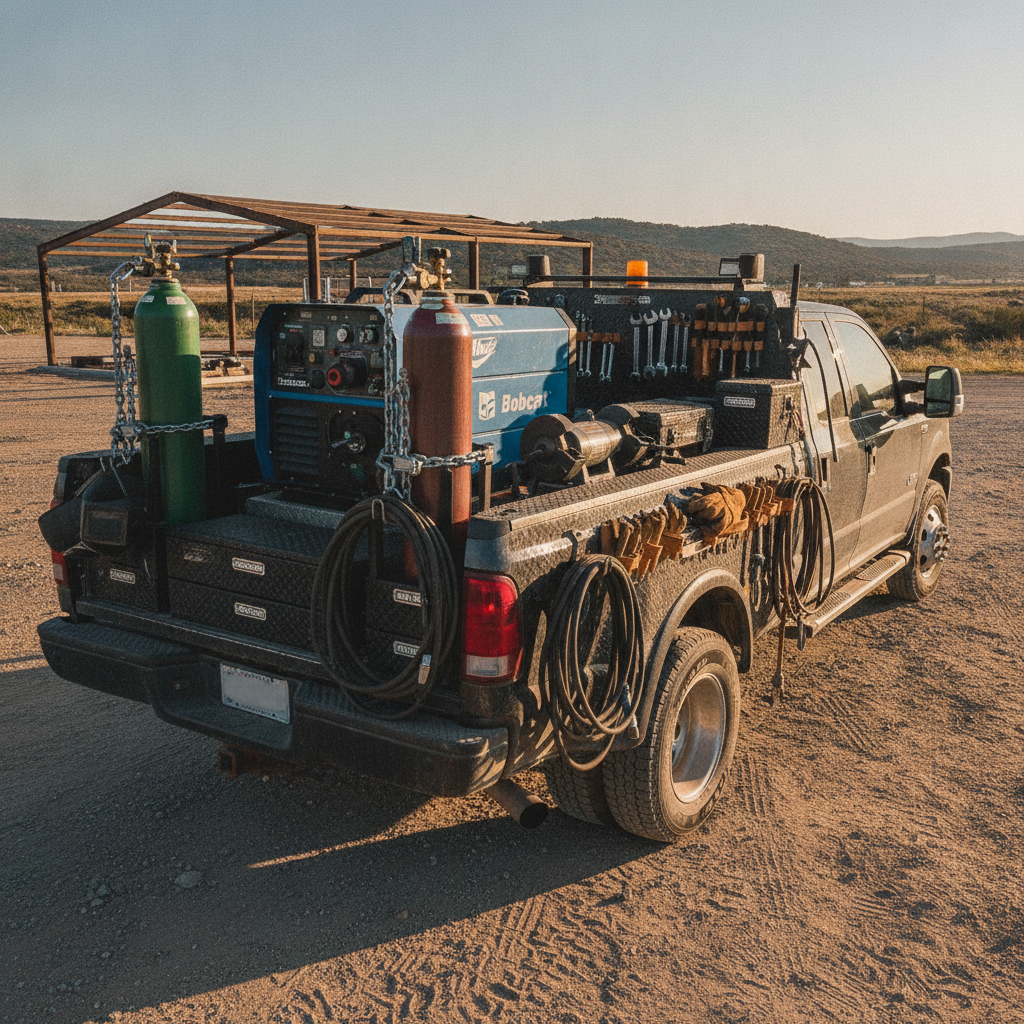
You want to know the fastest way to lose money as a mobile welder? It’s not a bad bid. It’s not a slow travel day. It’s standing at the back of your truck for twenty minutes digging through a pile of leads, random fittings, and that one grinding disc you swore you threw away last month — all before you’ve even touched your stinger. Mobile rig organization isn’t glamorous. Nobody’s going to post a reel of their sorted consumables drawer. But I promise you, the guy who’s got his rig dialed in is billing more hours per day than you are, and he’s doing it on the same jobs.
I’ve been running a mobile rig for over a decade. I’ve made every single mistake on this list. Some of them I made for embarrassingly long stretches before I woke up. So take this for what it is — a peer-to-peer rundown from someone who’s already paid the stupid tax on your behalf.
Why Rig Organization Is a Billing Problem, Not a Tidiness Problem
Let’s be real clear about something. This isn’t about being neat. I don’t care if your truck looks like a hardware store or a dumpster fire, as long as you can put your hand on what you need in under ten seconds. The issue is time. And time, for a mobile welder running his own operation, is literally money.
Think about it this way. If you waste fifteen minutes per job digging through your rig, and you’re running four jobs a day, that’s an hour gone. At $100 an hour — which is lowballing it — you just gave away $100 today. That’s $500 a week. That’s $26,000 a year. From a messy truck. Let that number sit with you for a second.
Good mobile rig organization isn’t about impressing customers, either. It’s about eliminating friction from your workflow. Every second you spend hunting for a fitting or untangling leads is a second you’re not billing. This is one of the fundamental concepts behind running a profitable mobile operation — something I got into more depth on when talking about moving from a garage setup to a real shop and what separates guys who make it from guys who don’t.
Mistake #1 — No Zones on Your Truck
This is the big one. Most guys just load stuff. They fill space. There’s no system, no logic, no intentional placement. The grinder ends up next to the come-along. The rod oven is blocking the leads. The socket set is under the fire blanket. Sound familiar?
Fix it with zones. Treat your truck body the same way a machinist treats his bench. Every zone has a purpose and only that purpose lives there.
Here’s a simple zone breakdown that works for most utility body setups:
- Zone 1 — Immediate access (driver’s side rear): Your daily carry items. Helmet, gloves, markers, tape measure, angle grinder. Stuff you touch on every single job.
- Zone 2 — Leads and cables: One dedicated compartment or rack. Coiled and hung, not piled. Label by length if you’re running multiples.
- Zone 3 — Consumables: One drawer or bin per process. Stick electrodes in one spot. MIG wire and tips in another. TIG filler organized by alloy. Not all dumped together.
- Zone 4 — Gas and regulators: Cylinders secured upright, always. Regulators wrapped and stored where they won’t get knocked. This is also a safety issue, not just an organization one.
- Zone 5 — Rarely used tools and backup equipment: Far corners, top shelves, or an underbed box. Out of the way because you don’t need it fast.
When you build zones, you stop thinking about where things are. Your hand just goes there. That’s the goal.
Mistake #2 — Leads Piled Like Spaghetti
I don’t know why this one is so universal, but every new mobile welder I’ve ever talked to has a lead situation that looks like a bowl of pasta somebody dropped. Leads piled, coiled wrong, twisted around each other, pinched under something heavy. It takes five minutes just to get them out of the truck, and then you spend another five untangling them on the ground.
Hang your leads. Full stop. Put hooks or a rack in one compartment and coil them properly — over-under if you want them to lay flat and last longer. Hang the electrode lead separate from the work lead. If you run multiple lengths, label them. A piece of tape and a marker takes thirty seconds and saves you minutes every single day.
Also, stop coiling leads by wrapping them around your elbow and shoulder. That’s how you put a twist into every coil and guarantee they never lay flat on the ground. It looks tough. It ruins leads. Do it right.
Mistake #3 — No Consumables System
Running out of 6010 on a pipeline job. Showing up with the wrong tip size for the wire you’ve got spooled. Grabbing a handful of electrodes that are three different rods you forgot you mixed together. These are all consumables organization failures, and they cost you time, credibility, and sometimes the job.
Your consumable system needs to do three things. First, it needs to tell you what you have. Second, it needs to tell you what you’re low on before you leave the shop. Third, it needs to be fast to access in the field.
Separate bins or drawers by process. Use labels. Do a ten-minute check at the end of every day or the start of every morning. If you’re running multiple processes — which most of us are — keeping your consumables straight also ties directly into how you set up your machine. If you’ve been thinking about a multi-process machine to simplify your field kit, take a look at what actually makes a unit field-ready versus just spec-sheet impressive.
Mistake #4 — Your Machine Is Buried
I’ve seen guys who have to unload three other things to get to their welder. The welder that they use on every single job. It’s baffling. Your primary machine should be the most accessible piece of equipment on the truck — second only to your helmet and gloves.
If you’re running a machine that lives in the bed or in a compartment, get a slide-out tray or a dedicated mount. Mount it so you can access the controls, swap wire, and connect leads without doing circus gymnastics. If you’re working in tight locations or running battery-based units for remote jobs, the same principle applies — easy in, easy out, controls forward-facing.
Speaking of battery-powered options — if you haven’t looked seriously at what’s available now for remote and off-grid jobs, the technology has come a long way. Worth a read on field-ready battery welders if you’re running jobs away from generator power.
Mistake #5 — Your Truck Isn’t Stocked for Your Actual Work
This one sounds obvious, but it catches people constantly. Your truck should be stocked based on the jobs you actually run — not the jobs you theoretically might run someday.
If you’re doing 80% structural steel work, you don’t need three different TIG filler alloys taking up space. If you’re doing a lot of aluminum, you better have a spool gun accessible and the right wire on it. If you’re getting into dissimilar metal work, your consumable and prep requirements change entirely — that’s a deeper conversation worth having around dissimilar metal welding techniques before you stock your truck for those jobs.
Do an honest audit of your last thirty jobs. What did you actually use? What sat there untouched? Load for reality, not for fantasy. You can keep a small “just in case” bin for the weird stuff, but your primary real estate should serve your actual bread and butter work.
Mistake #6 — No Daily Reset Habit
This is where most of the organization effort dies. Guys set up a great system once and then slowly let it fall apart over three weeks until they’re back to chaos. The rig gets messy in one direction — from organized to disorganized. It doesn’t self-correct. You have to build the reset into your routine.
End of day, before you lock the truck: leads coiled and hung, consumables back in their bins, tools wiped and put away, garbage out. Ten to fifteen minutes, max. Do it every day without exception. It’s the same discipline that makes the difference between a guy who stays profitable and a guy who’s always scrambling — and it connects directly to how you manage your whole operation. If you’re thinking about the bigger picture of running a lean, intentional mobile business, the smart heat mapping approach for startup operations is worth your time.
The daily reset also serves as your pre-check. You’ll catch that you’re low on wire before you’re forty miles from the supply house at 7am. You’ll notice a lead with a bad connection before it fails mid-job. It’s preventive maintenance wrapped inside an organization habit.
Mistake #7 — Ignoring the Cab
The truck bed gets all the attention but the cab is where you spend just as much time. Job folders, invoices, tape measures, markers, your phone charger, safety docs — all of it ends up in a pile on the passenger seat or the floor. It’s unprofessional when a customer walks up and it’s genuinely inefficient for you.
Get a simple cab organizer. Seat back pocket, center console tray, whatever works for your setup. Keep your active job docs in one spot. Keep a small notepad and pen accessible. Know where your phone and GPS are without fishing for them. It sounds minor until you’re trying to find a purchase order number in front of a customer while they’re watching you dig through a pile of receipts and fast food wrappers.
The Payoff Is Real and It Compounds
Here’s the thing about mobile rig organization — the benefit isn’t a one-time event. It compounds. Every day you run a dialed-in truck, you’re a little faster, a little less stressed, and a little more professional-looking than the competition. Customers notice when you walk up with your gear ready to go versus when you spend ten minutes getting set up. Repeat customers especially notice.
The time you save also gives you the mental bandwidth to focus on the actual work. When you’re not burning cognitive load remembering where you put things, you’re thinking about the weld. About the fit-up. About how to do the job right and fast. That’s where your skill actually pays off.
If you want to look at the broader picture of building a sustainable mobile welding business — from equipment choices to pricing your services correctly — the post on pricing certification services and the one on picking strategic niches are solid reads to pair with getting your truck dialed in. The rig is your tool, but the business around it is what actually pays you.
Quick Reference — Mobile Rig Organization Checklist
Before I wrap this up, here’s a no-fluff checklist you can actually use:
- Zones defined and labeled on the truck body
- Leads hung and coiled over-under, not piled
- Consumables separated by process with bin labels
- Primary machine on a slide-out or front-accessible mount
- Truck stocked based on actual job history, not wishful thinking
- Daily reset habit in place — fifteen minutes, end of every shift
- Cab organized with docs and tools in designated spots
- Low-stock items flagged during daily reset and restocked before next job
None of this is complicated. It’s just discipline applied to a physical space. Do it once right and then maintain it. Your hourly rate will thank you.
The welder who shows up ready goes home with more money in his pocket than the welder who spends the first half hour getting ready. That’s the whole lesson. Wrap up your rig, dial in your system, and go bill some hours.