Your Truck Setup Is Costing You Money Before You Touch a Rod
Let’s not sugarcoat it. If you’re spending the first twenty minutes of every job digging through a pile of leads, hunting for a tip, and moving a cylinder you should have secured differently — that’s not a bad day. That’s a mobile rig organization problem. And it’s coming straight out of your hourly rate, every single time.
I’ve been running mobile welding rigs for over a decade. I’ve seen guys with $80,000 trucks that looked like a tornado hit the service body. I’ve also seen guys with beat-up old rigs that were so dialed in, they were striking an arc within ten minutes of pulling up. Guess which one was more profitable.
This post is for the guys who are serious about running a tight operation. We’re going to talk about the specific mistakes that slow you down, and more importantly, how to fix them without spending a fortune in the process.
Mistake #1: No System for Where Things Live
This one sounds obvious. It isn’t. Most guys have a vague system. The grinding stuff is “over there,” the rod is “in that box,” and the extra tips are “somewhere in the back.” That’s not a system. That’s a pile with intentions.
A real system means every single item has a fixed location. When you reach for it, your hand goes directly there — day one, day five hundred, rain or shine. You don’t think about it. It’s muscle memory.
Here’s how to build that system. Start by making a list of every item you use on 90% of your jobs. Leads, stingers, ground clamps, rod, wire, tips, nozzles, chipping hammer, wire brush, angle grinder, cut wheels, flap discs. Everything. Then assign each one a permanent home based on frequency of use. The stuff you grab first goes closest to the cab. The stuff you grab once a week goes in the back corner.
Label everything. Sounds fussy, sounds like something your shop teacher told you. Do it anyway. When you’ve got a helper or an apprentice, labeled storage means they can hand you what you need without asking ten questions.
Mistake #2: Leads and Cables Are Always a Tangled Mess
Nothing wastes time like dealing with tangled leads. You reach in, grab the end of your stinger lead, pull — and out comes a coiled mess that takes three minutes to sort out. Multiply that by two or three jobs a day. That’s real time gone.
The fix is simple. Use lead hooks or hose reels mounted on the side of your service body or on a rack system above the bed. When you come off a job, you coil the lead properly and hang it. It takes thirty seconds. When you arrive at the next job, you pull it off the hook and it runs out clean.
For guys running longer leads — 50 to 100 foot setups for big structural work — consider a proper cable reel. It’s a one-time cost that pays for itself within a month in saved time and reduced lead damage. Leads that live in a pile get kinked, insulation gets cracked, connections get beat up. A lead that’s stored properly lasts years longer.
Speaking of equipment that can handle demanding field setups, if you’re not running a machine that was built for field work, that’s another whole problem. I covered the options worth looking at in my post on field-ready multi-process welders — worth a read if you’re still running shop equipment out of the back of a truck.
Mistake #3: Your Consumables Are Not Organized by Process
If you’re a multi-process guy — and most mobile welders doing serious work are — then you’ve got consumables for MIG, TIG, Stick, and maybe flux-core. Keeping all of that in one big drawer or one big tote is asking for problems.
You reach in for a .030 tip and pull out a 3/32 tungsten. You find the right tip but it’s the wrong thread. You can’t find a nozzle because it rolled behind a box of 6011.
Organize your consumables by process. Each process gets its own dedicated storage — whether that’s a drawer, a bin, or a divided tote. Inside that storage, go one level deeper. Wire tips organized by diameter. Nozzles grouped by machine. Tungsten organized by diameter and type, stored in a labeled tube or case so they don’t get mixed or broken.
This might take you an afternoon to set up properly. You will make that time back on your next three jobs. It’s not even close.
If you’re doing dissimilar metal work in the field, which has its own set of consumable challenges, the post on dissimilar-metal welding mastery breaks down what you’re actually dealing with process-wise.
Mistake #4: Gas Cylinders Are Not Secured or Accessible
Cylinder management on a mobile rig is where a lot of guys cut corners, and then pay for it. Cylinders that aren’t properly secured are a safety issue, obviously. But they’re also a logistics issue.
How many times have you had to move a cylinder to get to something behind it? Or pulled up to a job and realized the valve was facing the wrong direction? Or discovered your regulator got dinged in transit because the cylinder shifted?
Secure your cylinders in fixed brackets, valve side up, with the regulators removed during transport if you’re running a tight rig. Mount them in a location where you can access the valves without crawling behind other equipment. If you’re running multiple cylinders — Argon for TIG, CO2/mix for MIG, oxygen and acetylene for cutting — have a dedicated spot for each one and keep it consistent.
On shielding gas specifically, there’s more to managing it on the road than just making sure the tank is full. The post on smart shielding gas management goes deeper on this if you’re dealing with coverage issues in the field.
Mistake #5: Your Machine Isn’t Mounted — It’s Just Sitting There
A welder that’s just sitting loose in the bed of your truck is getting beat up every time you hit a bump. Vibration loosens connections. It shifts around and blocks access to other gear. In some cases it becomes a projectile hazard if you stop hard.
Mount your machine. This doesn’t have to be complicated. A welded steel frame bolted to the truck bed, built to your machine’s dimensions, with anti-vibration mounts if you want to go that far. Slide-out trays are even better if you need to access the front panel while the machine is in the truck.
While you’re at it — think about power access. Where are your leads exiting? Where does the ground cable run? Is there a clean path or are you running leads over sharp edges and around corners every job? Build the mount so the cable routing makes sense from day one.
For guys considering battery-powered units as a secondary machine or for remote work where running the truck isn’t ideal, I looked at the current options in the post on hybrid battery-powered welders. The technology has gotten a lot more capable than most guys realize.
Mistake #6: No Dedicated Lighting or Power Setup
You show up to a job. It’s early morning, or it’s inside a structure, or it’s under equipment and it’s dark. You’re fumbling around your truck trying to find gear you can’t see, and then you go fumble around the job doing the same thing.
A good mobile rig has dedicated lighting. Work lights mounted on the service body that you can flip on and point where you need them. A drop light or two that lives in a specific spot in the truck. A headlamp in the same spot every single time — not wherever it landed last time you threw it in.
On the power side, think about where your small tools are getting juice. Angle grinders, lights, phone chargers — if you’re running extension cords from random outlets every job, that’s setup time and it’s messy. A proper power strip or outlet setup on the service body with protected outlets makes that seamless.
Mistake #7: The Truck Itself Isn’t Set Up for the Work You’re Actually Doing
This one is bigger picture, but it matters. A lot of guys start with whatever truck they have, throw their gear in, and just make it work. That’s fine for getting started. But at some point you need to think strategically about whether your rig actually matches the kind of work you’re doing.
If you’re doing mostly agricultural repair — ranch fences, equipment, cattle guards — you’ve got different needs than a guy doing structural steel on commercial sites. The agricultural guy needs a rod oven, more rod storage, more grinding consumables, and probably a torch setup. The structural guy needs to be able to stage larger stock and may need a more robust power setup for bigger machines.
Before you spend money on organizing a rig that doesn’t fit your work, think about what your actual niche is. The post on strategic niches for mobile welders is worth reading if you’re still figuring out where you fit in the market — because who you’re working for should drive how your truck is set up.
Also worth considering: if you’re doing multi-material work in the field — aluminum, stainless, and mild steel on the same job — your rig needs to support process switching cleanly. That means organized consumable changes and machines set up to move between processes fast. The post on adaptive multimaterial welding covers the process side of that equation.
The Hourly Rate Math Is Brutal If You Ignore This
Let’s put some numbers on this, because I think a lot of guys don’t fully feel the pain until they see it written out.
Say you’re charging $95 an hour. Say you waste 20 minutes per job on disorganized setup and teardown — digging for gear, untangling leads, hunting for consumables, moving stuff that’s in the wrong spot. That’s a third of an hour. On two jobs a day, five days a week, that’s roughly 3.3 hours a week gone.
At $95 an hour, that’s over $300 a week. Over $15,000 a year. In lost billable time. From a disorganized truck.
That number should make you want to go reorganize your rig this weekend. Because the fix costs you one Saturday and maybe a few hundred bucks in hardware. The return starts showing up on Monday.
If you’re thinking seriously about your business numbers and where your time is actually going, the post on measure twice, invest once is a good framework for thinking about where to put your dollars and your time in a growing mobile welding business.
What a Tight Rig Actually Looks Like
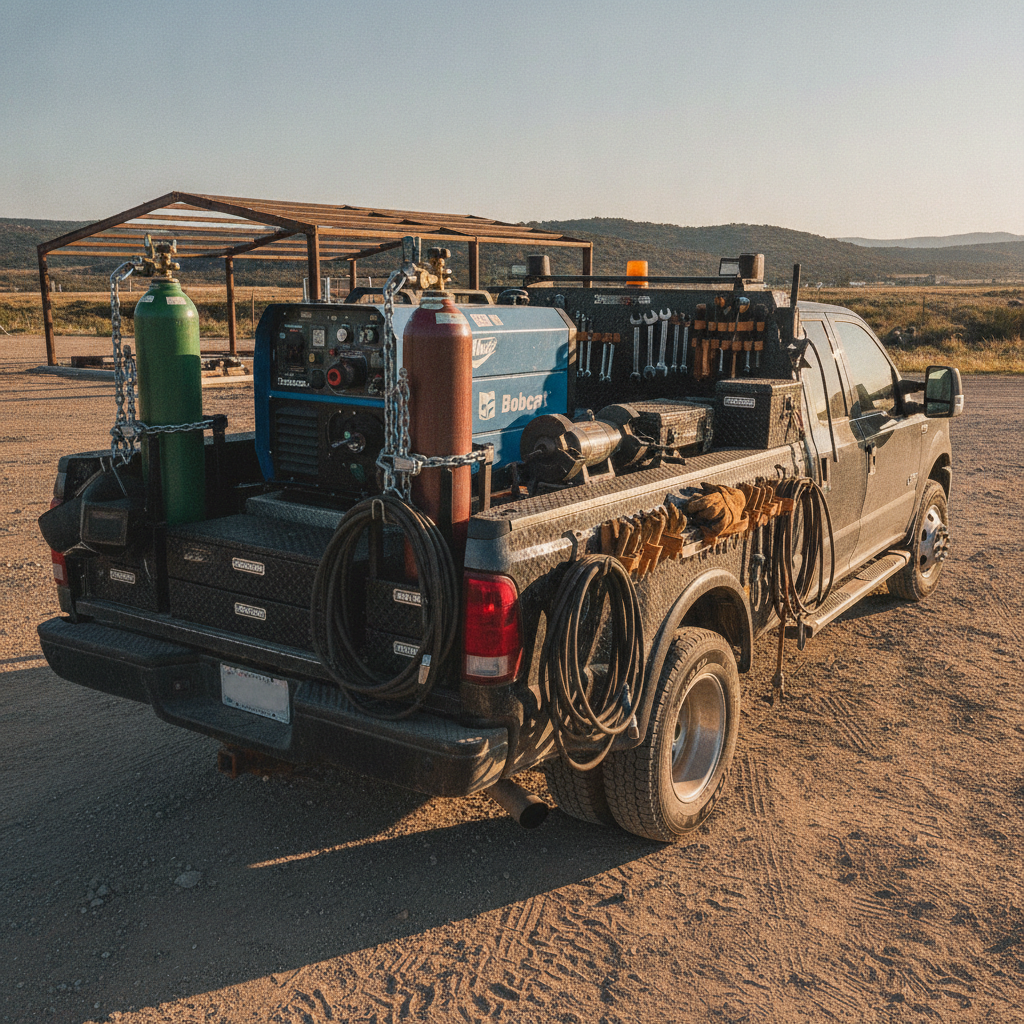
Here’s what a well-organized mobile rig looks like in practice. Everything I’m describing here is achievable on a moderate budget with a service body truck and a weekend of work.
Front of the service body (passenger side): Leads hung on hooks, organized by process. Stinger lead. Ground lead. TIG torch lead. All labeled, all hung so they run out clean.
Consumables drawer: One drawer per process. MIG drawer has tips organized by diameter, nozzles, liners. Stick drawer has rod organized by type in labeled tubes or a rod canister. TIG drawer has tungsten by diameter and type, collets, cups, back caps — everything in a foam-lined case so nothing rolls around or breaks.
Grinding station: Angle grinders mounted or stored in a dedicated spot. Wheels and discs in a bin organized by type — cut wheels, flap discs, grinding wheels. Separate bin for wire cups and flap wheels. You grab what you need without sorting through a mixed pile every time.
Machine: Mounted on a welded frame with a slide-out tray. Cables routed cleanly. Ground cable on a short reel or hung on a dedicated hook. Machine settings sheet laminated and attached to the mount for quick reference.
Cylinders: Secured in fixed brackets, organized by gas type, accessible without moving other gear.
Lighting: Two work lights on the service body. Drop light in a dedicated spot. Headlamp in the same pocket of the same bag every time.
When a rig is set up like this, you pull up to a job, open the body, and everything you need is exactly where you left it. You’re not thinking about gear. You’re thinking about the work. That’s the whole point.
Stop Bleeding Time — Fix the Rig
Nobody is going to come tell you your mobile rig organization is costing you money. Your customers don’t care. They just see a welder who shows up and gets to work — or doesn’t. Your bank account knows, though. It shows up in jobs that ran long, days that felt exhausting, and rates that never seem to stretch far enough.
Fix the truck. Spend one weekend doing it right. Build a system, label it, stick to it, and make everyone who works on your rig use the same system. It’s one of the highest-return investments you can make in a mobile welding business — and it costs almost nothing except time and attention.
The guys who run clean rigs aren’t just more organized. They’re more profitable, they’re less stressed, and frankly they look like they know what they’re doing before they strike a single arc. That matters when a customer is watching you work and deciding whether to call you back.
Get the rig dialed in. Then go weld.