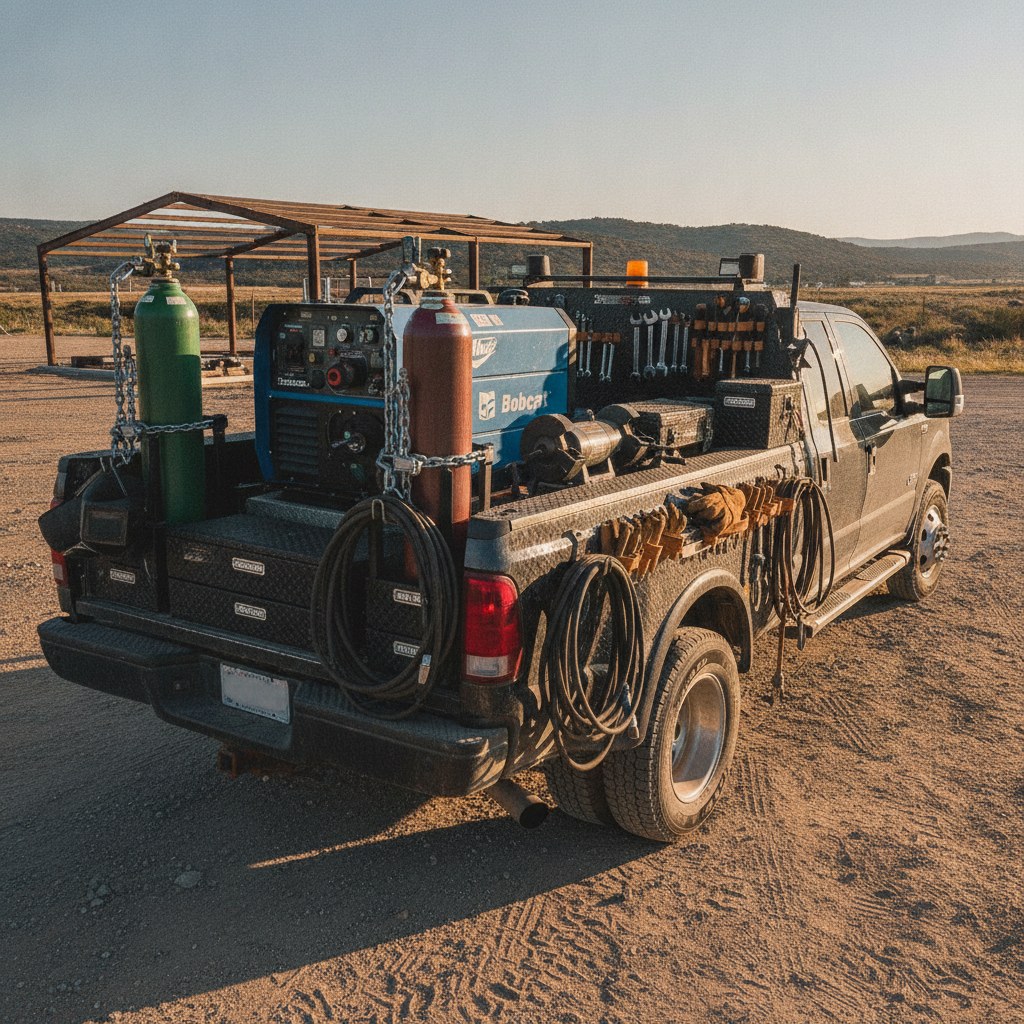
Here’s a number that’ll sting: if you spend twenty minutes digging through your truck before you strike your first arc, and you run five jobs a week, that’s over an hour and a half of unbillable chaos every single week. That’s not a productivity problem. That’s a mobile rig organization problem. And it’s completely self-inflicted. This post isn’t about being tidy for the sake of it. It’s about getting your rig dialed in so you stop bleeding time — and money — before the work even starts.
Why Mobile Rig Organization Is Actually a Business Problem
Most guys don’t think about their truck setup as a business issue. They think it’s a “I’ll clean it out this weekend” problem. Then the weekend comes and goes, and the truck stays exactly how it is — a rolling dumpster with a welder bolted to it.
But here’s the thing. Every minute you spend hunting for a tip, a ground clamp, or a roll of consumables is a minute you’re not billing. If you’re charging $100/hr and you waste 20 minutes per job, you’re handing back $33 before you’ve done anything. Multiply that across a week, a month, a year. That’s real money walking out the door.
And beyond the money, a chaotic rig makes you look like a rookie. Customers notice. If you show up to a job site and spend the first chunk of your visit rummaging through your truck, they’re mentally noting that you’re disorganized. First impressions on job sites matter more than people admit.
If you’re still figuring out how to price your services efficiently alongside organizing your operations, this post on pricing for certification services is worth a read — the same time-efficiency thinking applies across your whole business model.
Mistake #1: No Zoning System on Your Rig
The number one mobile rig organization mistake is treating your service body like a storage unit instead of a workstation. Everything just gets thrown in wherever it fits, and then you spend the next six months playing “where did I put that.”
Fix it with zones. It’s not complicated. Think about your workflow and organize accordingly:
- Zone 1 – First Touch: Everything you need in the first five minutes of any job. Ground clamps, leads, hood, gloves. This stuff should be front and center, accessible without climbing into the truck.
- Zone 2 – Consumables: Tips, nozzles, contact tips, rods, wire. Sorted by process. Not mixed together in a coffee can from 2019.
- Zone 3 – Gas and Power: Cylinders secured, regulators protected, extension cords coiled and hung — not crammed under a pile of cable.
- Zone 4 – Fab and Repair Tools: Grinders, cutters, clamps, squares. These get used but not on every job. They can live deeper in the truck.
- Zone 5 – Paperwork and Admin: Work orders, invoice books, pens, tape measure. One spot. Every time. No exceptions.
Zones turn a scavenger hunt into a predictable routine. You stop thinking about where stuff is and start thinking about the work.
Mistake #2: Leads and Cables Are a Tangled Nightmare
If your leads are coiled on the floor of your truck or wrapped around whatever was nearby, you are wasting time every single job. Cables tangle. Tangled cables take time to sort out. Time is money. This math is not hard.
Get proper cable hangers or hooks installed in your service body. Coil your leads the right way — over-under, not arm-wrap like you’re packing a garden hose. Label them if you’re running multiple processes. A bit of colored tape on the ends of your leads means you’re not tracing cables back to figure out which machine they’re from.
The same principle applies to your extension cords and ground cables. They should have a designated home, and they should go back to that home after every job. Not “most of the time.” Every time.
While you’re at it, think about your power setup. If you’re running a hybrid battery-powered welder on some jobs, make sure those charging cables and adapters have their own spot too. Nothing worse than showing up to a battery-powered job and spending ten minutes finding the right cable because it got mixed in with the stick leads.
Mistake #3: Consumables Are All Over the Place
I’ve seen trucks where MIG tips are in three different compartments. Grinding discs mixed in with the lunch cooler. Tungstens rolling around loose in a drawer with random hardware. This is how you spend $400 a year replacing consumables that were already in your truck somewhere.
Get a dedicated consumables system. Plano boxes, small parts organizers, labeled drawers — whatever works for you. The point is that every consumable has one location, sorted by process and size. When you’re low, you know. When you need it, you grab it. Done.
Sort it this way:
- MIG: tips by size, nozzles, liners, wire spools upright
- TIG: tungstens in a tube or case, filler rods in labeled tubes, collets and cups sorted by size
- Stick: rods in dry storage, sorted by rod type — not all dumped together
- Grinding: discs, flap wheels, cut-off wheels in separate sleeves
If you’re doing multi-process work on the same jobs — which most mobile welders are — this matters even more. Jumping between processes on a structural job is doable when your consumables are sorted. It’s a disaster when they’re not. For a deeper look at multi-process work in the field, this piece on field-ready multi-process welders covers the equipment side of that equation.
Mistake #4: Gas Cylinders Not Secured Properly
This one isn’t just an efficiency issue. It’s a safety issue. An unsecured cylinder rolling around in your truck is a problem waiting to happen — on the road and on the job site.
Cylinders need to be upright and secured with a proper chain or strap rated for the weight. They should be in a dedicated cylinder holder or rack, not wedged between a toolbox and a cooler. Regulators should be protected from impact. If a regulator gets knocked off in transit, your day just got a lot worse.
From an efficiency standpoint, proper cylinder storage also means you know exactly how many cylinders you have and what’s in them. Color code your valve covers or use cylinder collars. Know at a glance whether you’ve got Argon, CO2, or a mix on board without having to check labels while squinting in the sun.
Managing your shielding gas inventory is something a lot of mobile welders overlook until it bites them. This post on smart shielding gas management is a solid read if you want to stop running out mid-job or over-ordering.
Mistake #5: Your Setup Routine Is Improvised Every Time
Here’s one nobody talks about: if you don’t have a consistent setup routine, you will always forget something. Always. Because you’re relying on memory instead of habit.
Write a pre-job setup checklist. I don’t care if it feels like overkill. Use it for two weeks and it becomes automatic. Then you don’t need the list anymore — because the routine is locked in. But until it is, the list keeps you from showing up to a job with no grinding discs or a dead machine because you forgot to run it after your last job.
Your checklist should cover:
- Machine settings reset or noted from last job
- Leads connected and tested
- Ground clamp functional
- Consumables stocked for the job type
- Gas cylinder level checked
- Work order or job notes reviewed
- PPE accounted for — hood, gloves, sleeves
This is also where knowing your equipment inside and out pays off. If you’re running the right machine for the job, your setup is faster by default. Worth revisiting the gear discussion in this post on field-ready battery welders if you’re evaluating what you’re running.
Mistake #6: Your Truck Isn’t Set Up for the Jobs You Actually Do
This one takes some self-awareness. A lot of guys set up their rig for every possible scenario, which means it’s optimized for nothing. Your truck should be set up around the work you actually do most of the time — not hypothetical jobs.
If 80% of your work is structural steel in the field, your rig should reflect that. Stick and flux-core gear up front, easily accessible. Fab tools within reach. If you’re doing a lot of aluminum repair or pipe work, the layout changes accordingly.
Think about your strategic niche and let that drive your truck layout. The more specialized your work, the more dialed-in your rig should be for that specific type of job. Generalist rigs are fine when you’re starting out. But as you get intentional about the work you take, your truck setup should follow.
Small Fixes That Add Up Fast
You don’t have to rebuild your entire rig in a weekend to see results. A few targeted changes make a real difference fast:
Label everything. Drawer labels, bin labels, cylinder labels. You’ll thank yourself at 6 AM when you’re half-awake and trying to find a 3/32 tungsten.
Get a magnetic parts tray. Stick it to the inside of a door or to your machine. Small hardware, bolts, fittings — they go there while you’re working. Not in your pocket. Not on the ground.
Put a trash bag holder in the truck. Sounds dumb. Eliminates the slow creep of wrappers, empty tip boxes, and miscellaneous garbage that eventually buries the stuff you need.
Keep a spares kit. A small box with backup tips, nozzles, a spare contact tip, extra disc, and basic hardware. Not your main consumables storage — just a “oh no” kit for when something fails mid-job and you don’t want to dig through the whole truck.
Put your most-used hand tools in the same spot every single time. Chipping hammer, wire brush, angle grinder, tape measure. They go back. Always. Even if you’re tired. Especially if you’re tired.
The Real Cost of a Disorganized Rig
Let’s bring this back to the business reality. You got into mobile welding because you wanted to run your own operation and get paid for your skills. A disorganized rig quietly taxes every single job you run. It adds unbillable time, makes you look sloppy, increases the chance of forgetting something critical, and compounds your stress on every call.
Good mobile rig organization is a business investment. It’s not glamorous. You’re not going to brag about your organized consumables drawer the way you’d brag about a clean structural weld. But the efficiency you gain compounds over time in a way that absolutely shows up in your bottom line.
If you’re also thinking about the bigger picture of growing your welding business, this post on going from garage to shop has some good perspective on building systems that scale — and a well-organized rig is one of the first systems worth building right.
Final Word
Your truck is your shop. Treat it like one. A good shop has a place for everything, and everything goes back to its place. That’s not neat-freak behavior. That’s how professional operations run.
The guys who are consistently fast, consistently profitable, and consistently get called back are not winging it. They’ve got systems. Their mobile rig organization is one of the boring, invisible reasons they’re winning.
Stop digging. Start working. Your rate is only as good as the time you’re actually burning on the arc.