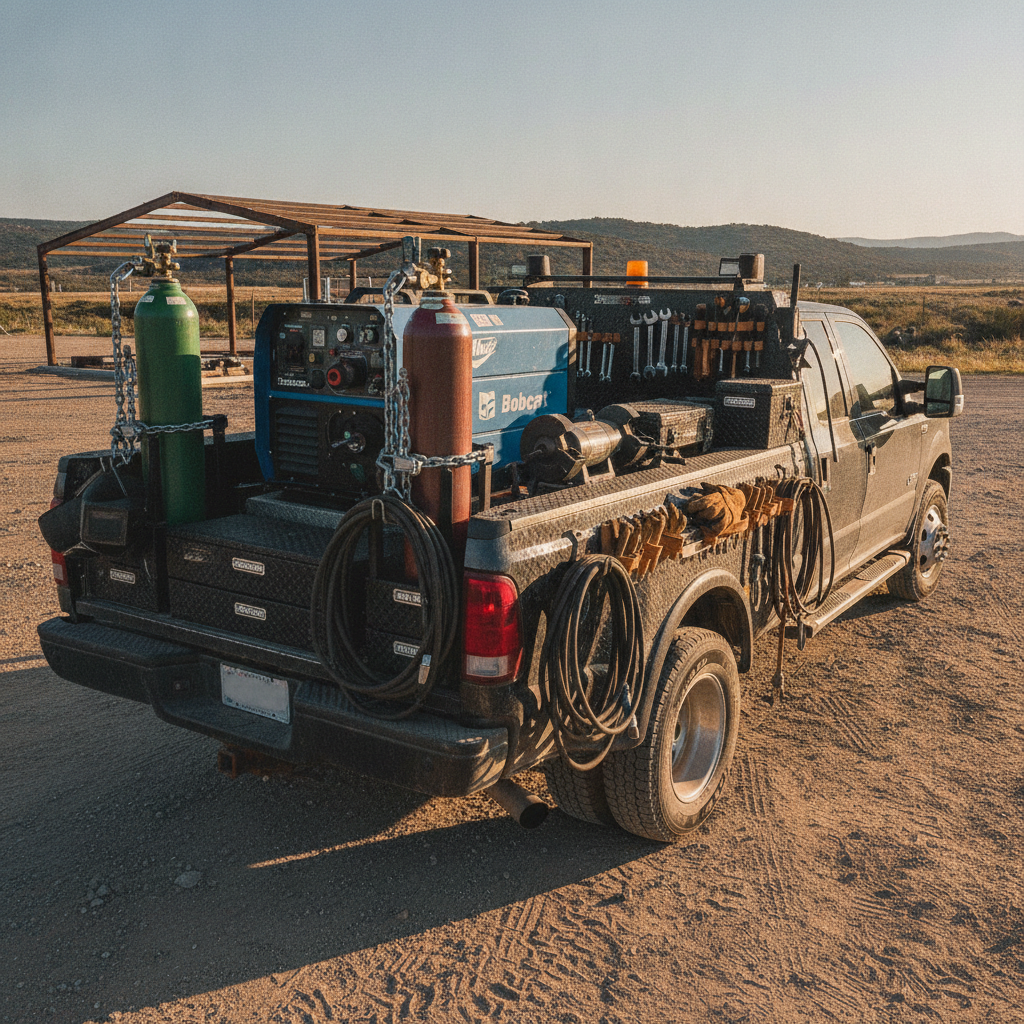
If your mobile rig organization looks like a hardware store exploded inside a utility body, you already know what happens when you pull up to a job. You spend the first twenty minutes digging through a pile of cables, grinding wheels, and mystery hardware just to find your chipping hammer. Meanwhile, your customer is standing there watching. That’s not a great look, and more importantly, that time is coming straight out of your effective hourly rate. Nobody’s paying you to play archaeologist in your own truck bed.
I’ve been running a mobile welding rig for over a decade. I’ve made every single one of these mistakes personally. Some of them I made for an embarrassingly long time before I wised up. This isn’t theory from somebody who’s never had grease under their nails. This is what actually works on the road, on real jobs, with real time pressure.
Let’s talk about what’s actually slowing you down — and how to fix it without spending a fortune.
The Real Cost of a Disorganized Welding Truck
Here’s a number worth thinking about. If you waste just fifteen minutes per job digging for gear, and you run five jobs a week, that’s over an hour of billable time gone every single week. At $100 an hour, that’s $5,200 a year. Just from being disorganized. That’s a machine payment. That’s a new welder. That’s real money flushed down the drain because you couldn’t find your contact tips.
Bad mobile rig organization doesn’t just cost you time. It costs you credibility. Customers notice when you look like you know what you’re doing. They also notice when you don’t. First impressions on a jobsite matter more than most welders want to admit, especially when you’re trying to build a repeat customer base.
The good news is that fixing this isn’t complicated. It just takes some intentional thinking about how your workday actually flows. You need to think about your rig the way a surgeon thinks about a tray. Everything in reach. Everything in order. Nothing missing when you need it.
Mistake #1: No Zones, No Logic
The number one mobile rig organization mistake I see is treating the truck bed like a storage unit instead of a work platform. Everything gets thrown in wherever it fits. Grinding wheels end up next to your lunch cooler. Electrode holders are buried under a tarp. Your angle grinder is somewhere in the back corner under three extension cords.
The fix is simple: zone your truck. Think of it in three basic categories.
- High-frequency items — things you grab on literally every single job. Helmet, gloves, angle grinder, leads, clamps. These live front and center, within arm’s reach of where you stand to work.
- Job-specific items — gear that comes out depending on the process. Stick rods, MIG wire, TIG torch consumables. These live in organized drawers or bins, labeled and sorted.
- Rarely used items — the stuff you bring because one day you might need it. These live in the back, out of the way, and they don’t get to take up prime real estate.
Once you zone your truck, setup time drops fast. You stop second-guessing where things are. You stop pulling everything out just to find one thing buried at the bottom. Zones mean your hands go to the right spot every time, automatically.
Mistake #2: Leads and Cables That Look Like Spaghetti
Tangled welding leads are an instant time-killer. You drop them out of the truck, they snag on the bumper, the whole pile hits the ground in a knot, and now you’re spending ten minutes untangling cable before you’ve touched a single piece of metal. It’s infuriating and completely avoidable.
A few things that actually work:
First, use a figure-eight coil on your leads every single time you store them. Not a loose pile. Not a random wrap around your arm. A proper figure-eight coil lays flat, stacks clean, and unrolls without twisting. Learn it once and do it every time.
Second, use a dedicated cable tray or hook system in your truck. Leads hung on hooks take up less space than coils lying on the floor, and they deploy faster. Some guys use large PVC hooks bolted to the side walls of their utility body. Cheap and effective.
Third, keep your work cable and your electrode holder cable separated. Color-code them or tag them if you have to. Grabbing the wrong one wastes time and looks sloppy.
If you’re running multiple processes on the road, your cable situation is even more critical. A good field-ready multi-process welder doesn’t do you any good if you spend fifteen minutes sorting out which leads go to what before every job.
Mistake #3: Consumables Without a Home
This one gets guys every time. You know you have contact tips. You bought a whole bag of them two weeks ago. But where are they? Are they in the red bin? The black bin? That plastic bag in the back corner? Nobody knows.
Consumables need a dedicated, labeled home. Full stop. Here’s a basic system that works:
Get a small parts cabinet — the kind with the little plastic drawers. Mount it or secure it in your truck. Label every drawer. 0.030 tips, 0.035 tips, nozzles, diffusers, liner sections, tungstens by size, rod ends, whatever you carry. When you use the last of something, it goes on your restock list immediately. Not later. Right then.
This single change saves more time than almost anything else on this list. You stop rummaging, you stop buying duplicates of things you already have six of, and you stop showing up to a job and realizing you’re out of the one thing you need.
While you’re at it, manage your gas situation too. A disorganized approach to shielding gas is its own kind of headache. If that’s an issue for your rig, the post on smart shielding gas management is worth a read.
Mistake #4: Tools That Aren’t Secure
A loose angle grinder rolling around your truck bed is a liability waiting to happen. It damages other equipment, it wears out faster, and one hard brake and it becomes a projectile. Unsecured cylinders are even worse — that’s not just a tool problem, that’s a safety problem.
Every tool in your truck should have a home it actually stays in when you drive. That means:
- Angle grinders in a mounted holder or a drawer with a latch
- Cylinders chained upright — every single time, no exceptions
- Hammers, wire brushes, clamps in a drawer or a hanging tool panel
- Spare wheels and discs in a flat bin, not loose in the bottom of a drawer
If you’ve ever had a grinding wheel crack because it got bounced around loose in your truck, you already know this lesson. If you haven’t yet, consider yourself warned.
Mistake #5: No Pre-Job and Post-Job Routine
Here’s the one that separates organized welders from guys who are perpetually scrambling. The actual organization of your truck doesn’t matter much if you don’t have a consistent routine for maintaining it.
The pre-job check doesn’t need to take long. Two minutes, max. A quick mental scan: leads out and coiled right, consumables stocked, gas turned off at the cylinder, tools accounted for, PPE in place. It becomes automatic fast.
The post-job reset is where most guys fall apart. After a long day, the last thing you want to do is put everything back exactly where it goes. So you toss the leads in the truck, throw the grinder on top, shove everything in and slam the doors. And then tomorrow morning you’re digging through a pile again. The post-job reset — even five minutes — is what keeps your rig organized over the long term. Without it, any system you build will decay within a week.
Build it into your habit. Do it before you leave the job. Do it while you’re still on the clock mentally. Don’t let yourself drive away with a messy rig.
Mistake #6: Ignoring the Top of the Truck
If you’ve got a service body with a ladder rack or a roof rack, you’ve got usable real estate up there. A lot of guys underutilize it. Long material — conduit, flat bar, tubing — can ride up top and stop cluttering your bed or bumping into your equipment. A pipe rack or ladder holder up top keeps long stock out of the way and protects it from the chaos in the bed.
Not everything belongs on the roof. Heavy stuff stays low. But using your vertical space intelligently is part of good mobile rig organization, and it’s often the most overlooked dimension of the whole setup.
Mistake #7: Building a Rig Without Thinking About Your Work
This is the big-picture mistake that causes all the smaller ones. A lot of welders set up their truck once — when they first buy it or first go mobile — and then never revisit whether that setup actually matches how they work. What made sense when you were doing mostly farm calls doesn’t necessarily work when you’re doing pipeline support or structural repairs. Your rig should evolve with your business.
If you’re running a specialty niche — trailer repair, heavy equipment, aluminum fab — your truck setup should reflect that. What you carry, how you carry it, and where you carry it should be a direct result of the specific jobs you run. A generalist setup is fine when you’re starting out. But as your business develops, your rig should get more dialed in, not more cluttered.
This connects to the bigger conversation about what kind of work you’re actually building a business around. If you haven’t thought hard about your niche yet, the piece on strategic niches for welding businesses is worth some time. And if you’re still sorting out the business side of things more broadly, the post from garage to shop covers a lot of the foundational thinking.
The Payoff of Getting This Right
When your truck is organized well, something shifts. You pull up to a job and you’re in control. You know exactly what you have, exactly where it is, and exactly how long setup is going to take. You project competence before you even strike an arc. That matters to customers. It matters to other tradespeople on the job. And honestly, it matters to your own headspace.
Working out of a chaotic rig is mentally exhausting in a way that’s easy to underestimate. The low-level frustration of not being able to find things, of having to improvise every time, of always being slightly behind — it adds up. A clean, organized rig removes a layer of friction from your entire day. The job itself is still hard. No reason to make everything around the job hard too.
If you’re investing in better equipment to go alongside a better rig — newer machines, better power options — it’s worth looking at what’s available in hybrid battery-powered welders for field use. And if you’re thinking about expanding your capabilities, understanding how to evaluate equipment investments carefully before you spend is always a smart move.
Quick-Reference: Mobile Rig Organization Checklist
Here’s a stripped-down checklist you can actually use. Print it out, put it on a clipboard in your truck, use it until it becomes second nature.
- Three zones defined: high-frequency, job-specific, rarely used
- Leads coiled figure-eight and hung on hooks or stored flat
- Consumables in labeled drawers, restocked immediately when low
- All tools in a dedicated, secured home — nothing rolling loose
- Cylinders chained upright every single time
- Pre-job two-minute check is habitual
- Post-job reset done before leaving the site
- Roof/rack space utilized for long stock
- Setup reflects your actual work, not just what fit when you started
Final Thought
Nobody’s going to hand you a prize for having the cleanest rig on the road. But you’ll notice the difference in your bank account at the end of the month. Less wasted time means more billable hours, more jobs in a day, and less of that grinding frustration that comes from fighting your own equipment just to do your job.
Good mobile rig organization isn’t about being fancy. It’s about being professional. It’s about respecting your own time and your customer’s time. The guys who last in this trade are the ones who run their operation like a business, not like a rolling yard sale.
Fix your truck. Do it this week. You’ll wonder why you waited.