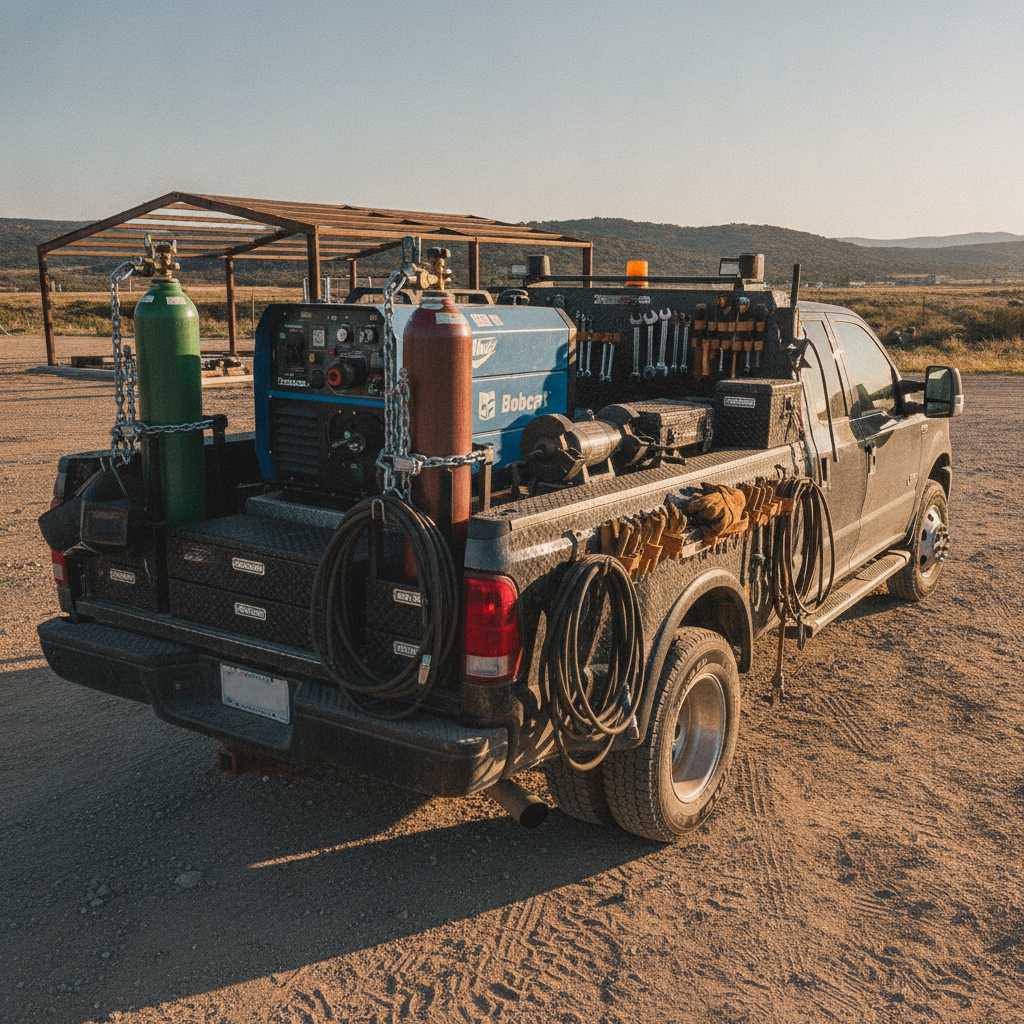
Let me paint you a picture. You pull up to the job site at 7 AM. The foreman is watching. You dig through a pile of cables, trip over a rod bucket, move three things to find your ground clamp, and finally strike your first arc at 7:22. That twenty-two minutes? Gone. You’re not getting paid for it. And if you’re billing hourly, you just handed the customer a discount they didn’t ask for. A sloppy mobile rig setup is one of the most expensive habits a field welder can have, and most guys don’t even realize they’re doing it.
This isn’t about being neat for the sake of neat. This is about money. Time on the job site is the only inventory you have to sell. Let’s talk about the specific mistakes that are bleeding your hours dry, and what to actually do about them.
Why Your Mobile Rig Setup Is Costing You More Than You Think
Most welders who go independent think the hard part is finding work. Spoiler: it’s not. Once the phone starts ringing, the hard part is staying profitable on every job. A mobile rig setup that wastes fifteen minutes per job doesn’t sound like much — until you run the math.
Say you’re running five jobs a week and losing twenty minutes of productive time per job through disorganization. That’s one hour forty minutes a week. At $85 an hour, you’re throwing away roughly $140 every single week. Over a year, that’s more than $7,000 in lost billable time — from a messy truck bed. That number should make you want to go reorganize your rig right now.
And it’s not just the money. Looking disorganized on a job site tells the foreman and the GC something about you. First impressions in this trade are sticky. If you show up looking like you threw your equipment in the truck during an earthquake, people notice. If you want to build a reputation that brings repeat work and referrals, your rig is part of your brand — whether you like it or not.
Before we dig into the fixes, if you’re still in the early stages of building your business, the post on going from garage to shop covers a lot of the foundational stuff that sets you up for this kind of efficiency down the road.
Mistake #1: No Dedicated Home for Every Piece of Gear
This is the big one. Everything on your rig should have one spot, and it should always go back to that spot. Not “usually.” Not “when I remember.” Always. The moment something doesn’t have a home, it becomes a pile, and piles turn into excavation projects when you’re trying to find your ground clamp at 6:45 in the morning.
Walk through your rig right now and ask yourself: can I put my hand on every piece of critical gear in under ten seconds without looking? If the answer is no for anything, you have a problem worth fixing.
Here’s how to actually fix it:
- Mount everything that can be mounted. Rod holders, torch holders, cable hooks — get them off the floor of the truck bed.
- Use labeled drawers or bins for consumables. Don’t mix your 6010 in with your 7018. Don’t dump your tips in the same bin as your nozzles.
- Put your most-used gear in the easiest-to-access location. Your angle grinder doesn’t belong buried under your chains.
- Designate a “ready box” — a small toolbox or tray right at the tailgate that has the stuff you need every single job: markers, angle finder, tape, chipping hammer, wire brush.
Sounds basic, right? Most guys haven’t actually done it. Most guys are still digging.
Mistake #2: Cable Management That’s Just a Pile of Cable
Cables are the bane of the disorganized welder. They tangle, they kink, they get run over, and when you need them fast they’re always the last thing you find. Bad cable management is also how you end up with damaged leads you didn’t notice until you’re already at the job trying to figure out why your arc is garbage.
A functional mobile rig setup has cables managed in a way that lets you deploy and recover them fast. That means:
- Figure-eight your leads when you coil them. Don’t just wrap them in circles — they’ll twist and fight you every time you unroll them.
- Use dedicated cable hooks or racks mounted to the side of the truck bed or the headache rack. Keep leads off the floor.
- Keep your work lead and electrode lead separated. When they’re in one tangled mess, you lose time every single job.
- Inspect leads every time you coil them. Cracks, bare spots, damaged connectors — find them before the job, not during.
If you’re running multiple processes — and most of us are these days — cable organization gets even more critical. Running MIG, TIG, and stick out of the same rig means you’ve got a lot of leads to manage. The post on field-ready multi-process welders goes into detail on equipment selection that makes this more manageable from the start.
Mistake #3: Consumables You Can’t Find When You Need Them
Running out of consumables mid-job is a rookie mistake. Running out and not knowing you’re low because your storage is a disaster is worse. You should be able to look at your rig before you leave the shop in the morning and know exactly what you’ve got and what you need.
Gas management is part of this too. Showing up to a job with a half-empty cylinder because you forgot to check it is the kind of thing that makes customers start questioning their decision to call you. Get a system for tracking your gas levels. Check before every job, not after. The post on smart shielding gas management is worth reading if you want to tighten this up.
For rod and wire, use dedicated dry storage. Your 7018 is worthless if it’s been sitting loose in an open rod can that got rained on. Small details, big consequences.
Mistake #4: Tools That Don’t Have a Job-Site Ready State
Here’s what I mean. Your angle grinder should be ready to run when you pull it out of the truck. Not “mostly ready, just need to find the right disc.” Ready. The disc you use 90% of the time should already be on it. Your brushes should be clean. Your chipping hammer should be where you can grab it in five seconds.
Every tool that needs prep before it works is a tool that’s costing you time. Do the prep at the shop, not on the job site. Swap out worn discs the night before. Charge your batteries before you leave. Fill your marker before you load up. This sounds like I’m lecturing you about being an adult, but you’d be amazed how often this stuff gets skipped.
Make a pre-job checklist and run through it every morning. Keep it short — ten items maximum. Tape it to the inside of your toolbox lid if you have to. The point is to build a habit so nothing gets skipped when you’re tired or rushing.
Mistake #5: No System for Paperwork and Job Documentation
I know, I know. You’re a welder, not an office manager. But if you’re running a business, paperwork is part of the job. And if your work orders, inspection records, and customer info are stuffed in various places around the cab, you’re going to look like a mess when a customer asks a question you can’t answer.
Keep a dedicated folder or binder in the cab for active job documentation. If you’re doing any certified work, your weld records need to be accessible and in order. If you haven’t thought hard about how certification work fits into your business, the posts on pricing for certification services and building a certification readiness calendar are worth your time.
Mistake #6: A Loading Order That Makes No Sense
How you load your rig matters almost as much as what’s on it. If the stuff you need first is under the stuff you loaded last, you’re creating a problem every single morning before the job even starts.
Think about the order of operations on a typical job. What do you need first? Usually it’s your power setup, your ground, your leads, and your PPE. What comes after? Process-specific equipment, consumables, grinding tools. Load in reverse order of use — last in, first out.
Also, weight distribution matters for how your truck handles and how your equipment takes the beating of daily road use. Heavy stuff low and toward the cab. Fragile stuff protected. This isn’t overthinking it — it’s just not being the guy whose machine walks off the tailgate on a bumpy road.
Small Fixes, Real Results
None of this is revolutionary. That’s the point. The gap between a welder who loses twenty minutes a day and one who doesn’t isn’t talent or experience — it’s habits and systems. The guys who run tight mobile rig setups didn’t get there by accident. They got fed up with wasting time, made a few decisions, and stuck to them.
If you’re building your business from scratch, now is the time to build these habits. It’s a lot easier to build a good system when you’re starting than to fix a disaster you’ve been living with for two years. The post on measure twice, invest once covers smart early-stage decisions that pay off long-term — the same principle applies here.
If you’ve been at this a while and you know your rig is a mess, pick one thing this week and fix it. Just one. Cable management, rod storage, your ready box — whatever the worst offender is. Fix that, let it become habit, then move to the next thing. You don’t need to overhaul everything in a weekend.
The Bigger Picture: Your Rig Is Your Shop
Shop welders have the luxury of a fixed workspace. Everything is where it is because that’s where it lives. As a mobile welder, your truck is your shop. You just happen to move it around. That mindset shift matters.
A real shop doesn’t have piles of junk in the middle of the floor. A real shop has systems. The guys who are killing it in this trade — the ones booked solid, the ones GCs call first — they run organized rigs. Not because they’re obsessive about neatness, but because they figured out that time is the one thing you can’t make more of.
Your mobile rig setup is either working for you or against you on every single job. There’s no neutral. The time you spend cleaning it up this weekend will pay you back every week for as long as you’re running that rig.
Get it sorted. Go make some money.