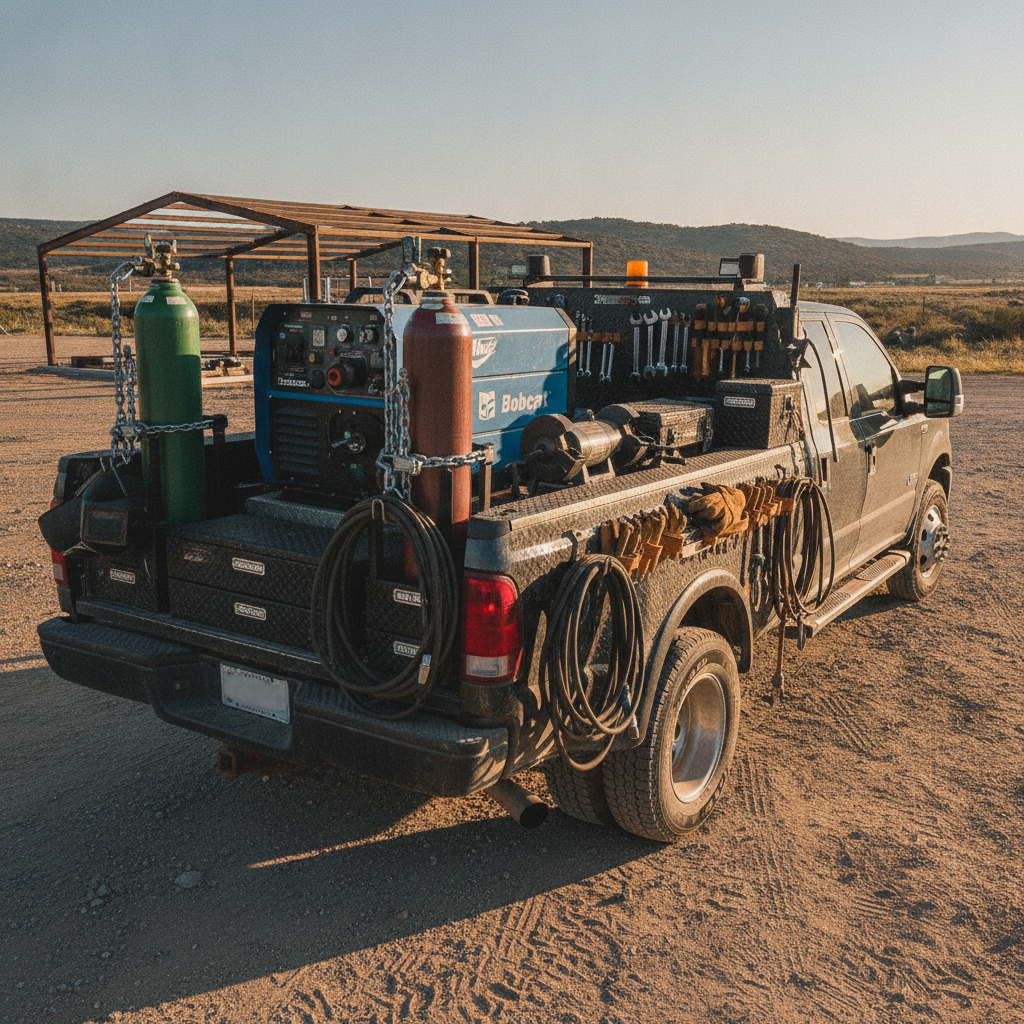
Your Truck Is Either Making You Money or Wasting It
Let me paint you a picture. You pull up to a job site at 7 AM. The foreman’s already looking at his watch. You pop open your service body and spend the next twenty-three minutes moving a grinder to find a cup, digging under leads to find your striker, and realizing your rod oven is buried behind the spare gas bottle you forgot to use last Tuesday. That right there? That’s your profit margin bleeding out on a gravel parking lot.
Mobile rig organization isn’t a luxury. It’s not something you get around to when business slows down. It’s the difference between a $95/hour operation and one that actually nets $95/hour. Every minute you spend looking for something is a minute you aren’t billing for. And if you’re still figuring out your rates, go read what pricing for certification services actually looks like — because wasted time on the clock hits harder than most guys realize.
I’ve been running a mobile rig for over a decade. I’ve made most of these mistakes myself. Some of them more than once, which is embarrassing to admit, but here we are. This post is about fixing the dumb stuff that costs you time every single day.
Mistake #1: No System, Just Stuff
The number one mobile rig organization failure isn’t a lack of storage. It’s a lack of system. Most guys just throw stuff in the truck and assume muscle memory will take over. It won’t. Especially not when you’re running multiple job sites, different processes, and different material types week to week.
Here’s how a system works: everything has a home, and everything goes back to that home at the end of every job. Not when you feel like it. Every job. No exceptions.
Start by doing a full audit of what’s actually in your truck right now. Pull everything out. I mean everything. You’ll find at least three things you didn’t know you had and two things you’ve been buying duplicates of because you couldn’t find the original. That’s cash money sitting in a dark corner of your service body.
Divide your truck into zones. Think of it like a shop floor layout, just on wheels. You want a process zone (welder, wire, leads), a cutting and grinding zone (grinders, cut-off wheels, flap discs), a consumables zone (rods, tips, nozzles, anti-spatter), and a hand tool zone (clamps, squares, tape, markers). Keep each zone consistent. Don’t mix zones. If a grinder ends up in the consumables bin, you’ve already failed.
Mistake #2: Leads Everywhere Like a Spaghetti Convention
Welding leads are the worst part of any rig if you let them be. They tangle. They kink. They get run over. And when you’re in a hurry, nothing slows you down like trying to pull a lead that’s wrapped around your gas bottle three times and looped through the handle of a dead angle grinder.
Get dedicated lead storage. There are a dozen ways to do it — wall-mounted coil brackets, simple wooden pegs, or a shallow tray bolted to the floor of your service body. The method matters less than the consistency. Coil your leads the same way every single time. Over-under if you’re doing it right. That whole “throw it in a pile and deal with it later” move is why later always takes longer than it should.
Also, if you’re running multiple processes — and if you’re looking at the kind of field-ready multi-process welders worth running in the field, this breakdown is worth your time — you’ve got multiple leads to manage. Label them. Colored electrical tape on each end costs almost nothing and saves real minutes when you’re switching between SMAW and MIG on the same job.
Mistake #3: Consumables Are a Disaster Zone
Rod boxes sliding around loose. Open tubes of wire getting nicked and rusty. Tips rattling around in the bottom of a drawer mixed in with drill bits and a random zip tie collection from 2019. Sound familiar?
Consumables need their own dedicated, organized space. And they need to be sorted by process and size, not by “whenever I threw it in here.” This isn’t being precious about it — it’s just math. When you can’t find a 7018 3/32 rod and end up grabbing a 6013 because it was on top, you’ve already made a decision that might cost you a grind-out.
Use a small parts organizer with labeled bins. Get the cheap plastic ones if budget is tight. Label them with a label maker or even a piece of tape and a Sharpie. Sort by process: MIG tips and nozzles together, SMAW rods by classification, TIG consumables in their own sealed container. If you’re working across dissimilar metals or specialty applications — and if you’re doing that kind of work you already know it gets complicated fast — keep specialty consumables separated and clearly labeled so you aren’t running 309L on carbon steel at 6 AM half-awake.
Keep your most-used consumables at the front of the truck, waist height. Stop making yourself dig for the thing you grab twenty times a day.
Mistake #4: Your Welder Isn’t Secured Properly
This one isn’t just about organization — it’s about not putting yourself through a costly repair or, worse, injuring yourself or someone else. A machine that shifts every time you hit a pothole is a machine that’s wearing out its connections, stressing its case, and eventually going down in the field at the worst possible time.
Mount your welder. Properly. Use rubber isolators to cut down on vibration. Make sure the cooling vents aren’t blocked by whatever pile of junk happened to end up beside it that week. If you’re running a battery-powered or hybrid machine, securing it matters even more — here’s what to know about hybrid battery-powered welders for field use, including weight and mounting considerations that are easy to overlook.
Also, keep airflow in mind. A welder that overheats because your organization plan accidentally blocked its intake is going to shut down mid-job. And you know exactly when it’ll happen: on a rush job, on a Friday afternoon, when the foreman is standing right behind you.
Mistake #5: Gas Bottle Management That Makes No Sense
Here’s a common scene: one full bottle, one empty bottle, and one bottle that might be empty but you’re not sure, all chained together in a configuration that makes it impossible to swap any of them without a fifteen-minute engineering project. Meanwhile, you’ve got a part-full bottle rolling loose in the bed because it didn’t fit in the rack.
Keep your bottle management simple and consistent. Full bottles on one side, empties on the other. Always. No guessing, no “I’ll remember which one is which.” If you’re managing multiple gas types for different processes — and smart shielding gas management is worth understanding before you’re running low mid-job — label every bottle clearly and rotate your stock so you’re not burning through a partial while a full one sits unused.
Chain everything that should be chained. Use proper bottle brackets. Don’t let anything roll free in the bed. That’s not a rig organization tip — that’s just basic physics and common sense.
Mistake #6: No Pre-Job and Post-Job Routine
Even the most organized truck in the world falls apart without a routine to maintain it. The guys who say “I don’t have time to organize” are the same guys burning twenty minutes every morning digging through a service body that started tidy six months ago.
Build a pre-job checklist and a post-job reset checklist. They don’t have to be fancy. A laminated card in the truck door is fine. Pre-job: leads where they need to go, consumables confirmed for the day’s process, machine settings checked, gas confirmed, safety gear accessible. Post-job: leads coiled and stored, consumables restocked from the shop before next use, garbage out, anything that moved gets put back.
This is a habit, not a one-time project. If you’re building out a startup business and trying to figure out how to systematize your operation from day one, going from garage to shop covers a lot of the operational thinking that applies here too. Same principles. Different scale.
Mistake #7: Safety Gear Is the Last Thing You Pack
Your helmet, gloves, and leathers should be the most accessible things on the truck. Not buried in a bag under the back seat. Not inside a toolbox you have to unlock. Right there, up front, grab-and-go.
A lot of guys treat PPE like an afterthought because they’ve been doing this long enough that it feels automatic. But when you’re in a hurry and a customer is standing there watching you set up, you don’t want to be the guy playing hide-and-seek with his own helmet for five minutes. It doesn’t look professional. And more importantly, there’s a version of rushing through that setup where you skip something and end up regretting it.
Keep a spare set of gloves in the truck. At least one backup. They disappear constantly and there’s no scientific explanation for it — it just happens.
Mistake #8: Tool Overload — Taking Everything “Just in Case”
A service body crammed with every tool you own isn’t preparedness. It’s anxiety with a coat of bed liner on it. The more you have in the truck, the harder it is to find anything, and the more likely things are to shift, break, or disappear.
Be intentional about what lives in the truck permanently versus what you load specifically for a job. Permanent items should be your core process tools, the ones you touch on ninety percent of jobs. Job-specific items get loaded the night before and pulled off when you’re done.
If you’re trying to figure out which equipment is actually worth having on the rig versus what’s just taking up space, thinking strategically about your niche helps a lot. Strategic niches for mobile welders walks through how your service offering should drive your equipment list — not the other way around. If you’re doing mostly structural work, your kit looks different than if you’re doing agricultural repair or pipeline maintenance.
What Good Mobile Rig Organization Actually Looks Like
Let me give you the short version of what a well-organized rig actually looks like in practice.
- Everything has a labeled spot. No guessing, no hunting.
- Most-used items are most accessible. Stop reaching past your striker to grab the thing you need every three minutes.
- Consumables are sorted, covered, and protected. Moisture, dust, and damage are your enemies.
- Leads are coiled and stored consistently. Every job, every time.
- Your machine is mounted, vented, and stable. Not sitting on a prayer and a rubber mat.
- Gas bottles are organized full vs. empty. Always.
- PPE is front and center. Not an afterthought.
- You have a reset routine. The truck ends every day the way it started.
None of this is complicated. That’s the thing. Mobile rig organization doesn’t require a custom fabricated service body or a five-figure equipment overhaul. It requires about half a Saturday, a label maker, some brackets, and the discipline to maintain the system you build.
The Real Cost of a Disorganized Rig
Here’s the math nobody wants to do. If you’re losing twenty minutes per job to disorganization, and you’re running five jobs a week, that’s a hundred minutes a week. Over a fifty-week year, that’s roughly eighty-three hours. At $95 an hour, that’s close to eight thousand dollars a year you’re not billing.
Eight thousand dollars. For not having a labeled bin for your 6011 rods.
If you’re just getting your mobile operation off the ground and want to think about where to invest your time and money intelligently, measure twice, invest once is the right mindset. Don’t throw money at problems that a bit of organization would solve for free.
Your rig is your business card. The way it’s set up tells every foreman and every site superintendent exactly what kind of operation you’re running before you’ve struck a single arc. Make it look like you’ve done this before. Because you have.
Now go pull everything out of that service body and start over. You’ll thank yourself on Monday morning.