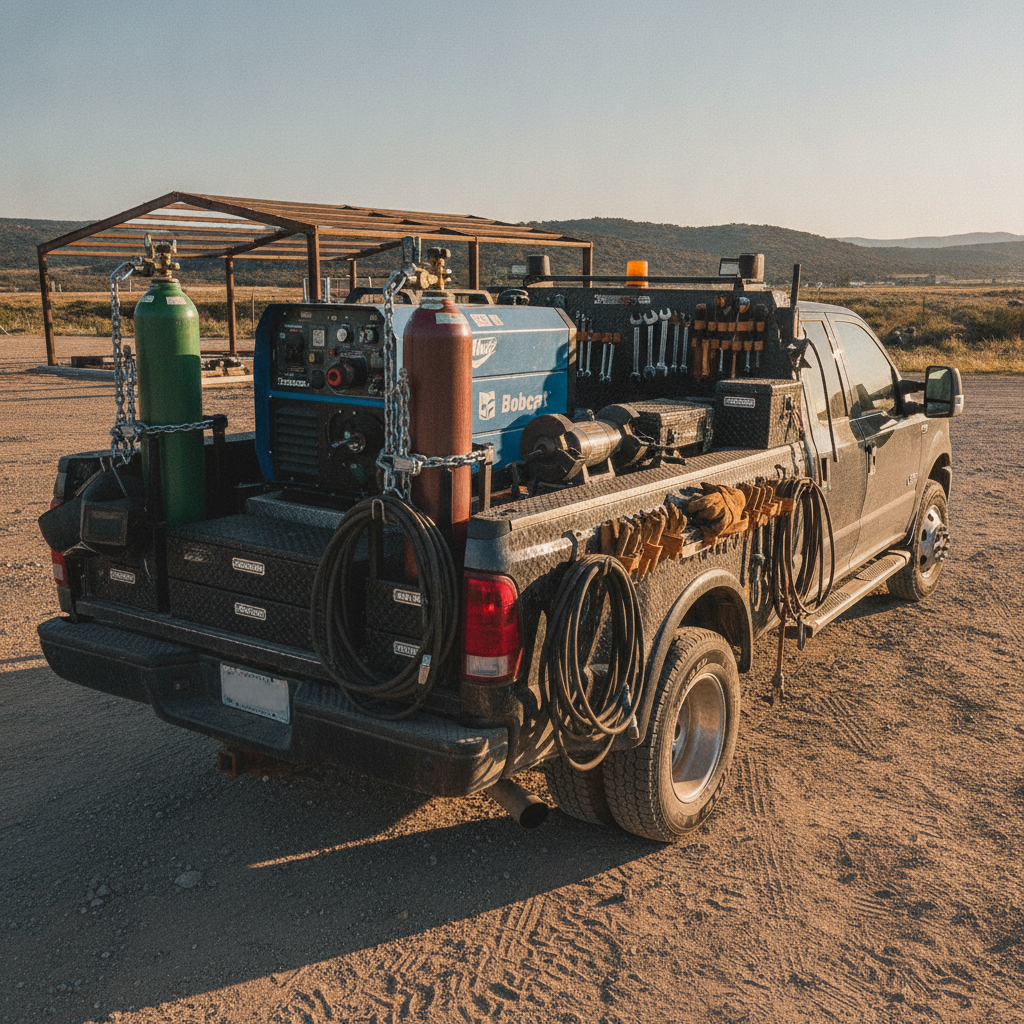
Let me paint you a picture. You show up to a job site, customer’s standing there watching you. You open the toolbox, dig past three random fittings, a half-empty spool of wire, two pairs of gloves with holes in them, and something that used to be a grinding disc. Twenty minutes later, you’re finally ready to strike an arc. Your mobile welder truck setup just cost you money — and worse, it cost you credibility. If you’ve been in this trade long enough, you’ve done this. So have I. But there’s no reason to keep doing it.
This isn’t about being tidy for the sake of it. This is about the fact that time on a job site is your hourly rate bleeding out. Every minute you spend hunting for a consumable is a minute you’re not billing. Over a week of jobs, a disorganized rig can quietly swallow two to three hours of your time. That’s real money. So let’s talk about what most mobile welders get wrong with their truck, and how to fix it without turning into some kind of organization influencer.
Why Your Mobile Welder Truck Setup Is the First Thing Customers Judge
You might think customers only care about the weld quality. They do — eventually. But before you strike that first arc, they’re already forming an opinion. A messy truck signals disorganization. Disorganization signals inexperience. Inexperience signals risk. That’s the mental chain happening in the customer’s head while you’re digging through your junk pile looking for a 3/32 electrode.
On the flip side, a clean, logical rig setup communicates something different. It says you’ve done this a thousand times. It says you run a tight operation. It builds confidence before you even pick up a stinger. If you’re building a mobile welding business from the ground up, your truck is part of your brand. Don’t overlook it.
And if you’re still figuring out which niche to chase in this industry, worth reading this piece on strategic niches for welders before you invest too much into a setup that doesn’t match your work type. The jobs you chase should drive how your rig is organized.
Mistake #1: No Zone System — Just One Big Pile
The most common truck setup mistake I see is treating the entire truck bed like one big junk drawer. Everything goes everywhere, and finding anything requires a full excavation. The fix is stupid simple: zones.
Divide your truck into functional zones based on when you need things. Here’s how I think about it:
- Strike zone: Everything you need before you weld — hoods, gloves, chipping hammer, angle grinder, clamps. This lives closest to the tailgate or most accessible compartment.
- Consumables zone: Electrodes, wire spools, tips, nozzles, gas lenses. Organized by process. Labeled if you have to. No shame in labels.
- Gas zone: Cylinders secured upright, regulators stored consistently, hoses coiled and not just thrown in a pile.
- Repair and misc zone: Fittings, extra cable connectors, electrical odds and ends. This is the only zone allowed to get slightly chaotic, but it still lives in one place.
When everything has a zone, you stop thinking about where things are. Your hands just go there. That’s efficiency. That’s how experienced operators work.
Mistake #2: Consumables Spread Across the Entire Truck
This one drives me crazy. Welding rods in one box, wire spools jammed under the seat, tips rattling around in a coffee can somewhere near the spare tire. You’re doing three processes in a week, you’ve got consumables for all of them scattered like confetti.
Get a dedicated consumables system. Doesn’t have to be fancy — a small drawer unit bolted in place works fine. Organize by process: one section for stick, one for MIG, one for TIG if that’s in your rotation. Within each section, organize by size. You should be able to grab a 6010 1/8″ rod with your eyes closed in the dark at 6 AM. That’s the standard you’re aiming for.
Also — stop buying in bulk quantities you can’t store properly. Having six pounds of 7018 loose in a bag that’s slowly absorbing moisture isn’t saving you money. It’s ruining your consumables and slowing your setup. Keep what you need for the week, store the rest at home or the shop.
If you’re running multi-process work in the field — which most of us do — your consumables organization has to match your process flexibility. We’ve written about field-ready multi-process welders before, and the machine decision and the rig organization decision go hand in hand. A versatile machine with a disorganized consumables setup is still going to slow you down.
Mistake #3: Cable and Hose Management Is an Afterthought
Nothing announces amateur hour faster than a truck where the leads are just piled in a heap. Tangled cables waste time every single job. You’re unrolling knots, chasing twists, trying to figure out where one cable ends and another begins. Every time. Because you threw them in the same pile again.
Buy cable reels or make your own mounting system. Even wrapping leads properly before stowing them takes thirty seconds and saves five minutes on the next job. Hoses get the same treatment — coil them consistently, store them consistently. If you’re running a cylinder with a regulator, that regulator should be protected, not rattling around loose.
For guys running battery-assisted or hybrid setups, cable management gets even more critical because you’ve got more cables. If that’s your rig situation, the post on hybrid battery-powered welders has some useful context on what that setup actually looks like in the field and what the layout demands.
Mistake #4: No Pre-Job Checklist — You’re Winging It Every Time
Here’s the thing about forgetting stuff. You don’t forget it because you’re careless. You forget it because you’re running on four hours of sleep, you’re thinking about three other jobs, and your brain is full. A pre-job checklist fixes this. Not because you need babysitting, but because it removes the cognitive load of trying to remember everything while you’re already moving.
A basic field checklist should cover:
- Machine settings and leads for the job type
- Consumables confirmed for the specific process and material
- Gas cylinder level and regulator condition
- PPE fully stocked — gloves, hood lens, sleeves
- Grinding and cutting equipment ready
- Any job-specific fittings or hardware
You run through this before you leave, not when you’re standing on-site missing something. Keep it on your phone or taped inside a toolbox lid. Simple. Effective. Stops the “I drove forty minutes to a job and forgot my ground clamp” situation we’ve all lived through.
Mistake #5: The Machine Is Not Job-Ready When You Arrive
Your welder should be set up as close to job-ready as possible before you leave. That means if you know you’re running 6010 on 3/8″ root passes tomorrow, your machine shouldn’t be sitting at the settings from the last job. Set it the night before. Coil your leads properly. Stage your consumables on top of the machine box.
Arrival time on a job site is not setup time — it’s confirmation time. You arrive, you confirm everything looks right, you make minor adjustments if needed, and you’re welding in five minutes. That’s the goal. Not twenty minutes of rummaging and resetting.
This also ties into knowing your machine well enough that setup is fast. If you’re still spending ten minutes dialing in your machine because you don’t know it well, that’s a different problem worth addressing. The better you know your equipment, the faster your setup becomes.
Mistake #6: No System for Odds and Ends (That Somehow Multiply)
Every welder’s truck accumulates junk. Random fittings, old electrodes that are definitely not worth keeping, mystery hardware from three jobs ago, backup equipment you’ve never actually used. This stuff quietly takes over your truck and turns every bin into a treasure hunt.
Do a truck cleanout quarterly. Pull everything out. Throw away what’s useless. Return what belongs somewhere else. Organize what stays. It takes two hours and pays back in time savings over the next three months. Stop letting the junk layer build up because you’ll deal with it later. You won’t. Nobody does.
Also think about weight distribution when you’re reorganizing. Heavy stuff — cylinders, the machine itself, heavy toolboxes — should be as far forward as possible over the rear axle. This isn’t just about fuel economy. It affects how the truck handles, especially on uneven job site terrain. Worth thinking about if you’ve never considered it.
Building Efficiency Into Your Business, Not Just Your Truck
Your rig organization is a microcosm of how you run your business. The guys who have their truck dialed in usually have their pricing dialed in, their scheduling dialed in, their customer communication dialed in. It’s all connected. If you’re sloppy in one area, you’re probably sloppy in others.
If you’re early in building your mobile welding operation, there are some bigger-picture pieces worth getting right alongside the rig setup. The post on going from garage to shop walks through some of the operational decisions that matter when you’re growing. And if you’re thinking about how to price your work so your time actually gets compensated — especially once your setup is efficient and you’re getting through jobs faster — check out the breakdown on pricing for certification services. Getting faster doesn’t mean charging less. Price accordingly.
For guys tracking where their business time actually goes, the smart heat maps for startups approach gives you a data-driven way to see where you’re losing time and money across your whole operation — not just on the truck.
The Setup That Actually Works
Here’s the bottom line on a functional mobile welder truck setup. It doesn’t have to be pretty. It doesn’t have to look like a magazine photo. It has to be logical, consistent, and fast. You should be able to arrive at a job, set up, and be welding in under ten minutes on a standard field call. If you’re regularly going beyond that, your rig is costing you money.
Small adjustments compound. Shaving five minutes off setup per job, across twenty jobs in a week, is over an hour and a half back in your pocket. That’s billable time, drive time, or rest time — all of which matter when you’re running your own operation.
Stop tolerating the chaos because you’ve always done it that way. Spend a Saturday afternoon reorganizing your rig with a purpose. Zone it. Label it. Clean it out. Build a checklist. Then go run jobs with a setup that looks like you’ve been doing this for years — because you have.
The arc quality doesn’t change much between a clean rig and a messy one. But your efficiency, your professionalism, and your ability to scale the business sure do. Get the truck right, and everything else gets easier.