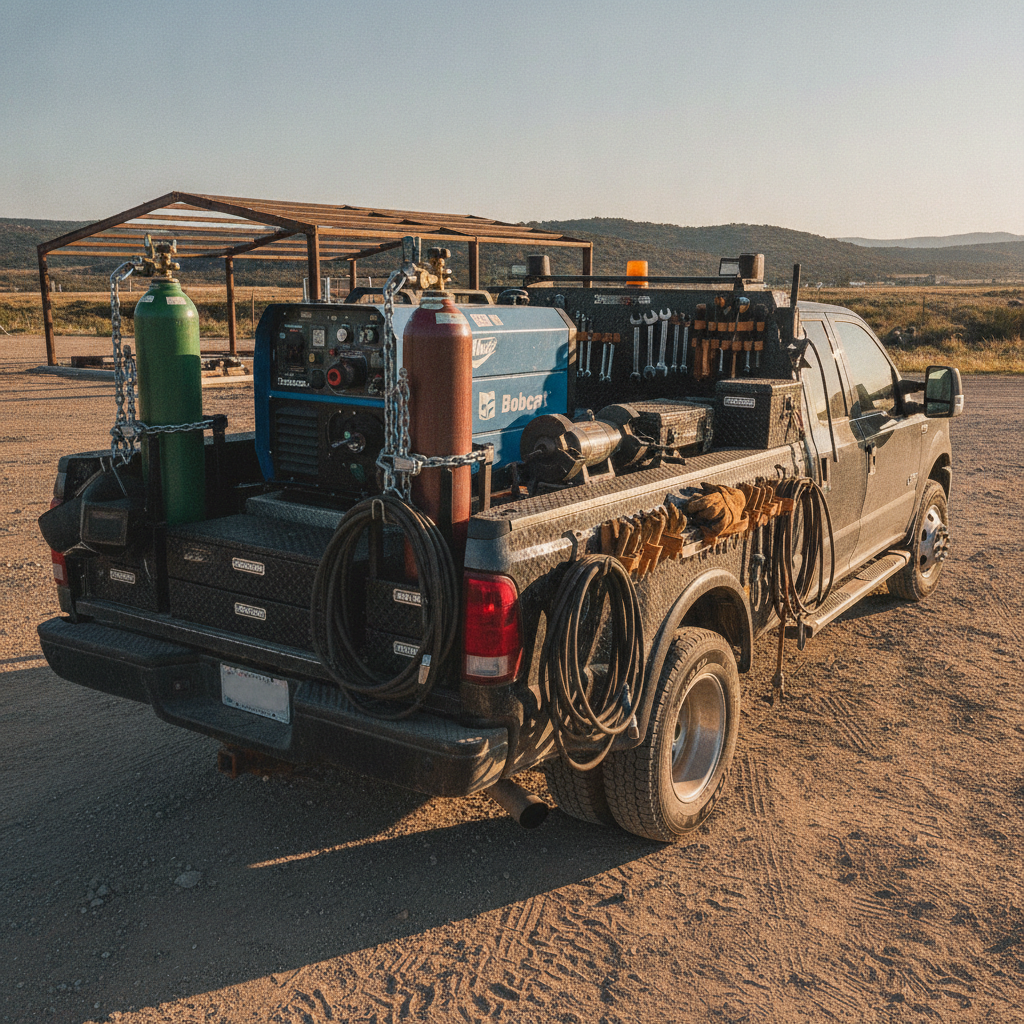
Let’s talk about truck setup mistakes that every mobile welder makes at least once — and a lot of guys make every single day. You pull up to a job, the clock starts running, and you spend the next twenty minutes digging through a pile of cables, grinding discs, fittings, and whatever else somehow migrated to the front of your truck bed. By the time you’re actually set up to strike an arc, you’ve already burned a chunk of your hourly rate standing in the dirt looking for your regulator wrench. That’s not a work ethic problem. That’s an organization problem, and it’s fixable.
This isn’t about having a Pinterest-perfect rig. Nobody on a job site cares if your truck looks like a magazine spread. This is about not wasting time, looking like you’ve done this before, and actually making money instead of just working hard. There’s a difference.
Why Truck Setup Mistakes Cost You Real Money
Most guys don’t track their setup time. They think about drive time, weld time, and maybe cleanup. But setup? That gets mentally filed under “part of the job.” Here’s the problem — it is part of the job, and you’re probably not charging for it correctly.
Think about a week with six jobs. If each one eats twenty minutes of hunting and digging before you’re operational, that’s two hours gone. Two hours at whatever your field rate is. Multiply that over a month. Over a year. You’re leaving serious money on the table because your truck looks like a junk drawer on wheels.
And it’s not just about money. Clients notice. When you show up and immediately look like you know exactly where everything is, you project competence. When you’re visibly digging through chaos, you’re starting the conversation on the back foot before you’ve even said hello. If you’re thinking about how your business is actually presenting itself in the field, the strategic niches post has some solid perspective on how positioning starts before you open your mouth.
The Most Common Truck Setup Mistakes Mobile Welders Make
1. No Zones, No Logic
The number one offense is loading a truck with no system. Everything just goes wherever it fits. The angle grinder is under the come-along which is on top of the extension cord which is buried under your hood. There’s no logic to it because it grew organically — job by job, tool by tool — until now it’s a disaster.
Fix this by thinking in zones. Your truck bed, toolboxes, and any auxiliary storage need defined purposes. Consumables in one spot. Electrical in another. Grinding and cutting tools together. Gas equipment in its own dedicated area. It sounds simple because it is simple. The problem is most guys never actually sit down and do it.
Zone your rig based on how often you need things. Stuff you grab on every single job — helmet, gloves, your most-used grinder — needs to be at the front, on top, or in the most accessible spot. Stuff you need once a week or for specialty work goes further back or in secondary storage.
2. Cables and Leads Going Everywhere
Welding leads are the worst offenders in a disorganized rig. They’re heavy, they’re long, and if you don’t have a system for coiling and storing them, they end up tangled around everything. You go to pull your stinger lead and suddenly you’re also pulling your ground clamp, a bungee cord, and whatever else got wrapped up in it.
Get cable hangers or dedicated reels. Some guys run their leads on side-mounted reels so they deploy and retract cleanly. Others use large hooks mounted on the headache rack or toolbox sides. Whatever system you pick, pick one and stick to it. Coil your leads the same way every time. Every. Single. Time. This is one of those habits that takes one week to build and saves you hours every month.
While you’re thinking about your power equipment setup, it’s worth knowing what your machine options are. The field-ready multi-process welders post breaks down what’s actually worth putting on a work rig versus what’s going to give you headaches in the field.
3. Consumables Buried and Unorganized
Electrodes loose in a box. Wire rolls stacked with no covering. Grinding discs mixed in with cutting discs. Gas tips in a bag with three other bags. Sound familiar? This is a slow bleed every single job.
Consumables need a dedicated, accessible, organized home. Rod ovens if you’re running 7018. Labeled bins or trays for your grinding and cutting discs. Wire spools covered and protected from moisture and contamination. A small parts organizer for tips, contact tips, nozzles, and fittings goes a long way. These things are cheap. The time you save pays for the organizers on the first job.
One trick that works well: a shallow drawer or tray right at the back of the truck that’s your “current job” tray. Before you head to a job, you pull the consumables you expect to need and put them in this tray. You’re not digging through the main storage mid-job. Everything you need is right there.
4. Gas Equipment That’s a Trip Hazard and a Time Sink
Loose cylinders are dangerous and illegal in most jurisdictions. But beyond the safety issue, unsecured cylinders with regulators and hoses flopping around are a constant tangle. You waste time dealing with the mess and you risk damaging regulators, which are not cheap.
Cylinders go in dedicated holders, chained or strapped in, period. Regulators get covers or caps when not in use. Hoses coil and hang on dedicated hooks — not draped over the cylinder, not tossed in the truck bed. If your rig setup doesn’t have dedicated cylinder holders, that’s the first thing to fix.
For the guys running battery or hybrid power setups to go with their gas equipment, the hybrid battery-powered welders post covers what’s worth knowing before you invest in that direction. Power setup and gas setup go hand in hand on a mobile rig.
5. No Pre-Job Checklist
You’ve done this job a hundred times, so you don’t need a checklist, right? Wrong. That’s exactly when you forget the thing that makes the job take twice as long. The job where you drove an hour and forgot your specific gas regulator for the process the client needed. The job where you had everything except the one fitting that would have taken you five minutes to grab from the shop.
A pre-job checklist isn’t admitting you’re forgetful. It’s a professional system that eliminates variables. Keep it simple — a laminated card in the cab or a checklist on your phone. Adjust it as your typical job scope changes. This is basic operational discipline, and it separates guys who run tight businesses from guys who just work hard.
The Setup That Actually Works: Principles Over Perfection
Here’s the thing about truck organization — there’s no universal perfect setup. Your rig depends on what you haul, what jobs you take, what processes you run, and what kind of truck or trailer you’re working with. A guy running stick exclusively needs different organization than someone doing multi-process work. If you’re doing multi-process field work, the dissimilar-metal welding post is worth a read for understanding how your process flexibility affects what you need to carry.
But these principles work regardless of your specific setup:
Frequency first. Most-used items, most accessible location. Every time.
Everything has a home. If a tool doesn’t have a specific spot, it will end up in the wrong spot. Give everything a place, and put everything back in its place at the end of every job. Not when you get back to the shop. At the job, before you drive away.
Separate clean from dirty. Grinding dust and weld spatter contaminate consumables and damage equipment. Keep your grinding and cutting setup separated from your welding consumables and sensitive equipment.
Weight and access balance. Heavy stuff low and forward for vehicle handling. But don’t sacrifice access to frequently-used heavy items. Sometimes you need to think creatively about drawer placement or tailgate access.
Redundancy where it counts. You don’t need three of everything. But having backup contact tips, a spare grinding disc, and a spare gas fitting means a minor issue doesn’t become a job-ending problem. The cost is nothing. The time saved when something goes wrong is significant.
Small Fixes That Pay Off Fast
You don’t have to rebuild your entire rig this weekend to start seeing improvement. A few targeted fixes deliver immediate returns.
Label everything. Your boxes, your bins, your trays. Labels cost nothing and eliminate the “where the heck is the…” moment completely. Even if you know where everything is, someone else helping you on a job doesn’t. And even you won’t remember your own system six months from now if it’s not labeled.
Add lighting. A battery-powered work light inside a toolbox or truck bed sounds trivial until you’re at a job at dusk digging for something. A well-lit storage area cuts your find time in half and eliminates the flashlight-in-the-teeth fumble.
Audit your load every month. Stuff accumulates. You’ll find tools you haven’t used in three months that are just taking up prime real estate. Pull them off, get them back to the shop, and free up the space for things you actually use.
Think about your financial setup with the same discipline you apply to your truck. A well-organized business has systems in place — knowing what to charge, when to charge it, and how to track it. The pricing for certification services post is a good example of applying that kind of structured thinking to your rates.
The Time Math Is Simple
Let’s do the math one more time because it’s worth it. Twenty minutes of setup waste per job. Six jobs a week. Two hours of unbilled, unproductive time every single week. At $100/hour that’s $200/week. That’s over $10,000 a year you’re leaving in the dirt because your truck is a mess.
Even if your numbers are half that — ten minutes per job, four jobs a week — you’re still looking at thousands of dollars a year in lost productivity. For fixes that cost you an afternoon and maybe a couple hundred bucks in organizers and holders.
If you’re in the startup phase and still figuring out your business model and overhead, the from garage to shop post covers the kind of operational thinking that applies here. Getting organized early is a lot easier than trying to fix years of bad habits once you’re busy.
Stop Making the Same Truck Setup Mistakes
The point isn’t to have the cleanest rig on the road. The point is to not waste time, not lose money, and not show up to a job looking like you threw your truck together in a parking lot ten minutes before arrival.
Truck setup mistakes are silent margin killers. They don’t show up on your invoice. Nobody puts “wasted 25 minutes finding my grinder” in their job notes. But the time adds up, the money adds up, and the professional image takes a hit every time a client watches you dig through chaos to find a basic tool.
Spend a Saturday organizing your rig properly. Build the habits that keep it organized. Implement a pre-job checklist and stick to it. These are not glamorous fixes. They’re not exciting. But they’re the kind of operational discipline that separates a mobile welding business that’s actually making money from one that’s just staying busy.
And there’s a difference between those two things. A big one.