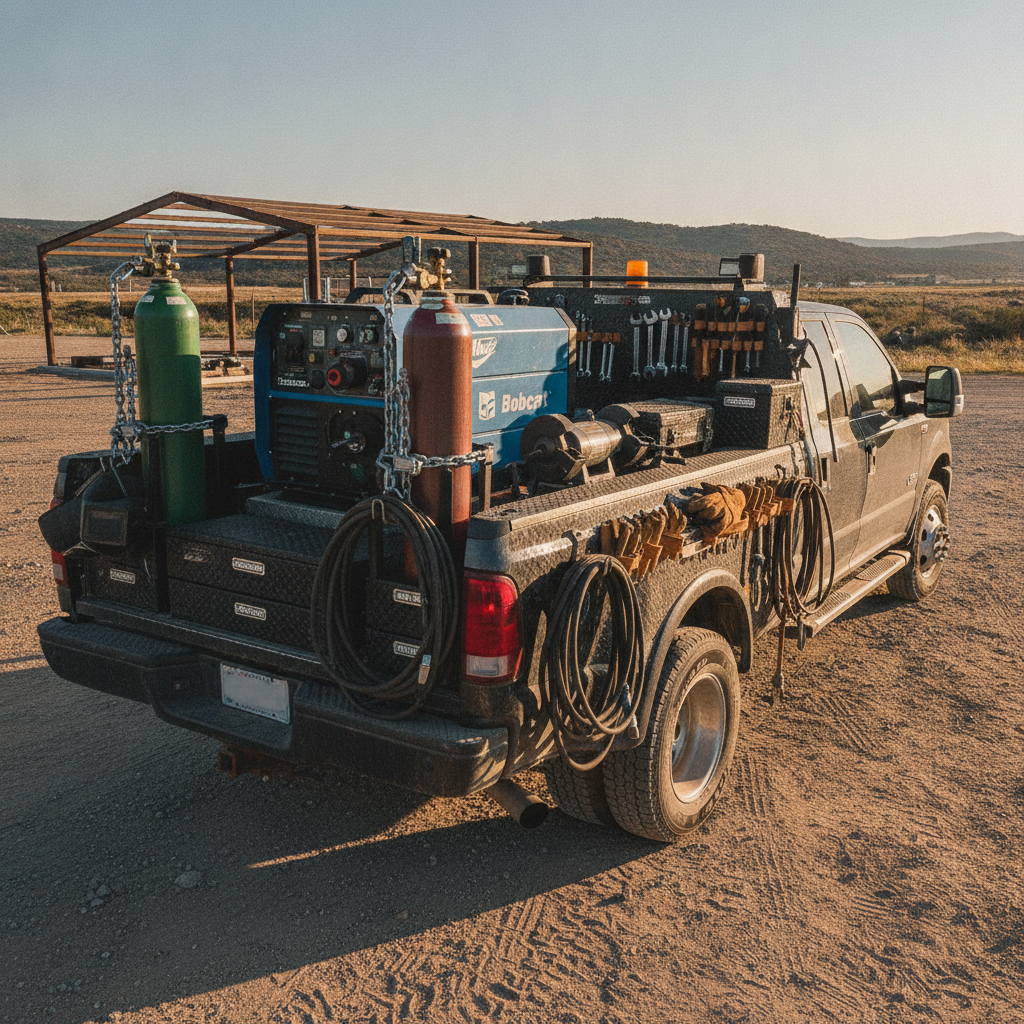
You know that guy on the jobsite — the one who spends twenty minutes digging through a pile of leads, loose fittings, and half-empty spools before he even fires up his machine? Don’t be that guy. Mobile rig organization isn’t some fancy concept. It’s the difference between billing eight productive hours and billing six while you tear apart your truck bed looking for a 5/32 rod holder you swear was just there yesterday. This post is about fixing that. Practical stuff. Stuff that actually works on a real rig doing real work.
Why Your Truck Setup Is Quietly Killing Your Rate
Here’s the math nobody talks about. Say you lose fifteen minutes per job to setup chaos. That’s fifteen minutes of unbillable fumbling — finding gear, untangling leads, realizing your grinder disc is buried under a rain tarp.
Five jobs a week. That’s over an hour of your time gone. Every week. At $100 an hour, you’re handing back $400 a month to the universe for free. Four hundred dollars because your truck looks like a storage unit on wheels.
The good news is this is fixable. It doesn’t take a new truck. It doesn’t take a professional van wrap and a fancy toolbox sponsorship. It takes about a weekend and some honest thought about how you actually work.
If you’re just getting your mobile operation off the ground, you might also want to read up on going from garage to shop — because a lot of the same organizational thinking applies whether you’re setting up a space or a rig.
Mistake #1 — No System for Where Things Live
The number one mobile rig organization failure isn’t having bad gear. It’s having no assigned home for anything.
When everything just gets tossed in the truck after a job, you create a lottery system. Maybe your wire brush is in the left box. Maybe it’s under the seat. Maybe it rolled out at the last jobsite and you don’t know yet.
Fix it with zones. Serious. Treat your truck bed like a shop floor with stations.
- Zone 1 — Welding leads and power: Everything electrical lives here. Stinger, ground clamp, extension leads, machine connections. Coiled properly, not thrown in a pile.
- Zone 2 — Gas and consumables: Cylinders secured and upright, always. Regulator covers on when traveling. Filler rod organized by type — not in one big tube where you’re guessing whether that’s 6010 or 7018 at 6 AM.
- Zone 3 — Hand tools and grinders: Every grinder has a home. Every disc has a holder. Wire brushes, chipping hammers, clamps — all in one consistent spot.
- Zone 4 — Safety gear: Helmet, gloves, respirator, fire blankets. Not buried. Not optional. Front and accessible because you need them before anything else.
This isn’t complicated. It’s just consistent. Once you do it, you stop thinking about where things are. Your hand goes to the right spot automatically.
Mistake #2 — Leads That Look Like Your Kid’s Headphones
Nothing slows a setup down like tangled leads. And nothing looks worse to a customer watching you work.
You show up to a job, and the first five minutes are you wrestling a lead knot the size of a basketball off the back of your truck. That customer is doing math in their head right now. Not favorable math.
Get in the habit of the over-under coil. Every single time. Without exception. Your leads lie flat, they uncoil without kinking, and they actually last longer because you’re not stressing the insulation with death spirals.
Hang them, don’t pile them. A couple of sturdy hooks or a simple rack on the inside of a toolbox lid keeps leads off the floor of the truck. Off the floor means not getting run over, not collecting grease and debris, and not turning into a trip hazard when you’re working fast.
While you’re at it — label your leads. A piece of heat shrink or even a wrap of colored tape at each end. You know which is which at a glance. No more tracing a cable from one end of the truck to figure out what connects to what.
Mistake #3 — Your Machine Is Doing Double Duty as a Shelf
Your welder/generator is a machine, not a table. Stop piling stuff on top of it.
Rod ovens sitting on the machine. Helmets balanced on the exhaust stack. Cardboard boxes of consumables wedged against the panel. Every single thing stacked on your machine adds vibration stress, blocks airflow, and makes the next setup slower because you have to move all that junk before you can even check the settings.
Mount the machine clean and keep it clean. If your rig doesn’t have a proper mounting frame or skid for the welder, that’s the first investment worth making. A properly mounted machine is stable, accessible, and doesn’t vibrate loose over a thousand miles of rough roads.
Speaking of machines — if you’re running multi-process work in the field and haven’t thought hard about your equipment choices, the post on field-ready multi-process welders is worth the read. The right machine for mobile work changes how your whole rig gets organized.
Mistake #4 — Consumables Are a Treasure Hunt
How many times have you bought a new box of electrodes because you couldn’t find the half-used one in the truck? Twice a month? Every week?
That’s not a supply problem. That’s a storage problem.
Rod needs a proper home. A dry one. Rod that’s been rattling around in the bottom of a toolbox with coolant drips and condensation is going to give you porosity problems and a bad day. Invest in a proper rod storage system — even a simple PVC tube rack mounted to the truck bed works. Label each tube. Know what you have.
Same goes for wire spools, tungsten, tips, nozzles, and contact tips. Small parts boxes with labeled compartments. Not a zip-lock bag thrown in the back. When you reach for a .035 contact tip, you should find it in under ten seconds without looking twice.
This also means doing a proper inventory reset at the end of each week. Fifteen minutes on Friday afternoon. Restock what you’ve burned through. So Monday morning you’re not discovering on a job that you’re out of the one thing you need.
Mistake #5 — Safety Gear Is an Afterthought
You should never have to dig for your helmet. Ever.
I’ve seen guys on jobs where the helmet is somewhere under a tarp, behind a cylinder, under a jacket. Every time they need to strike an arc they do a thirty-second dig. Over an eight-hour day that adds up. Over a career it’s genuinely embarrassing.
Safety gear goes in the most accessible spot on your rig. Not the most convenient leftover spot — the best spot, deliberately assigned. Helmet on a hook at the back of the truck where you can grab it while your other hand is on your stinger. Gloves hanging right next to it. Glasses clipped or velcroed right there.
This isn’t just about time. This is about actually putting your gear on every time because it’s right there. Not skipping it because it’s a pain to find.
Mistake #6 — No Prep Kit for the Walk-Up
Here’s something the organized guys do that most people never think about. They have a small walk-up kit — a bag or small box they grab immediately when they step out of the truck.
In it: measuring tape, soapstone, a sharpie, a clamp or two, wire brush, chipping hammer, and their helmet. Everything they need for the first five minutes of any job before the machine is even running.
This means they’re at the work immediately. While the machine is warming up, they’re already marking, measuring, and prepping the joint. They look like they’ve done this before — because they have, and they’ve got the system to prove it.
If you’re trying to position yourself as a professional operator rather than just a guy with a truck, the details matter. The way you run your rig tells customers something before you’ve welded a single bead. If you want to think more strategically about how you’re positioning your business, check out the post on strategic niches for welding businesses.
Mistake #7 — Gas Management Is a Disaster
Cylinders tipped over in transit. Running out of gas mid-job because nobody tracked usage. Regulators getting dinged around loose in the truck. These are all avoidable.
Cylinders get strapped — always. Two-point restraint, upright, caps on when traveling. This isn’t a suggestion, it’s physics and common sense. A cylinder that goes over in the truck is a problem you don’t want.
Track your gas. Keep a log — a simple whiteboard on the inside of a box lid works fine. When you change cylinders, note it. Before a job, check your levels. Running out of shielding gas thirty minutes into a job you’re billing hourly is not a good look and not a good feeling.
For a more detailed take on shielding gas management in mobile operations, the post on smart shielding gas management covers the topic properly.
Mistake #8 — The Truck Itself Is Wrong for the Work
Sometimes the organization problem isn’t the organization. Sometimes the truck itself is fighting you.
A flatbed with no boxes means everything is exposed and shifting. A pickup with a canopy and no shelving is just an expensive storage shed you drive around. A service body with compartments you haven’t thought through is almost worse — stuff disappears into the wrong door and you spend time opening every compartment on the truck.
Think about your most common jobs and work backward. What do you pull out first? What do you grab fifty times a day? Those things need to be in the most ergonomic position — waist height, on the side of the truck that faces the work, with no digging required.
If you’re running hybrid or battery-powered equipment now or considering it, your rig layout changes. The post on hybrid battery-powered welders is relevant here — the power setup changes what you need in terms of space and access.
The Real Cost of a Disorganized Rig
Let’s bring it back to money, because that’s what this is really about.
When you’re inefficient on setup, you have two choices. You eat the time, which means you’re making less per hour than you think. Or you pad your quotes to cover it, which makes you less competitive. Neither is a good answer.
A properly organized mobile rig is a business asset. It’s not just about looking professional — though that matters too. It’s about having a system that runs lean and lets you spend your time on billable work rather than on logistics.
If you’re also thinking about how to price your work correctly so the time you do spend on jobs is actually profitable, the post on pricing for certification services has some solid thinking on rate structure that applies more broadly than just cert work.
And if you’re building your operation from the ground up and trying to figure out where to invest, the measure twice, invest once post is exactly the right mindset for making smart rig investments without blowing your budget on stuff that doesn’t help you work faster.
The Weekend Fix — What To Actually Do
Here’s the action plan. Block a Saturday morning. Pull everything off your truck. Everything. Lay it all out.
Now look at what you actually use every day versus what’s been riding around for six months unused. Cut the dead weight. Every item that doesn’t earn its spot on your rig is just something you’re moving out of the way twice a day.
Then reload intentionally. Zone it. Anchor what needs anchoring. Label what needs labeling. Hang what can be hung. Build in the walk-up kit. Confirm your cylinder restraints. Set up a consumables inventory system, even a basic one.
Do one test run in your driveway. Time yourself from stepping out of the truck to striking your first arc on a scrap piece. That’s your benchmark. Next week, beat it.
Good mobile rig organization isn’t a one-time fix — it’s a habit. You reload correctly after every job. You restock on Fridays. You adjust the system when something isn’t working. Over time it becomes automatic, and you stop thinking about it because it just works.
That’s the goal. A rig that works for you instead of against you. Get your truck dialed in and get back to the work that actually pays.