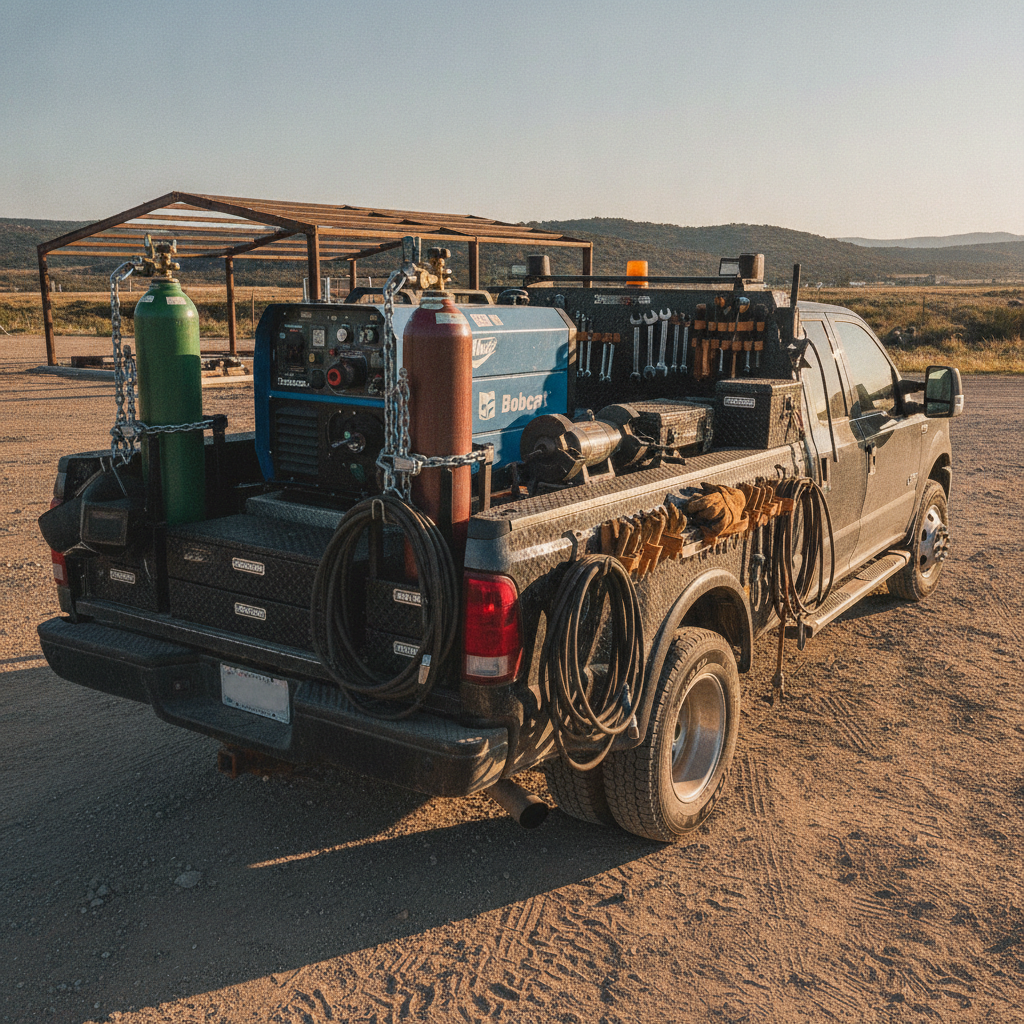
If your mobile rig organization looks like a hardware store got hit by a tornado, you already know what I’m talking about. You pull up to a job, the customer’s watching, and you spend the next fifteen minutes digging through a pile of cables, grinding discs, half-empty rod cans, and that one random brake caliper you’ve been meaning to return since 2022. That time is not free. You’re burning it off the clock before you’ve made a single dollar on the job. And if you’re charging by the hour, you’re either eating it yourself or the customer’s sitting there doing math. Neither one is good.
This post is about fixing that. Not with some color-coded drawer system you saw on YouTube. Just practical mobile rig organization changes that cut your setup time, make you look like a professional, and actually stick when you’re hauling gear in and out every day.
Why Mobile Rig Organization Directly Hits Your Hourly Rate
Let’s be real about the math first. Say you lose twenty minutes per job to setup chaos. You’re running five jobs a week. That’s over an hour and a half every single week just gone. Multiply that across a month and you’ve lost six-plus hours of billable time to disorganization. At $100/hr, that’s $600 a month walking out the door because you couldn’t find your chipping hammer.
If you’re still figuring out what to charge in the first place, go read the post on pricing for certification services — it covers how to think about your rate in a way that actually makes you money instead of just keeping you busy.
The point is this: your truck is your shop floor. A machinist wouldn’t tolerate tools scattered across the floor every morning. Neither should you. The difference between a guy who shows up and gets to work in ten minutes and a guy who’s still setting up when the first guy is halfway done — that gap is mostly organization, not skill.
Mistake #1: No Zones on the Truck
The single biggest problem I see on mobile rigs is everything living everywhere. Cables tangled with consumables. Gas bottles rolling around next to the coffee thermos. Arc rods in the same drawer as wrenches and a random set of drill bits.
Fix this with zones. It sounds stupidly simple, but most guys never actually do it. Here’s a basic breakdown that works:
- Power zone: Machine, leads, ground clamps, cable connectors. Nothing else lives here.
- Gas zone: Cylinders secured upright, regulator, hose, fittings. Keep a spare tip set here too.
- Consumables zone: Rods, wire spools, tips, nozzles, anti-spatter — in a dry, sealed container.
- Hand tools zone: Grinders, cutoff wheels, wire brushes, chipping hammer, clamps, squares.
- Safety zone: Hood, gloves, leathers, fire blanket, first aid kit. Always in the same spot, always accessible.
Once you set these zones, you stop thinking about where stuff is. You just go to the zone. That’s the goal — remove decisions from the morning routine.
Mistake #2: Cables That Look Like a Plate of Spaghetti
Tangled leads are a productivity killer and a safety hazard. Every time you pull a cable out of a twisted mess, you’re fighting the equipment before the job even starts. And if you’ve ever had a lead develop a fault because it was kinked under a toolbox for six months, you know the downstream cost of that too.
Coil your leads properly every single time. Use hook-and-loop straps or cable hangers, not zip ties you have to cut. Mount a couple of dedicated cable hooks on the side of your toolbox or on the headache rack. Hang them the same way every time you put them away. It takes thirty extra seconds. It saves you five minutes of untangling every morning.
Keep your lead lengths matched to your actual job types. If 90% of your work is within 25 feet of the truck, you don’t need to be dragging 50-foot leads every day. Extra cable means extra weight, extra coiling time, and more opportunities for tangles. Match your gear to your real-world work, not to some worst-case scenario you’ve prepared for three times in ten years.
Mistake #3: Consumables Stored Like an Afterthought
Moisture-damaged rods are one of the most common avoidable problems in mobile welding. You buy a fresh box of 7018, toss it in the bed, and three weeks later you’re wondering why your welds are porosity city. Condensation, temperature swings, and a thin plastic wrap are not a moisture barrier.
Get a dedicated sealed rod container. A cheap plastic storage bin with a rubber gasket lid works fine. Throw a couple of silica gel packs in there. Keep it off the floor of the truck bed where it can soak up ground moisture. This isn’t complicated — it’s just not skipping the step.
Same idea applies to wire spools. A half-used spool left in open air will rust on the outer wraps faster than you’d expect, especially in humid climates. Keep spools in sealed bags or containers when they’re not on the machine.
While we’re talking about consumables and gas, don’t sleep on smart shielding gas management for your mobile setup. Running out of gas mid-job because you didn’t track your bottle levels is the kind of thing that makes customers question your professionalism.
Mistake #4: Your Machine Is Impossible to Get To
Some guys load their rig like they’re packing a moving truck — welder buried under everything else, leads stacked on top, toolbox blocking access from the side. Then they wonder why setup takes forever.
Your machine should be the first thing accessible and the last thing you touch when packing up. If you’re on a flatbed or in a truck bed, position the welder so you can get to the panel without moving anything else. All your connections — lead studs, gas quick-connect, power switch — should be reachable from the ground or the tailgate without climbing over obstacles.
If you’re running a dedicated welding rig or service body, this is easier. But even on a pickup truck with a toolbox setup, you can engineer access. Think about what you touch first on every job and make sure that thing is on top or on the outside.
Speaking of choosing the right machine for field work, if you’re still deciding what process welder makes the most sense for a mobile setup, check out the breakdown on field-ready multi-process welders. The wrong machine for mobile work creates its own setup headaches before you even start thinking about organization.
Mistake #5: No Dedicated Work Surface
Watching a guy balance a piece of steel on his tailgate while it tries to slide off, then set his angle grinder down in the dirt — that’s painful. You need a work surface that’s actually functional.
A solid tailgate pad or a folding work table that mounts to the hitch is worth every dollar. Some guys weld a fold-down table directly onto their service body. Whatever you use, it should have a flat stable surface large enough to hold your work, somewhere to set tools down without them walking off, and ideally a lip or clamp point to hold material steady while you work alone.
Working alone in the field is almost always the reality. Build your rig like you don’t have a helper, because most days you won’t.
Mistake #6: The “I’ll Find It When I Need It” Inventory System
Translation: you have no idea what’s on your truck until you need it and it’s not there. You either run light and make emergency parts store runs, or you carry everything and can’t find anything. Both options waste time and money.
Run a physical checklist. I know, I know — sounds like something from a safety seminar. But it works. Write down the fifty things that need to be on your truck for a typical job. Before you head out in the morning, you know in three minutes whether you’re set or whether you need to grab something.
Keep a small stock of the consumables you burn through fastest — tips, nozzles, grinding discs, rod. When you hit the last package of something, add it to the restock list right then. Not when you’re halfway through a job and realize you’re out.
If you’re building your mobile business from the ground up and trying to figure out how to scale intelligently, the post on going from garage to shop covers how to think about growth without just buying more gear and hoping for the best. Same logic applies to your truck — more stuff doesn’t automatically mean more capable.
Mistake #7: Safety Gear You Have to Dig For
Your hood, gloves, and leathers should never be buried. Ever. Not under cables, not under spare parts, not under your lunch bag.
I get it — you’ve been doing this long enough that you move fast and you know where things “usually” are. But the day you’re rushing to get a job started, you’re reaching around in the toolbox without looking, and you put your hand into the wrong spot — that’s the day you remember why having a dedicated safety zone matters.
Also, if a customer or an inspector walks up while you’re getting ready, you don’t want to be the guy who can’t locate his own PPE. That’s not a good look. Dedicated spot, same place every day, done.
The Actual Time You’ll Get Back
Here’s what good mobile rig organization actually buys you. Not just faster setup — though that’s real. It’s fewer mistakes, lower stress at the start of every job, better customer impressions, and less wear on your gear because it’s stored properly instead of rattling around loose.
When you show up, open the toolbox, and have everything exactly where you expect it — you start the job with your head right. That matters. Field welding isn’t just physical work. The mental overhead of a chaotic rig adds up across a week in ways that are hard to measure but very easy to feel.
If you’re growing your mobile operation and thinking about what else separates the guys doing okay from the guys doing well, take a look at the piece on strategic niches for welding businesses. Being efficient on the truck is the foundation, but knowing what work to go after is what actually builds the business.
Quick-Start Rig Organization Checklist
Don’t overthink this. Set aside a Saturday and do it once. Here’s the short version:
- Pull everything off the truck. Yes, everything.
- Throw away anything broken, expired, or that you haven’t used in a year.
- Group everything into the five zones listed above.
- Figure out the most logical home for each group based on your truck layout.
- Mount, bracket, or bin everything so it stays put when you’re driving.
- Put cable management in place before you load the leads back on.
- Make the checklist while everything is fresh in your head.
- Drive around the block and then open every compartment. Fix what shifted.
That’s it. One Saturday and your rig is a different machine. The hard part isn’t doing it — it’s actually doing it instead of just meaning to get around to it.
Final Word on Mobile Rig Organization
Your truck is your livelihood. Treat it like a professional’s workspace and it’ll function like one. Treat it like a rolling dumpster and it’ll cost you like one — in lost time, damaged gear, and the occasional customer who doesn’t call back because you spent more time finding your stinger than you did welding.
Good mobile rig organization isn’t a one-time fix either. It’s a habit. Every time you come back from a job, five minutes of putting things back properly saves you twenty minutes the next morning. Do it consistently and it becomes automatic. That’s when you start genuinely showing up to jobs ready to work instead of ready to dig.
The guys who make real money in mobile welding aren’t always the best welders on the job. They’re the most efficient ones. And efficiency starts before you ever strike an arc.