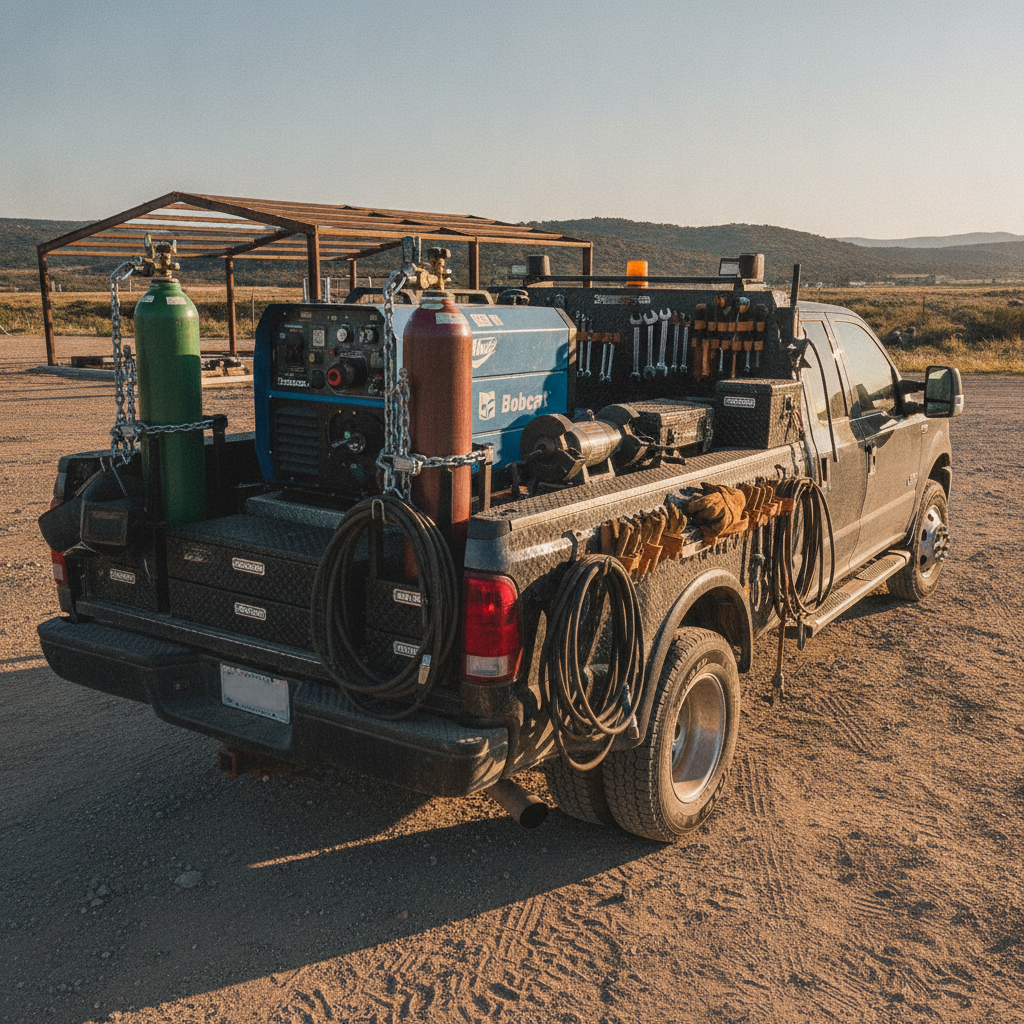
Your Truck Setup Is Costing You Money Every Single Day
Let’s skip the polite intro. If your mobile rig organization is a disaster, you are already losing money before you’ve done a single thing productive on the job. A customer is watching you dig through a pile of leads, consumables, and mystery junk for twenty minutes, and every minute of that is coming straight out of your effective hourly rate. It doesn’t matter how good your welds are if you look like you threw everything in the truck on a Tuesday morning hangover.
I’ve been running a mobile rig for over a decade. I’ve made most of these mistakes myself. Some of them I made for an embarrassingly long time before I wised up. So this isn’t theory — this is what I learned from wasting my own time and watching other guys waste theirs.
Let’s get into it.
Mistake #1: No Zones, No Logic, No System
The biggest mobile rig organization failure I see is trucks loaded with zero intentional layout. Everything just gets thrown in wherever it fits. The grinding discs are under the rod oven. The clamps are behind the gas bottles. The extra tips are loose in a drawer with three broken chisels, a fast food receipt, and something nobody can identify.
You need zones. It’s that simple.
Think about how a job actually flows. You pull up, you assess the work, you prep the material, you weld, you finish, you clean up. Your truck should be loaded to match that workflow from front to back, or driver’s side to passenger’s side — whatever makes sense for your specific body and setup.
How to Build a Zone System That Actually Works
Here’s a dead-simple framework. Break your truck into three zones:
- Zone 1 — First Touch: Safety gear, angle grinders, prep tools, tape measure, markers, soapstone. Everything you need before you even think about striking an arc.
- Zone 2 — Welding Operations: Leads, electrodes, wire, tips, liners, nozzles, rod oven. The stuff you’re grabbing mid-job.
- Zone 3 — Finish and Cleanup: Wire brushes, flap discs, chipping hammers, finishing tools, rags, cleanup supplies.
When every tool has an address, you stop hunting. That’s the whole game.
Mistake #2: Consumables Are Everywhere and Nowhere
This one drives me insane. A guy will have six boxes of 7018 in three different spots in the truck, but when he needs 6010 he can’t find any. Meanwhile there’s a half-opened box of something-or-other baking in the sun under a coat he hasn’t worn since February.
Consumables need a dedicated, consistent home. Full stop. And they need to be organized by process and diameter, not just crammed wherever they fit after the last supply run.
If you’re running stick, MIG, and TIG out of the same rig — and a lot of us are — keeping consumables straight gets complicated fast. This is especially true when you’re doing adaptive multimaterial welding where you’re switching processes and filler metals based on what’s in front of you that day.
The Consumable Drawer Rule
One drawer. One process. Label the outside. Restock it when it gets to one-third capacity, not when it’s empty. Running out of tips on a job site because you waited too long to restock is a rookie mistake that keeps happening to people who should know better.
Moisture-sensitive rods like 7018 and low-hydrogen electrodes need to be in a rod oven or a sealed container. If you’re leaving them loose in a toolbox overnight and wondering why your welds look like garbage, now you know.
Mistake #3: Your Welder Is Hard to Get To
I’ve seen rigs where the welder is buried behind gas bottles, toolboxes, and a spare tire nobody ever rotates. Getting to the machine settings or the wire feed compartment requires moving three other things first. That’s not a setup — that’s a puzzle.
Your machine needs to be accessible from the ground without climbing into the bed. The controls need to be reachable without contorting yourself into a pretzel. If you’re running a field-ready multi-process welder, the panel needs to be clear and accessible because you’re going to be adjusting it multiple times on every job.
Slide-Out Trays and Swing-Out Racks
If your truck body doesn’t already have slide-out trays or swing-out compartments, this is worth investing in. The time you save across a year of jobs pays for the upgrade easily. A slide-out tray that brings your welder to you at waist height instead of making you lean across a bed full of gear is not a luxury — it’s a time and back saver.
Same goes for your leads. A lead reel or a lead management system keeps them from turning into a knotted mess that takes ten minutes to unsnarl before every job. Yes, lead reels exist. Yes, they’re worth it.
Mistake #4: Gas Bottles Are an Afterthought
The gas bottle situation on most mobile rigs is a liability, a safety hazard, and an efficiency killer all at once. Bottles rolling around loose, chained wherever they happened to land last time, with regulators and hoses crammed in with them.
Bottles need to be secured upright, always. That’s not negotiable for safety and it’s not negotiable for keeping your regulators from getting smashed. But beyond safety, how your bottles are positioned affects how fast you can hook up and get running.
If you’re managing multiple gas types — CO2, argon, mixed gas — organization becomes even more critical. I wrote about this more specifically when talking about smart shielding gas management, but the short version is: label everything clearly, know exactly what you have before you leave the shop, and build a check routine into your morning startup.
Know Your Levels Before You Leave the Yard
Nothing burns time like rolling up on a job and discovering your bottle is almost empty. Check your levels every morning before you leave. Make it as automatic as checking your mirrors. A simple log on a whiteboard or even a notes app works fine. You don’t need a sophisticated system — you just need a consistent one.
Mistake #5: No Standard Setup Checklist
Most welders hate paperwork. Understood. But a simple job setup checklist isn’t paperwork — it’s a time machine. It takes two minutes to run through in the morning, and it saves you from making the forty-five-minute round trip back to get something you forgot.
This is also where running a business starts to look different from just being a welder. When you’re building systems that work every time without you having to think about them, you’re running a business. That shift in thinking is one of the bigger transitions guys struggle with when they go out on their own. If you’re in that process, the jump from garage to shop covers a lot of the mindset ground worth reading.
What Goes on the Checklist
Keep it short or you won’t use it. Here’s a starting point:
- Gas levels confirmed for the day’s work
- Consumables restocked to minimum levels
- Leads, clamps, and ground confirmed functional
- Safety gear — hood, gloves, jacket, boots — on the truck
- Grinders loaded with appropriate discs for the job
- Any job-specific items pulled and loaded
Six items. Takes ninety seconds. Saves you from looking like an amateur at the job site.
Mistake #6: The Truck Looks Like a Rolling Dumpster
This one isn’t just about efficiency. It’s about what your rig says to a customer before you’ve said a word.
A well-organized, clean truck communicates competence. A disaster zone on wheels communicates the opposite, and no amount of good welding reverses that first impression. Customers talk. They refer you or they don’t. Your rig is part of your brand whether you think of it that way or not.
When you’re trying to build a real business, every touchpoint matters. You’re not just selling welds — you’re selling confidence that you’re going to show up, do the job right, and not cause problems. A professional-looking rig is part of that package. If you’re thinking seriously about building the business side of your mobile operation, spending time on strategic niches and positioning is worth your time — because who you’re targeting affects how professional you need your presentation to be.
Five Minutes a Day Keeps the Chaos Away
At the end of every job, take five minutes to put things back where they belong. Not when you get home. Not at the end of the week. After every job. This is the only habit that actually keeps a rig organized long-term. Everything else is just triage.
Mistake #7: Tools Are Mixed With Equipment
Welding equipment and hand tools need to live in separate homes. When your wrenches, hammers, and miscellaneous hand tools are mixed in with welding supplies, nothing is where it should be and everything takes longer to find.
Dedicate specific storage to hand tools — a separate toolbox, a separate drawer, a separate compartment. Keep them out of the welding gear. This sounds obvious when you read it. Walk up to ten mobile rigs and tell me how many have this figured out.
Mistake #8: No Plan for the Job Before You Arrive
Rig organization starts before you load the truck. If you know what you’re doing tomorrow, load for it tonight. Don’t load everything because you might need it. Load what you know you’ll need, plus a reasonable kit for the unexpected.
This also feeds into how you price and schedule work. Understanding your real costs — including all the setup time most guys never count — is part of building a business that actually makes money. The numbers behind how to price your services are worth understanding at a deeper level, and pricing for certification services digs into some of the rate-building logic that applies across your operation regardless of what you’re welding.
When you’re loading for a specific job, you move faster. You know exactly where everything is because you put it there deliberately. You arrive looking like a professional instead of someone who packed in the dark.
The Bottom Line on Mobile Rig Organization
None of this is complicated. That’s actually the frustrating part — the solutions to most mobile rig organization problems are simple. The problem is that most guys never stop and think about their setup systematically. They just keep reacting to the mess instead of fixing it.
Here’s the math: if bad organization is costing you thirty minutes a day across five working days, that’s two and a half hours a week. At $75 an hour — and you should be charging more than that — you’re giving away nearly $200 a week in wasted time. That’s over $10,000 a year. For a disorganized truck. Think about that.
If you want to run a business that actually works, systems matter. Your rig is your most important piece of business infrastructure. Treat it that way.
Fix the zones. Lock down the consumables. Secure the bottles. Build the checklist. Keep the truck clean. Do it every day, not just when it gets bad enough to embarrass you.
Show up ready to work. Everything else gets easier from there.