You know exactly what I’m talking about. You pull up to the job, the foreman’s watching you, and you spend the next fifteen minutes digging through a pile of leads, grinding discs, and mystery hardware looking for your chipping hammer. That right there is your mobile rig setup working against you. Every minute you’re rooting around in your truck bed is a minute you’re not billing. And if you’re charging by the hour, that waste is coming straight out of your pocket — not the customer’s.
I’ve been running a mobile rig for over a decade. I’ve made every one of these mistakes myself. Some of them I made repeatedly, which makes me either persistent or slow — jury’s still out. But I’ve also fixed most of them, and the difference in daily efficiency is not subtle. This post is going to walk through the most common mobile rig setup mistakes I see guys making and what you can actually do about it without rebuilding your entire truck from scratch.
Why Your Mobile Rig Setup Is Your First Impression
Before we get into the nuts and bolts, let’s be honest about something. How your truck looks when you roll onto a job site tells the customer — and the general contractor — a lot about how you operate. A truck that looks like a hardware store exploded in the bed signals disorganization. That can absolutely cost you work.
On the flip side, a clean, functional rig that gets you to striking an arc in under five minutes says you’ve done this before. It builds confidence. Customers pay more attention to that stuff than most guys think.
This isn’t about being pretty. It’s about being fast, professional, and not looking like you threw your gear in a dumpster and drove away. If you’re trying to grow a legitimate welding business — and if you’ve read anything about choosing strategic niches for your mobile welding operation, you know the competition is real — your truck needs to back up your pitch.
Mistake #1: Leads Piled Like Spaghetti
Nothing slows down setup like leads that have been tossed in a heap. You grab one end, pull, and drag half your truck bed with it. Then you spend three minutes untangling before you can even get to work.
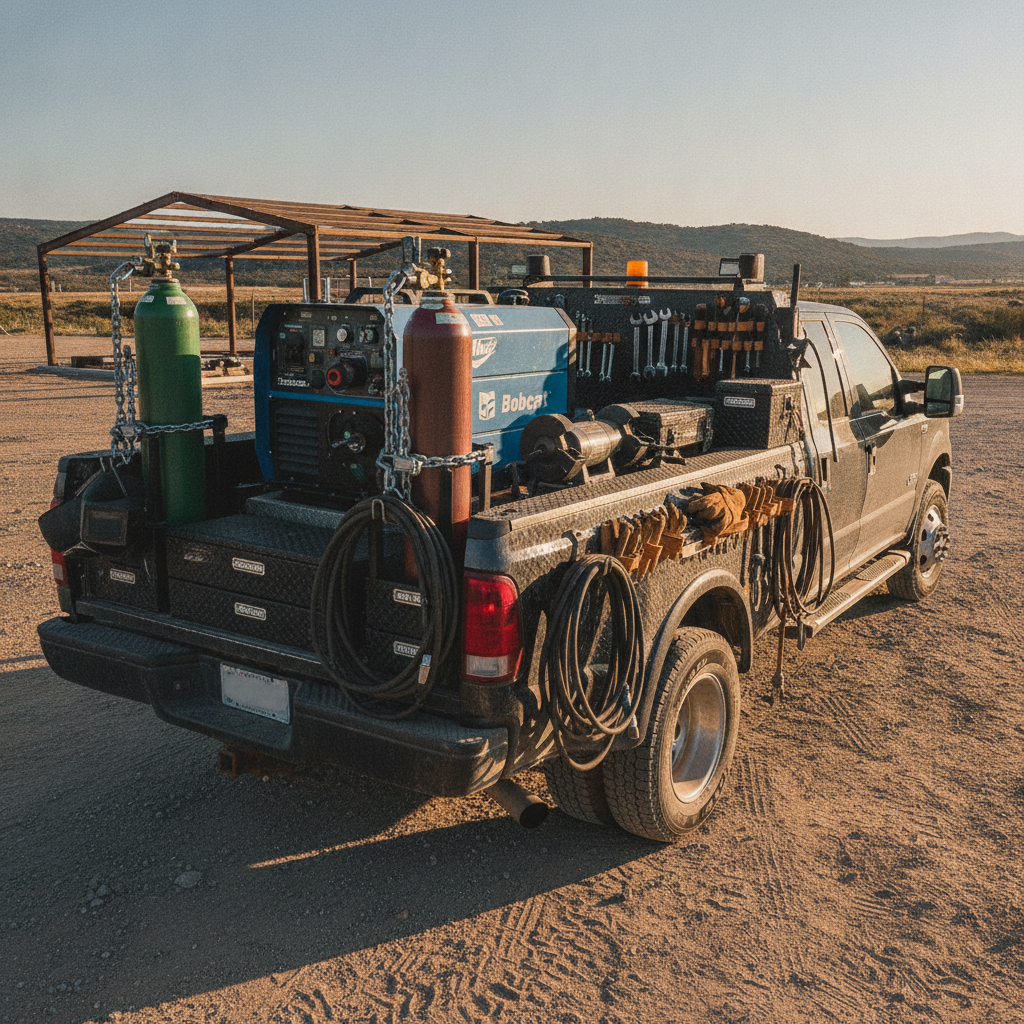
Fix it: Use a lead rack or a set of large hooks mounted to the side of the truck bed. Coil your leads properly — over-under or the shepherd’s coil if you want to get fancy — and hang them every single time. Non-negotiable.
A lot of guys skip this because hanging leads properly takes an extra ninety seconds when you’re packing up a job. But that ninety seconds saves you five to ten minutes the next morning. That math works out in your favor every single day you run the rig.
Also, while you’re at it — label your leads. Work lead, ground lead, extension. Masking tape and a marker if that’s all you have. You’ll thank yourself at 6 AM when you’re tired and the light isn’t great.
Mistake #2: No Dedicated Home for Consumables
Electrodes rolling around loose in a toolbox. Wire spools with no cover, collecting moisture and dust. Grinding discs scattered across the truck bed. This is probably the single most common mobile rig setup problem I see, and it’s also one of the easiest to fix.
You need a dedicated consumables station. This doesn’t have to be expensive. A mounted rod oven if you’re running low-hydrogen electrodes in critical conditions. At minimum, a sealed container for your electrodes sorted by type and diameter. A disc caddy or mounted holder for your grinding and cutting discs.
If you’re running multi-process and switching between wire and stick on the same job — and if you’ve thought about the field-ready multi-process welders that make that easier — your consumables organization becomes even more critical. You don’t want to grab a 6010 when you need a 7018. That’s a bad day.
Wire spools should be covered or in a sealed box. Moisture is not your friend. Neither is the layer of iron oxide dust that accumulates from cutting and grinding settling onto your wire. Keep it covered, keep it clean.
Mistake #3: Gas Cylinders Not Secured or Organized
This one is both a safety issue and an efficiency issue. Cylinders rolling around in the truck bed is a hazard. Cylinders laying on their side is a problem for the regulator. And having your full and empty cylinders mixed together means you’ll find out you’re out of gas right when you need it most.
Mount a cylinder rack. Keep full cylinders on one side, empties on the other. Mark your empties with a cap and a piece of tape or a paint marker so there’s zero confusion. When you need to swap, you know exactly where your next full cylinder is.
If you’ve been considering battery-powered options to reduce your gas dependency on certain jobs, there’s solid reading on field-ready battery welders and newer hybrid battery-powered welders that can change your setup calculus. But until then, get your cylinders organized and secured properly. It’s not optional.
Also — and I cannot believe I have to say this — always cap cylinders when they’re not in use. Regulators are expensive. Valve damage is more expensive. And a projectile cylinder is going to ruin everyone’s day.
Mistake #4: Tools With No Assigned Home
Your angle grinder should live in the same spot every single time you put it away. Your wire brush, chipping hammer, clamps, squares, markers — everything needs a home. The moment you start playing “where did I put that,” you’re losing money.
Shadow boards work great for this. Cut out the shape of each tool in foam or trace it on a painted surface so you can see at a glance what’s missing. This also helps you pack up at the end of a job without leaving half your tools on site. Which yes, happens. Ask me how I know.
Drawer-style toolboxes mounted in the truck bed are a solid investment. Organize by category — cutting tools in one drawer, measuring tools in another, clamps and hardware in a third. Pull the drawer, grab what you need, close it. That’s it. No digging, no piling, no drama.
You don’t have to build a custom truck from scratch to get this right. Most of this organization can be done with off-the-shelf truck bed toolboxes, some foam inserts, and about a Saturday afternoon of actual effort.
Mistake #5: Your Welder Is Hard to Access
If you have to move four things to get to your machine’s panel, your setup is wrong. The welder is the center of your operation. Its controls, its leads connections, and its power cable should all be accessible without performing gymnastics over the side of the truck.
Think about how you position the machine in the bed. Is the panel facing outward? Can you adjust heat and wire speed without climbing into the truck? Can you plug into a generator or power source quickly without untangling a cord that’s wedged under something else?
This also applies to maintenance access. You need to be able to check fluid levels on your engine-driven welder, blow out dust, check connections — all without moving your entire rig around. Position for access, not just for fit.
If you’re in the market for a new machine and thinking about what actually works in the field, our breakdown of field-ready multi-process welders covers what matters for mobile operators specifically.
Mistake #6: No System for Job-Specific Gear
Not every job needs every tool. But most guys load the truck once and just live with it. The result is a truck packed so full that finding anything takes forever, and half of it doesn’t apply to today’s work.
Develop a tiered system. Permanent fixtures — your welder, cylinder rack, core toolbox — stay put. Secondary gear — specialty clamps, specific filler metals, job-specific fixtures — gets added and removed based on what you’ve got coming up.
Keep a physical or digital checklist of what you need for different job types. Pipeline work has a different kit than structural steel, which is different from agricultural repair, which is different again from anything involving dissimilar-metal welding. Knowing what each job type demands and packing accordingly means a tighter, faster rig every time.
I know “make a list” sounds like basic advice. But I’ve watched experienced guys show up to a job without the right filler because they assumed it was already in the truck. It wasn’t. The job got delayed. The customer was not impressed.
Mistake #7: Ignoring Shielding Gas Management
Running out of gas mid-job is a rookie move. But running out because you didn’t have a system to track your cylinder levels? That’s a systems problem. Fix the system.
Mark your cylinders with a paint pen when they hit about a quarter full. That’s your signal to have a fresh cylinder ready before the next job. Don’t wait until the regulator reads empty at 7 AM on a job site an hour from your supplier.
There’s a solid post here on smart shielding gas management that goes into more detail on tracking, purchasing, and supplier relationships. Worth a read if gas cost and availability is eating into your margins.
Mistake #8: No Pre-Job Walkthrough Habit
The best-organized rig in the world still fails you if you don’t do a quick check before you leave for a job. A five-minute walkthrough before you pull out of the driveway catches the problems before they become job-site emergencies.
Check your leads. Check your cylinders. Check your consumables for the specific job. Verify your welder starts and runs clean. Make sure your grinder discs are not cracked or past their use date. Confirm you have your PPE — hood, gloves, jacket — and they’re in usable condition.
This also ties into the bigger picture of running a tight operation. If you’re thinking about the business side of things — pricing, positioning, making sure your time is actually profitable — it connects directly to resources like our post on growing from garage to shop and understanding how your daily habits build (or kill) a real business.
The Real Cost of a Disorganized Rig
Let’s put some numbers on this because it makes the point better than any amount of nagging.
If a disorganized mobile rig setup costs you twenty minutes of productive time per job — and that’s a conservative estimate — and you’re running four jobs a week, that’s over an hour and twenty minutes of lost billing per week. At $100/hour, that’s $130 a week. That’s nearly $7,000 a year you’re leaving on the table because your leads are tangled and you can’t find your chipping hammer.
Now factor in the jobs you might not get called back for because the customer watched you dig through a mess for fifteen minutes before you even picked up a hood. That’s a number nobody can calculate, but it’s real.
Fixing your mobile rig setup is not a weekend project. It’s an ongoing habit. You build it once, then you maintain the system every time you pack up a job. That’s it. The upfront work is one afternoon. The return is every single day you run that truck.
Where to Start If Your Rig Is a Disaster Right Now
Don’t try to overhaul everything in one shot. Pick the biggest pain point — probably your leads or your consumables — and fix that first. Get it working right, make it a habit, then move to the next problem.
In a month, your rig will look different. In three months, your average setup time will be cut in half. And if you’re tracking your time and jobs — which you absolutely should be if you want to build a business that actually grows — you’ll see it in the numbers.
If the business side of mobile welding is where you need the most work, start with the fundamentals. Understanding how to measure your investment decisions before you buy gear, and knowing how to price your services so the hours you do bill are actually profitable, are the underpinnings of everything else.
A well-organized truck doesn’t just save time. It’s a signal — to customers, to contractors, to yourself — that you run a real operation. That matters more than most guys give it credit for.
Final Word
A bad mobile rig setup is a tax you pay every single workday. It’s slow, it’s frustrating, and it’s completely preventable. Nobody’s going to come organize your truck for you. That’s on you.
But if you put in the work to build a system that actually functions — leads hung, consumables organized, tools in their place, cylinders secured and sorted — you will get that time back. Every day. For as long as you run that rig.
Now go clean your truck. Seriously.