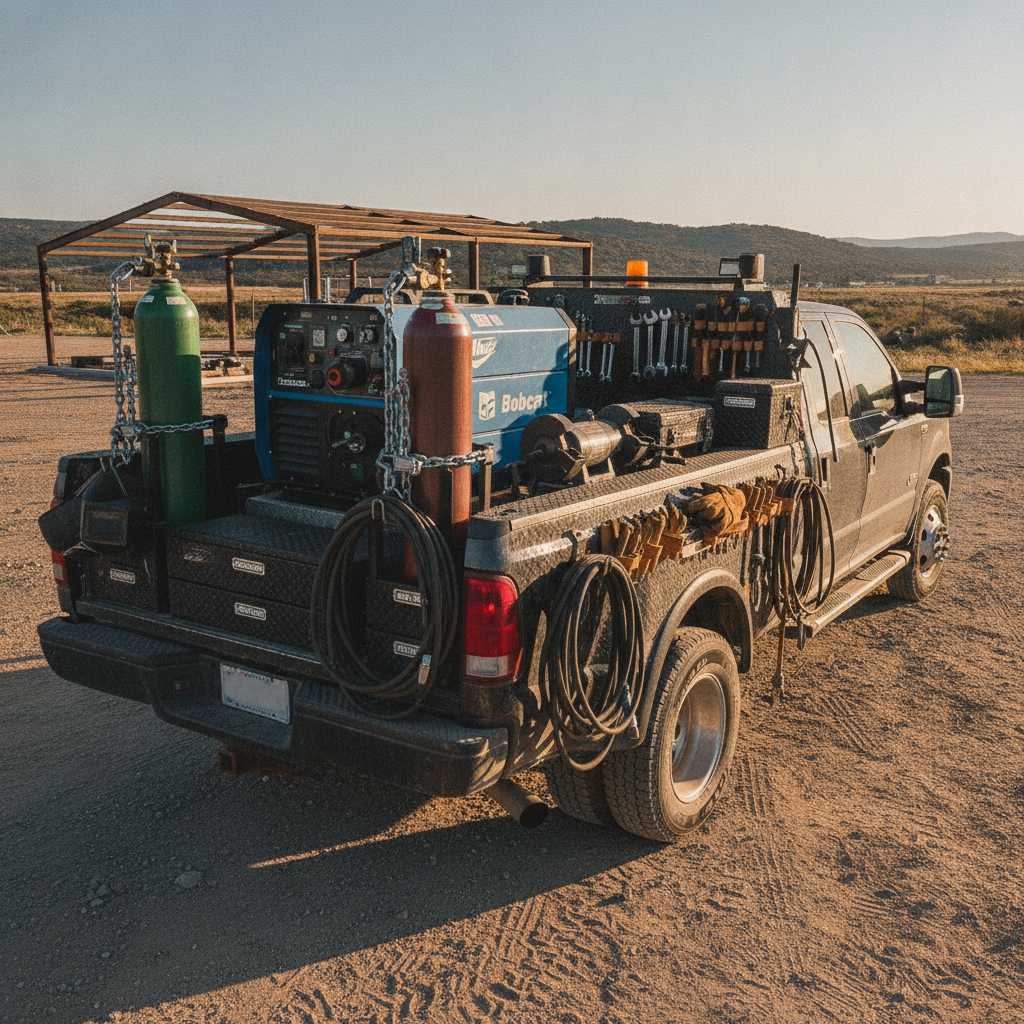
You know that feeling when you pull up to a job, the customer’s watching, and you spend the next fifteen minutes digging through your truck bed like you lost your keys in a dumpster? That’s not a small problem. That’s your hourly rate bleeding out before you’ve touched a rod. Mobile rig organization isn’t a fancy concept — it’s just not being an idiot about where you put your stuff. And yet, half the guys running mobile welding rigs are set up like they packed in the dark. This post is about fixing that, job by job, dollar by dollar.
Why Your Truck Layout Is a Business Problem
Most welders think about their rig in terms of equipment. What welder. What process. What gas. That’s fine — that stuff matters. But the layout of how all that gear lives in your truck? That’s where your actual efficiency lives or dies.
Think about it this way. If you spend an average of 20 minutes per job just getting set up and organized before you strike your first arc, and you’re running four jobs a day, that’s an hour and twenty minutes of unpaid labor. Every single day. Five days a week. That’s almost seven hours a week you’re giving away for free because your truck looks like a garage sale.
Seven hours. At even $85 an hour, that’s nearly $600 a week you’re not billing. Do the math on a month. Now do it on a year. Now tell me mobile rig organization isn’t worth spending a Saturday afternoon on.
If you’re still figuring out how to price your time as a mobile welder, take a look at this breakdown on pricing for certification services — a lot of the same logic applies to structuring your day-rate work.
Mistake #1 — The Everything-in-One-Box Method
You’ve seen this rig. Maybe you are this rig. One giant toolbox where everything goes. Grinding discs on top of rod ends. Clamps tangled with extension cords. Tip cleaner buried under three layers of whatever got tossed in last.
This is the number one killer of setup time. And it happens because guys load the truck in a hurry at the end of a job and never build a real system.
The fix is simple but it requires actually doing it: separate your gear by task, not by size.
Think in work phases. Everything that touches the joint prep goes together. All your grinders, flap discs, wire brushes, cutting wheels — one designated spot. Everything for actual welding setup — leads, clamps, stinger or gun, tip kit — goes in another spot. Finishing and cleanup gear gets its own home. You pull up to the job, you open the right compartment for the right phase, and you move.
It sounds obvious. That’s because it is. Do it anyway.
Mistake #2 — Unsecured Gear That Moves Around in Transit
Nothing tanks your setup time like opening a compartment and finding that everything has shifted during the drive. That carefully stacked row of rods? Scattered. The extension cord you coiled? A bird’s nest. The measuring tape you put right on top? Gone somewhere into the dark back corner.
Every item in your truck needs a home that keeps it in place while driving. That means hooks, brackets, bungee loops, magnetic strips, or bin dividers. Whatever works for the item — use it.
Gas bottles especially. Those need to be strapped down every single time, not just when you remember. A fallen bottle isn’t just a setup problem, it’s a safety problem. Strap them. Always.
For welders thinking about battery-powered or hybrid options that can shift some of this weight balance, this piece on hybrid battery-powered welders is worth reading — lighter equipment changes how you can load your rig.
Mistake #3 — Your Leads Are a Mess
Lead management is one of those things that experienced mobile welders are weirdly obsessive about, and for good reason. A tangled lead costs you five minutes to sort out every single time. Multiply that by every job, every day, every week. You do the math.
The fix has two parts.
First: coil your leads properly every time you break down a job. Figure-eight coil if that’s what works for you, over-under if you’re particular, whatever keeps them from tangling. Do it consistently. Every time. Not when you feel like it.
Second: hang them. Wall hooks, mounted rod holders, whatever keeps them off the floor of your truck bed and keeps that coil intact. A lead sitting flat on the bed gets stepped on, driven over by gear shifting around, and twisted into a pretzel. Hang it up and it stays ready.
Same goes for your ground clamp cable. Separate hook. Don’t let it live tangled with the welding lead or you’re starting every job with a puzzle.
Mistake #4 — No Standard Pre-Job Checklist
Here’s one that nobody talks about because it sounds too simple: you don’t have a consistent pre-job sequence. So every job, you’re basically winging it. You think you grabbed everything, you get to the site, and now you’re missing something or you’re setting up in the wrong order because you’re going off memory and memory gets fuzzy at 6 AM.
A checklist doesn’t make you look unprofessional. A half-prepared rig does.
Build a simple pre-job list. Keep it on your phone or laminated on your visor. It should take thirty seconds to run through. It should cover gas check, lead condition, consumables stock, grinder discs, your PPE, and anything job-specific you need. Run it before you leave the shop or yard. Every single time.
This is the kind of operational discipline that separates guys running a real business from guys running a hustle. If you’re building toward the former, the post on going from garage to shop covers a lot of the same mindset shifts you’ll need to make.
Mistake #5 — Consumables Living Everywhere (or Nowhere)
You’re mid-job. You need a fresh tip. Where is it? If the answer is “somewhere in the truck,” you’ve already lost. The walk back to the truck, the rummaging, the finding the wrong size first — that’s three to five minutes gone on a task that should take thirty seconds.
Consumables need a dedicated, labeled spot. Not a drawer where they might be. A specific container, in a specific location, that you restock after every job so you always know what you have.
This includes:
- Contact tips by size, labeled
- Nozzles
- Diffusers
- Rod ends or partial sticks, sorted by type
- Grinding and cutting discs
- Wire brushes
- Anti-spatter spray
If you run multiple processes on the same rig — and a lot of mobile guys do — this matters even more. Field-ready multi-process welders are great tools, but they don’t help you if your consumables for each process are scattered across four different bins.
Mistake #6 — The Rig Doesn’t Match the Work You’re Actually Doing
This one stings a little because it means some guys need to rethink more than just their organization — they need to rethink their load-out. If you’re doing mostly aluminum repair work and your truck is set up like you’re running structural steel all day, you’re carrying wrong gear, missing right gear, and wasting space that could be working for you.
Your rig should be optimized for your most common job types first. Everything else gets carried in a job-specific auxiliary kit that you pull for special work and leave behind when you don’t need it.
If your work involves multi-material jobs — aluminum to steel, stainless to mild — your organization system needs to account for cross-contamination prevention between materials too. That means separate brushes, separate storage, and a clear system for which consumables touch which metal. Adaptive multi-material welding is a growing part of field work, and your rig needs to reflect that if it’s part of your business.
Mistake #7 — No Post-Job Restocking Habit
You finish a job. You’re tired. You throw everything back in the truck and drive home. Tomorrow morning you show up to a job and you’re low on gas, you’re down to your last two tips, and the grinding disc you thought was in there is actually a worn-out disc you meant to throw away last Tuesday.
Post-job restocking is not optional if you want to run a tight operation. Build it into your job closeout routine the same way you build in cleanup and paperwork. Five to ten minutes after every job: check consumables, replace what’s depleted, coil leads properly, secure everything for transport, confirm gas levels.
This one habit alone eliminates a huge percentage of the fumbling-around-the-truck time that kills your efficiency. It’s also just professional. Customers notice when a mobile welder shows up and gets to work immediately. That perception matters for repeat business and referrals.
The Layout That Actually Works
Every rig is different. Truck beds, service bodies, utility trailers — they’re all different shapes with different compartments. But the principles of good mobile rig organization are the same regardless of what you’re working with.
Here’s the framework:
Zone 1 — Prep gear. Grinders, discs, wire brushes, clamps, measuring tools. Everything you need before you strike an arc.
Zone 2 — Welding gear. Leads, gun or stinger, ground clamp, helmet, gloves. Everything you need to actually weld.
Zone 3 — Consumables. Dedicated bin, labeled, restocked after every job. No exceptions.
Zone 4 — Gas and power. Bottles secured, regulator accessible, power leads organized, extension cords coiled on a real cord reel.
Zone 5 — Cleanup and finishing. Chipping hammer, wire brush, rags, anti-spatter, finishing tools if you use them.
Keep heavy stuff low and centered for truck balance. Keep frequently used stuff at arm’s reach. Keep rarely used stuff in the back or bottom. That’s it. That’s the system.
Small Changes, Real Hours
Look, nobody’s saying you need to spend a grand on a new service body or rebuild your entire setup from scratch. Most of the mobile rig organization improvements that make the biggest difference cost almost nothing. A few hooks. A couple of labeled bins. A cord reel. A restocking habit. A checklist that lives on your phone.
What they do cost is a Saturday afternoon to set up properly. That’s the real investment. And if you’re not willing to put in that one afternoon to save yourself seven-plus hours a week, then the problem isn’t your truck — it’s how seriously you’re taking the business side of this trade.
If you want to sharpen your business operation beyond just the truck, strategic niche selection for mobile welders is a good next read. Knowing exactly what work you’re going after also tells you exactly how your rig should be loaded.
Set up your rig like a professional. Show up, open the compartment, grab what you need, and get to work. That’s the job. Everything else is just wasted time you’re not billing for.