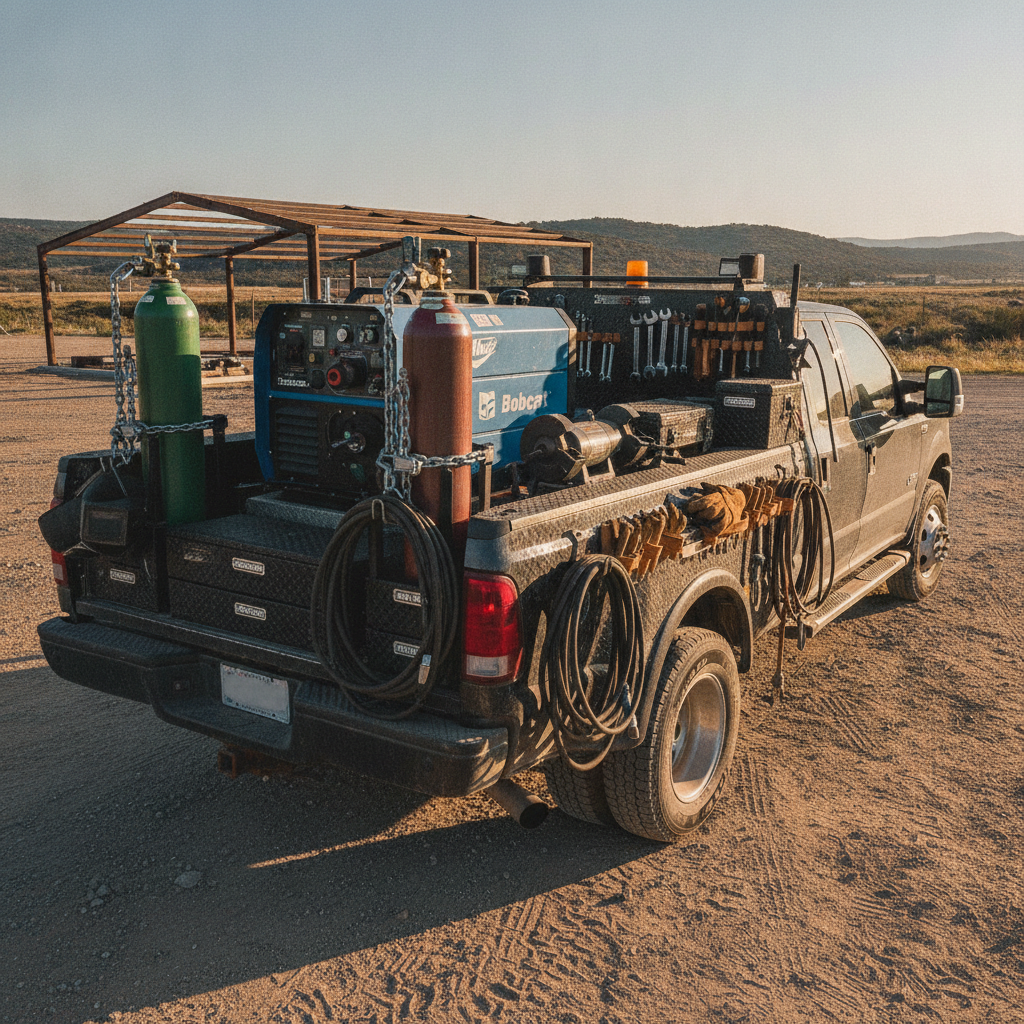
Let me paint you a picture. You pull up to the job, the foreman’s already looking at his watch, and you spend the next twenty minutes digging through a pile of cables, mystery consumables, and that grinder you definitely remember putting somewhere. Your first arc doesn’t strike until you’re already behind. Sound familiar? That right there is a mobile rig organization problem, and it’s bleeding money out of your hourly rate every single day. This post is about fixing it — practically, without spending a fortune — so your setup looks like you’ve done this before, because you have.
Why Mobile Rig Organization Is a Business Problem, Not Just a Tidiness Problem
New guys think this is about being neat. It’s not. This is about billable hours.
If you’re running a mobile welding business — or trying to build one — your truck is your shop floor. Every minute you spend hunting for a 7018 rod or untangling a cable is a minute you’re not welding. You can’t bill for that time. Or if you do, the customer remembers it. They remember watching you dig through your rig like a raccoon in a dumpster.
Think about it this way: if you waste fifteen minutes per job on disorganized setup and teardown, and you run four jobs a day, that’s an hour gone. At $100/hr, you just lost a hundred bucks. Every day. Five days a week, that’s $500 you didn’t make. Over a year, we’re talking real money — the kind that buys a new welder or actually pays down your truck note.
Getting your mobile rig organization dialed in isn’t a luxury. It’s a competitive advantage. The guy who walks up to a job, opens his rig, grabs what he needs in thirty seconds, and starts welding — that guy looks like a professional. Customers notice. Foremen notice. It leads to repeat calls and referrals. The other guy? He gets the “we’ll call you” treatment.
Mistake #1 — No Zones, Just Chaos
The number one sin of the disorganized mobile welder is treating the truck bed like a junk drawer. Everything goes in, nothing has a home, and you rely on memory to find it. Memory fails. Especially after a twelve-hour day when you’re packing up in the dark.
Fix this with zones. It’s not complicated. Break your service body or truck bed into functional areas:
- Welding zone — your machine, leads, ground clamps, electrode holders
- Consumables zone — rods, wire, tips, gas, flux
- Cutting and grinding zone — grinders, wheels, cutoff tools, guards
- Hand tools zone — chipping hammers, wire brushes, clamps, squares, measuring tape
- PPE zone — hood, gloves, sleeves, safety glasses, hearing protection
Zones sound obvious until you’re standing in front of your rig realizing you’ve never actually done it. Pick a day. Pull everything out. Assign it a home. Put it back. Stick to it. That’s literally all it takes to stop the chaos.
Mistake #2 — Consumables Buried Under Everything Else
Your consumables should be the easiest things to reach on your rig. They’re what you grab most often. Instead, on most trucks I’ve seen, they’re buried under cable, behind the machine, or shoved in a box where everything’s mixed together.
Rods mixed with tips mixed with wire mixed with random hardware is a recipe for wasted time. You end up handling everything twice just to find one thing. And when you need a 6010 in a hurry, you don’t want to be opening every box on the truck to find it.
Separate your rod rods by type if you run multiple processes. Keep a dedicated rod oven or dry box if you’re running low-hydrogen in humid conditions — this is especially relevant if you’re doing any structural work where hydrogen cracking is a real concern. Keep tips, diffusers, and contact tips for your MIG setup together in a small parts organizer bolted to the wall of your service body.
The goal is to grab what you need with one hand, without looking, in under ten seconds. If you can’t do that right now, your consumables aren’t organized. They’re just stored.
Mistake #3 — Cable Management That Would Make an Electrician Cry
Tangled leads. Cables stuffed in wherever they fit. Ground clamps with hooks going in every direction. This is probably the most time-consuming disorganization problem on a mobile rig, because cables don’t just slow you down — they create hazards and wear out faster when they’re coiled wrong or kinked constantly.
Get proper cable hooks or a cable reel. Wrap your leads the same way every single time. The over-under wrap method takes about fifteen seconds longer than a sloppy bundle, but it means your cable uncoils without tangles every single time. That alone is worth the effort.
Mount your cable storage so your leads come off the truck in the direction you’ll actually be pulling them. Sounds simple. Most guys don’t think about it until they’ve pulled a 50-foot lead the wrong way around their own truck three times.
Label your leads if you run multiple machines or processes. Masking tape and a Sharpie. Done. It costs nothing and saves the “which lead goes to which machine” confusion during setup.
Mistake #4 — Your Machine Is Hard to Access
If you have to move three other things to get to your welder, your welder is in the wrong spot. Period.
Your machine should be positioned so you can access the controls, adjust settings, and attach leads without contorting yourself or unloading half the truck. On a service body, that usually means the machine rides near the tailgate end or on a slide-out shelf. On a flatbed, it needs to be centered and unobstructed.
This also matters when you’re running a multi-process setup. If you’re out there doing MIG one day and stick the next, you need to reach controls quickly. If you’ve been considering upgrading to a more versatile machine, check out our breakdown of field-ready multi-process welders — the machine’s capabilities mean nothing if you can’t get to it during a job.
Think about how you work. Where do you stand? Where does the lead need to go? Set up your machine to match your workflow, not the other way around.
Mistake #5 — No System for Gas Cylinders
Gas cylinders rolling around in a truck bed is one of those things that can get you killed, get someone else killed, or at minimum dent your wallet when you drop one on the job. Chain them. Always. Two-point restraint — top and bottom. Don’t argue with me on this.
Beyond safety, your cylinder positioning affects your setup time significantly. If you’re running shielding gas, that cylinder needs to be close enough to your machine that the regulator hose reaches without running it across the truck bed or over the tailgate where it’ll get crushed. Map out your hose run before you bolt your cylinder mounts down.
If you’re smart about mobile rig organization, you’re also tracking your gas levels. Running out mid-job because you didn’t check before you left is amateur hour. A simple log on the inside of your service body door — cylinder serial, fill date, approximate gauge reading at start of day — keeps you from driving to a supply house in the middle of a billing hour. We’ve covered smart gas management in more detail over at our smart shielding gas management post if you want to get deeper into that.
Mistake #6 — Tools With No Home and No List
Hand tools are the most common thing mobile welders leave on job sites. Not because they’re careless — because there’s no system for putting things back and no checklist to catch it.
Build a shadow board or a simple pegboard insert for your service body drawers. Outline every tool in its spot. When you pack up, you can see at a glance what’s missing. It takes one afternoon to build, and it’ll save you buying replacement tools three times a year.
Keep a laminated checklist on the inside of your rig door. Tools, consumables, PPE — every category. Check it before you pull off a job site. Yes, this feels like overkill until you’re halfway to the next job realizing your $80 angle grinder is still sitting next to a beam two counties back.
Mistake #7 — Ignoring Ergonomics and Fatigue
Most guys don’t think about this until their back starts going. But how you load your truck directly affects how you feel at the end of a long day.
Heavy items — your machine, cylinders, heavy cable — belong low and centered. Not just for vehicle stability, though that matters too. They belong low because lifting a 60-pound cable spool from above your head forty times a day is how you end up with a shoulder that ruins your career before you’re fifty.
If you’re doing the work to build a sustainable mobile welding business, the physical toll matters. The guys who last longest in this trade are the ones who treat setup and teardown like part of the job — ergonomically smart, not just fast. If you’re in the process of building out your business model and thinking strategically about your niche and longevity, our piece on strategic niches for mobile welders is worth a read alongside getting your rig dialed in.
What a Dialed-In Rig Actually Looks Like
Let me describe a well-organized mobile rig in plain terms. You pull up. You open the service body. Your machine is right there, controls facing you. Your leads are coiled and hanging on hooks to the left. Your rod box is in the drawer directly below — organized by rod type, labeled. Your grinders are on a shelf to the right, wheels stored separately. Your PPE is in a bin at eye level near the door so there’s no excuse not to grab it. Your gas cylinder is chained in the back corner, regulator hose routed cleanly to the machine. Your hand tools are on a pegboard with outlines. Your checklist is on the inside of the door.
You can be set up and striking an arc in under five minutes. Every time. On every job.
That’s what mobile rig organization looks like when it’s done right. It didn’t cost a fortune. It took maybe a weekend of work and some basic hardware. But now your truck is a professional operation, not a rolling storage unit.
Making the Investment Pay Off
Here’s the business case in simple terms. Better organization means faster setup. Faster setup means more billable time per job. More billable time means either you make more money per day, or you take on more jobs, or you finish earlier and have a life. Pick whichever one sounds good to you.
If you’re still figuring out how to price your work so those recovered hours actually show up as profit, take a look at our guide on pricing for certification services — the principles around valuing your time and building margin into your rate apply directly to field work too.
And if you’re just getting started building your mobile operation from scratch, our from garage to shop post walks through the broader business setup so you’re not just organized on the truck but organized in how you run the whole thing.
The bottom line is this: the guys who struggle in mobile welding aren’t usually struggling because they can’t weld. They’re struggling because they didn’t treat the business side — including the operational basics like rig organization — with the same seriousness as the technical side. Your truck is your business. Set it up like one.
Start With One Change This Week
You don’t have to redo your whole rig in a day. Pick one problem area. Maybe it’s your cables. Maybe it’s your consumables drawer. Fix that one thing this week. Then fix the next thing. In a month, you’ll have a completely different setup — and you’ll wonder how you ever worked out of a disorganized truck.
Small changes compound. That’s true in welding technique, it’s true in smart investment decisions for your welding business, and it’s absolutely true in how you organize your operation.
Stop digging through junk. Start billing for the time you’re actually worth.