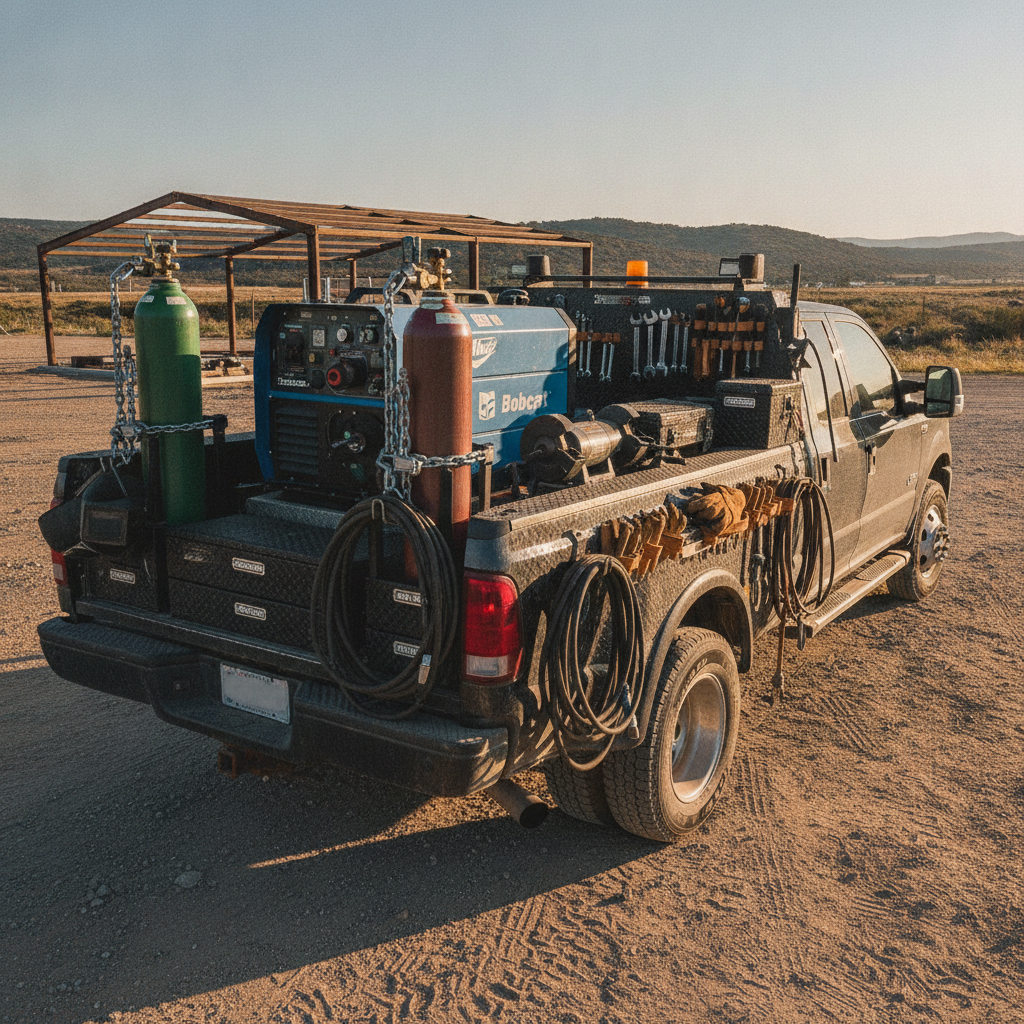
You ever pull up to a job, pop open your compartments, and spend the next twenty minutes digging through a pile of leads, grinders, fittings, and mystery garbage just to find your striker? That’s not bad luck. That’s a mobile rig organization problem, and it’s eating your profit margin one minute at a time. If you’re billing $85 an hour and wasting 30 minutes per job getting set up, that’s real money gone before you even light an arc. This post is about fixing that. No theory, no fluff — just practical changes that actually work on a real work truck.
Why Your Truck Setup Is a Business Problem, Not Just an Annoyance
Most guys think of a messy truck as just a personal quirk. “I know where everything is.” Sure you do. Until you’re on a job two hours from home, it’s 95 degrees, the customer is standing over your shoulder, and you cannot find your 1/8″ 7018 because it’s buried under a broken angle grinder and three rolls of wire you haven’t used since 2022.
Here’s the business reality. Every minute you spend searching for equipment is a minute you’re not billing. Worse, it’s a minute the customer is watching you look incompetent. First impressions on a job site matter. If you’re scrambling around your truck like you lost your keys, they’re already wondering if they made the right call hiring you.
Poor setup also causes physical wear. Reaching over junk, lifting things out of the way, awkward angles — that stuff adds up. Your back doesn’t need the extra work.
Good mobile rig organization isn’t about being neat for neat’s sake. It’s about being efficient, professional, and protecting your body over a long career. If you’re just getting started building your operation, check out this breakdown on going from garage to shop — the same organizational mindset applies whether you’re setting up a workspace or a service truck.
Mistake #1: No Zone System on Your Truck
The number one mobile rig organization mistake is treating your truck like a storage unit instead of a work tool. Everything just gets thrown in wherever it fits. That approach works fine when you’re 22 and have the energy to dig for stuff. At 35 with two bad shoulders, not so much.
Set up your truck in zones. It sounds obvious. Most guys still don’t do it.
How to Zone a Service Truck
Zone 1 — First-touch items. These are things you grab on every single job without exception. Striker, angle grinder, wire brush, tape measure, marker, chipping hammer. These live in the same spot, every time, no exceptions. Closest compartment to where you stand when you open the truck.
Zone 2 — Process-specific gear. MIG supplies together. Stick rod and stingers together. TIG torch and filler together. You know what process you’re running before you show up. That compartment gets opened. The rest stay closed.
Zone 3 — Consumables and spares. Extra tips, nozzles, contact tips, wire, rod. These are restocked regularly, so they go where you can count and grab fast.
Zone 4 — Rarely used but critical items. Back corner or top shelf. Specialty fittings, backup regulators, stuff you need once a month but really need when you need it.
Map this out on paper before you reorganize. Seriously. Spend 20 minutes thinking about what you touch first on every job. Then build around that.
Mistake #2: Leads and Cables Going in Loose
Loose leads are the enemy. They tangle. They snag. They get stepped on, pinched in doors, and somehow wrap around everything else in the compartment. A tangled lead at the start of a job is a guaranteed five minutes of swearing before you even get to work.
Invest in proper lead management. That means dedicated hooks or racks mounted inside your compartments or on the exterior of your bed. Coil your leads the same way every single time. Some guys use velcro straps. Some use the figure-eight coil method. Pick one system and stick to it religiously.
The same goes for your ground cables. Don’t just throw them in. A loose ground cable that gets kinked repeatedly fails faster than one that’s properly stored. You don’t want to be diagnosing a bad connection in the middle of a job because you were lazy about storage.
Gas hoses get their own dedicated spot too. Nothing worse than an acetylene hose with a kink in it you didn’t notice until you’re ready to cut.
Mistake #3: Cylinders Not Secured Properly
This one isn’t just an efficiency problem. It’s a safety problem and a liability problem. A cylinder that tips over in transit can be catastrophic. But even short of that, unsecured cylinders rattle around, damage regulators, and beat up everything around them.
Every cylinder gets secured upright with a proper chain or strap rated for the weight. Non-negotiable. If you’re running multiple cylinders — and most of us are — build or buy a cylinder rack that keeps them separated and stable.
Also label your cylinders clearly. Full, in-use, empty. Don’t guess. Showing up to a job with what you think is a full cylinder of argon and finding out it’s empty is a half-day wasted. If you’re thinking about how gas management fits into your cost structure, this older post on smart shielding gas management is worth a read.
Mistake #4: No Inventory System for Consumables
Running out of contact tips mid-job. Showing up without the right rod diameter. Grabbing a wire spool that’s down to the last 10 feet. These are all inventory failures, and they’re completely avoidable.
You don’t need fancy software. You need a simple system. Some guys keep a whiteboard or clipboard in the truck. Others use a notes app on their phone. Whatever works for you — the point is you check your consumables at the end of every job and restock before you leave the supply house.
Set minimum quantities for everything you use regularly. When you hit the minimum, you reorder. Simple as that. The goal is to never make a second trip to a job or to a supplier in the middle of a job because you ran out of something basic.
This kind of operational discipline is also what separates guys who can scale their business from guys who stay stuck. If you’re thinking about growth, the strategic niches post covers how to position your mobile operation for better margins and less wasted effort.
Mistake #5: Your Welder Isn’t Accessible
On a lot of trucks, the welder is buried. You have to move three other things to get to it, the leads have to come out a specific way, and if you need to adjust settings you’re half-crawling into a compartment to see the panel. That’s a design failure.
Your machine should be accessible from the outside, period. If you’re running a dedicated welder box truck or utility bed, the welder needs to be positioned so you can set it, start it, and adjust it without contorting yourself. Ideally you should be able to see the display without crouching.
If you’re running a multi-process machine — which most of us are now — make sure your mobile rig organization accounts for switching between processes quickly. That means having the right torch, the right leads, and the right gas connection for each process staged where you can access them without disassembling your entire setup. If you’re evaluating machines for field use, the post on field-ready multi-process welders covers what actually holds up in mobile work.
Mistake #6: Tools Not Dedicated to the Truck
This is a sneaky one. You take your good grinder off the truck for a shop job at home. You borrow your truck’s crescent wrench for something in the garage. Next week you show up to a job and it’s gone. You spend ten minutes confirming it’s definitely not on the truck. Then you improvise.
Your truck tools are truck tools. Period. Buy a second set if you have to. Every tool that lives on that truck gets marked, tagged, or otherwise designated as truck-only. Your truck is a revenue-generating tool. Treat it like one.
This also means knowing exactly what’s on the truck. A basic tool list posted inside a compartment door isn’t overkill. It’s a ten-minute job that saves you from showing up without something critical.
Mistake #7: Ignoring the End-of-Day Reset
Here’s where most guys fall apart. They do a great job setting up a clean, organized rig. Then after a hard day, they throw stuff back in approximately the right area and call it good. Two weeks later, the organization has degraded back to chaos.
The end-of-day reset is what maintains the system. It takes five to ten minutes, max. Everything goes back to its designated spot. Consumables get checked. Leads get coiled and hung. Cylinders get secured.
It’s not glamorous. But it’s the difference between a truck that works for you and one you’re constantly fighting. Think of it like sharpening your tools. You do it because skipping it costs you more later.
If you want to think about efficiency in a broader business context — how your time and investments actually translate to profit — the measure twice, invest once post applies that same thinking to equipment decisions.
The Real Cost of a Disorganized Rig
Let’s put some numbers on this. Say you’re doing five jobs a week. You’re wasting an average of 20 minutes per job on setup and searching for gear. That’s 100 minutes a week. Over 50 working weeks, that’s over 83 hours a year.
At $85 an hour, that’s over $7,000 in lost billable time. Just from a messy truck. That number doesn’t include the jobs where you had to make a second supply run, or the customer who didn’t call you back because you looked disorganized on the first visit.
Good mobile rig organization is one of the highest-ROI changes you can make to a mobile welding operation, and it costs almost nothing to implement. Mostly it costs time up front and discipline to maintain.
What a Good Setup Actually Looks Like
To make this concrete, here’s what a well-organized mobile rig looks like in practice.
- Compartments labeled on the outside — no guessing what’s in there
- First-use items in the first compartment you open, within arm’s reach
- Leads and hoses coiled and on hooks, never loose
- Cylinders chained, upright, and labeled by status
- Process-specific gear grouped together
- Consumables counted and above minimum stock
- A basic tool list posted inside a compartment door
- End-of-day reset is a habit, not an option
None of this requires expensive aftermarket solutions, though some guys do invest in custom drawer systems and it’s worth it if you can. Most of it is just thinking through your workflow and building the truck around how you actually work — not how you happened to load it the first time.
If You’re Just Setting Up Your First Rig
If you’re newer to mobile work and building your setup from scratch, you have an advantage. It’s easier to build good habits from day one than to break bad ones after years of sloppy loading. Think through your most common job types and work backwards. What do you touch first? What do you need close? What can live in the back corner?
Also think about your machine selection carefully. A machine that’s too heavy, too bulky, or has controls you can’t see without climbing in makes everything harder. Battery-powered options are getting genuinely capable for field work — if you haven’t looked at them lately, the post on hybrid battery-powered welders is worth checking out for how they fit into a mobile setup.
And if you’re thinking about pricing your mobile services correctly — including building in time for setup and travel — the pricing for certification services post covers the mindset around valuing your time, which applies to all mobile work.
Bottom Line
Your truck is your shop. It’s your office, your tool crib, and your first impression all in one. A disorganized rig doesn’t just slow you down — it costs you money, costs you credibility, and makes every job harder than it needs to be.
Good mobile rig organization isn’t about being compulsive. It’s about building a system that works so you can focus on the actual welding — which is the part you’re good at and the part that pays.
Spend a weekend reorganizing your rig. Map out your zones. Hang your leads. Label your compartments. Then maintain it with a five-minute reset at the end of every day. The time investment pays back fast, and your back will thank you by the time you’re 50.