If your mobile rig organization looks like a yard sale exploded in the back of a truck, you already know what I’m talking about. You pull up to a job, customer’s watching, and you spend the next fifteen minutes moving rods, tripping over leads, and hunting for a grinding disc you swear you had yesterday. Meanwhile, the clock is running. Your clock. Because nobody’s paying you for that circus.
I’ve been running a mobile welding rig for over a decade. I’ve made every single one of these mistakes myself, usually more than once. So this isn’t a lecture — it’s a post-mortem on a bunch of time and money I already wasted so you don’t have to waste yours.
Let’s get into it.
Why Mobile Rig Organization Actually Affects Your Bottom Line
Here’s the math nobody talks about. Say you bill $95 an hour. You waste 20 minutes on setup at each job because your truck is a disaster. You run four jobs a day. That’s 80 minutes of unbillable, unproductive nonsense — every single day. Over a five-day work week, that’s nearly seven hours gone. At $95 an hour, you just threw away $630 a week on a problem that a trip to the hardware store and a Saturday afternoon could fix.
That’s not a small number. That’s a truck payment. That’s your rod budget for a month.
And it’s not just the money. Customers notice when you look disorganized. It shakes their confidence. You want them watching you work, not watching you dig through a pile of junk wondering if they hired the right guy. First impressions on a job site are hard to undo, and a chaotic rig is a first impression.
If you’re just getting started and working through what to charge, check out this breakdown on pricing for certification services — because inefficiency and underpricing are equally deadly to a mobile welding business.
Mistake #1: No Dedicated Home for Consumables
This is the number one killer. Grinding discs mixed in with cutting wheels mixed in with wire tips and nozzles and anti-spatter spray and who knows what else. Everything just gets thrown in a bin or a milk crate and forgotten until you desperately need it mid-job.
Fix it with dedicated storage. Not suggestions — actual assigned spots. Labeled bins, divided drawers, or even something as simple as separate Ziploc bags inside a larger container. When something has a home, you can grab it in three seconds instead of three minutes. Multiply that by every time you need a consumable on a job and you get back a shocking amount of time.
Some guys use small plastic drawer units you can get at any hardware store. Others build custom sheet metal dividers. Doesn’t matter. Pick a system and stick to it. The only requirement is that everything goes back to its exact spot after every single job. Every time. No exceptions.
If you’re still figuring out what equipment deserves a permanent home in your rig, it helps to understand what you’re actually working with. This post on field-ready multi-process welders covers what machines actually make sense for mobile work, which changes how you plan your storage around them.
Mistake #2: Leads and Cables with No System
Tangled leads are the fastest way to look like an amateur. They’re also a trip hazard, they wear out faster when they’re kinked and coiled wrong, and they slow down your setup by a solid five minutes every time you have to unsnarl them before you can get to work.
Learn to coil properly. The over-under method keeps leads tangle-free and makes them hang or store flat. It takes about thirty seconds more than just throwing them in a pile. After a week, it’s automatic.
Beyond coiling, you need a place for them. Horizontal hooks or arms on the side of your rig bed work well. Some guys use large PVC pipe sections mounted on the rack. Others use hose reel systems. Whatever keeps them off the floor and off each other.
Keep your ground lead and your stinger separate. Label the ends if you run multiple machines. You should be able to reach in, grab the right lead, and run it to your work without untangling a single thing.
Mistake #3: Rods Stored Like an Afterthought
Wet rods are worthless rods. If you’re throwing your low-hydrogen electrodes loose in a box in the back of the truck, you’re asking for porosity on every job. And in field work, you often can’t afford to find out mid-weld that your rods have absorbed moisture from sitting in a toolbox for a week.
A rod oven on the rig is not optional if you’re doing any structural work, pressure work, or anything that gets inspected. It’s the cost of doing the job right. Mount it securely, wire it properly, and keep it plugged in when you’re running toward a job that needs dry rods.
For smaller jobs or filler rods that are less sensitive, at minimum use a sealed rod tube or a dry box. Keep your rods organized by type and diameter. Label them. Don’t mix 6010 and 7018 in the same container unless you enjoy the specific kind of job-site panic that comes from grabbing the wrong rod on a root pass.
Mistake #4: The Grinder Situation
Most mobile welders carry two or three grinders. Which is smart — you want dedicated wheels for different tasks and you want a backup when one dies mid-job. What’s not smart is having all three grinders loose in the back, rattling around, banging into everything, guards getting broken, discs getting chipped.
Each grinder needs its own spot. Foam-lined holders, bolt-down brackets, or a simple rack system. The disc attached to each grinder should tell you what that grinder is for — a piece of tape or a paint marker on the handle works fine. “CUT” on one, “GRIND” on another, “FLAP” on the third. Simple. Dumb. Effective.
Store your spare discs flat and protected. They crack under weight and they nick easily. A divided drawer or a dedicated flat bin keeps them intact. Broken discs become projectiles. That’s not just a productivity problem, that’s a safety problem.
Mistake #5: No Vertical Space Utilization
Most guys think in two dimensions when loading a truck. They fill the floor space and call it done. The walls of your bed, your headache rack, the underside of a canopy — all of that is usable real estate that most mobile welders completely ignore.
Side-mounted brackets for torches and leads free up floor space. A mounted fire extinguisher bracket gets it out of the way but keeps it accessible. Tool holders on the side walls put your angle finders, squares, and tape measures within arm’s reach instead of buried under a pile of stuff.
Think about it like a race car driver’s cockpit, not a junk drawer. Everything within reach, nothing rattling around, nothing buried. You’re in and out of this truck fifty times a day. Every extra step, every unnecessary bend, every “where the hell is that” moment is friction. And friction costs time and money.
If you’re expanding your business and wondering what niches make sense for a mobile operation, this post on strategic niches is worth a read — because the work you take on affects what you need to have on that rig every single day.
Mistake #6: Gas Cylinders Not Secured or Organized
An unsecured cylinder in a moving vehicle is a missile. A falling cylinder on a job site is a lawsuit. And mixed-up gas cylinders — grabbing your CO2 mix when you needed straight argon — will ruin a weld and ruin your day.
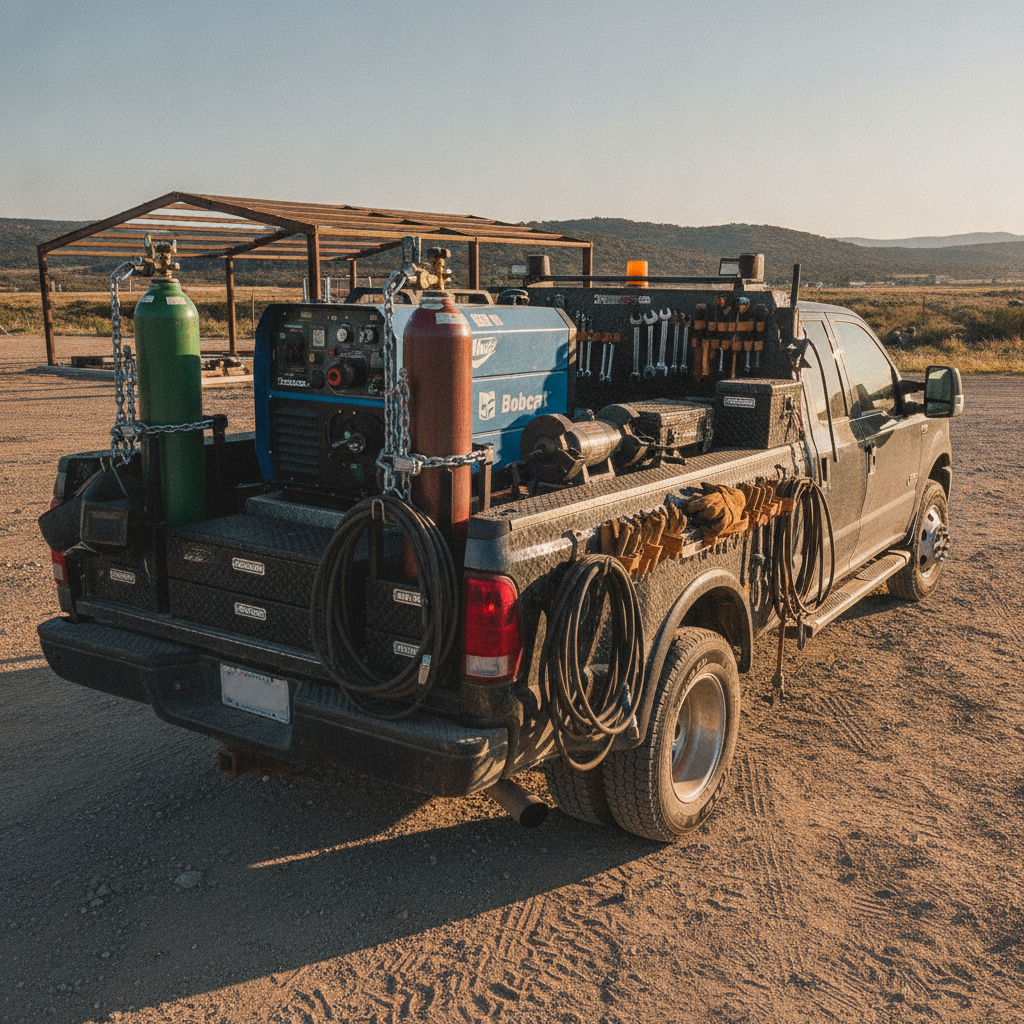
Cylinders go in a rack. Period. Properly chained or strapped, standing upright, valves protected. This isn’t a suggestion — in most places it’s a legal requirement for transporting compressed gas.
Label your cylinders and your regulators clearly. If you run multiple processes and multiple gas mixes, color-code the regulators. A strip of colored tape costs nothing. Accidentally TIG welding with the wrong gas and having to re-do the whole job costs a lot more than nothing.
If you want to go deeper on managing your shielding gas setup efficiently, this post on smart shielding gas management covers it in real detail. It’s one of those areas where a little organization pays dividends on every single job.
Mistake #7: Your PPE Is Everywhere Except Where You Need It
Helmet in one spot. Gloves in another. Fire-resistant jacket stuffed behind the seat. Welding jacket on the floor. You suit up for every job, but it takes five minutes because nothing is in the same place twice.
Designate a PPE zone. Whether that’s a hook system on the side wall, a dedicated bin, or a small locker — your gear lives there and only there. Helmet on a specific hook. Gloves in the same pocket every time. Jacket hung, not stuffed.
This also helps your gear last longer. A helmet rattling around the truck bed gets scratched, the auto-darkening lens gets damaged. Gloves stuffed under heavy tools wear out faster. Taking care of your PPE storage is taking care of your PPE investment.
Mistake #8: No Staging Zone for the Active Job
This is the one most people don’t think about. When you’re on a job, you need a spot — in your truck or on your tailgate — where the stuff you’re actively using lives during that job. Not your whole inventory. Just what you need right now.
A small tray, a dedicated flat surface, even a section of your tailgate mat designated as “active job” space. When you go back to the truck, you put things back in this zone until the job’s done, then return everything to its permanent home before you drive away.
This prevents the constant “I just set it down, where’d it go” problem that plagues disorganized rigs. It also makes cleanup faster because you know exactly where the job stuff is and exactly where it all needs to go back.
Making the Time to Actually Fix Your Rig
Here’s the honest part. None of this is complicated. All of it takes a Saturday and maybe $150 in hardware store materials to implement. The reason most welders don’t do it is the same reason they don’t do a lot of things that would help their business — they’re too busy working to stop and fix how they work.
But that’s exactly backwards. One day of lost work time to reorganize your rig will pay you back in the first week. Probably the first three days if you’re running multiple jobs daily.
If you’re in startup mode and trying to figure out where to invest your time and money as you grow, the Measure Twice, Invest Once post is worth a read. The principle applies directly here — a little planning before you build your rig setup beats having to redo it six months later.
And if you’re thinking about where your business is headed, your equipment choices and your rig setup are deeply connected. The From Garage to Shop post covers the bigger picture of what a growing mobile welding business looks like — and how to set yourself up to scale without reinventing everything from scratch.
The Bottom Line on Mobile Rig Organization
Good mobile rig organization isn’t about being neat for the sake of being neat. It’s about being fast, looking professional, protecting your gear, and keeping your head in the work instead of in a pile of junk looking for a grinding disc.
Every minute you save on setup and breakdown is a minute you can bill. Every tool that has a home is a tool you can find in the dark. Every cylinder that’s secured is an incident that won’t happen.
Your rig is your shop. Treat it like one. Build it with intention, maintain the system every single day, and adjust it as your work evolves. The welders who run tight, efficient rigs aren’t lucky — they built them that way on purpose.
Now go fix your truck. You know exactly what I’m talking about.