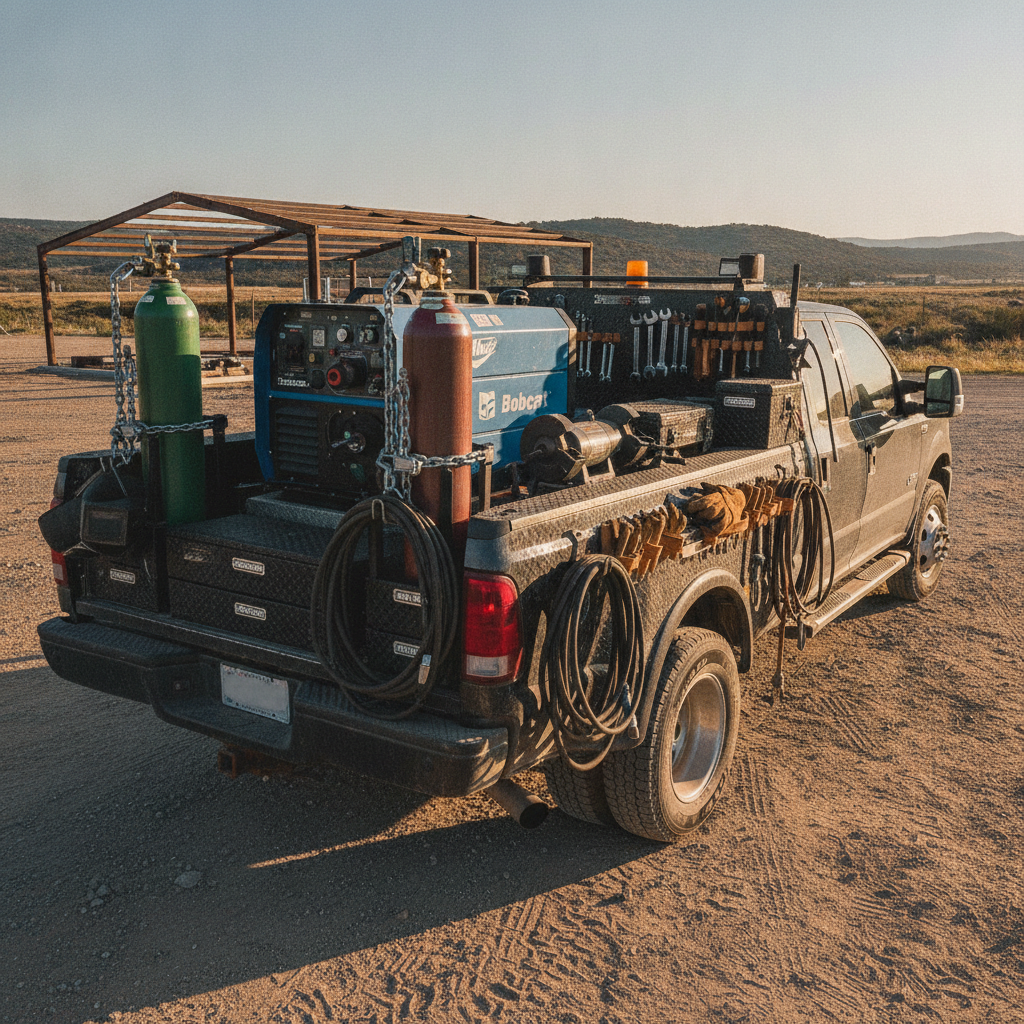
Here’s a scenario every field welder knows. You pull up to a job, the customer’s already watching you, and you spend the next twenty minutes digging through a pile of gear that looks like a hardware store exploded in your truck bed. By the time you strike your first arc, you’ve already lost money. That is the real cost of bad mobile rig organization. It doesn’t show up on an invoice, but it comes straight out of your effective hourly rate every single day.
If you’re running a mobile welding business — or trying to get one off the ground — your truck is your shop. Treat it like one. The guys who look like pros aren’t necessarily better welders. They’re just better organized. And in this business, looking like you’ve done it before matters almost as much as actually doing it well.
This post is about fixing the dumb stuff. The organizational mistakes that slow down every job, make you look sloppy, and quietly drain your income week after week. Small changes. Real results. Let’s get into it.
Why Mobile Rig Organization Is a Business Problem, Not a Comfort Problem
Let’s be clear about something. This isn’t about being neat for the sake of being neat. Nobody cares if your truck is pretty. This is about time, and time is money when you’re billing by the hour or quoting flat-rate jobs.
Think about it this way. If you waste fifteen minutes per job finding gear, and you run five jobs a week, that’s over an hour of unpaid labor every single week. Over a year, you just handed a client about sixty hours of your time for free. At even $75 an hour, that’s $4,500 walking out the door because you couldn’t find your chipping hammer.
When you’re building a mobile welding business from scratch, margins are tight. If you’re still working through the early stages of figuring out how to price your work, check out this breakdown on pricing for certification services — the same logic about valuing your time applies here. Every unbillable minute on a job site is a minute you’re losing, not spending.
Good mobile rig organization is a profit lever. Treat it like one.
Mistake #1: No Zone System on the Truck
The single biggest mistake most mobile welders make is loading their truck with no system. Everything gets thrown in wherever it fits at the end of the last job. After a few weeks, it looks like a yard sale back there.
The fix is a zone system. Simple concept. Your truck gets divided into logical zones based on how often you use things and what task they belong to.
How to Set Up Your Zones
Here’s a basic framework that works for most mobile rigs:
- Zone 1 — Hot work: Your machine, leads, ground clamps, electrodes or wire. Everything you need to actually weld goes here. This zone should be the fastest to access.
- Zone 2 — Grinding and prep: Angle grinders, discs, wire wheels, flap discs, marking tools. Grouped together because prep always comes before welding.
- Zone 3 — Consumables and filler: Rod oven if you’re running low-hydrogen, wire spools, tips, diffusers. Sealed from moisture and organized by process.
- Zone 4 — Safety and PPE: Helmet, gloves, sleeves, fire blankets. Fast access because OSHA doesn’t care that you left your gloves buried under a come-along.
- Zone 5 — Fabrication and fit-up: Clamps, squares, levels, magnets, tape measure, soapstone, hand tools. Anything that touches the metal before the arc does.
The point is that everything has a home. When a job is done, gear goes back to its zone. Every time. Not later. Not when you get back to the shop. Right then.
Mistake #2: Cables and Leads Are a Tangled Disaster
Tangled leads slow you down more than almost anything else. You pull one cable and three others come with it. You spend five minutes unknotting a ground lead that’s wrapped around a come-along strap. It’s infuriating and completely avoidable.
Invest in proper cable management. That means dedicated hooks, reels, or straps for every lead. If you’re running a multi-process setup out of your rig — and if you’re not, you probably should be, here’s a rundown on field-ready multi-process welders worth looking at — your cable management gets even more critical because you’ve got more leads to keep straight.
Cable Management That Actually Works
A few things that make a real difference:
- Use dedicated cord reels mounted to the truck or trailer for your welding leads. Retractable reels are great if the budget allows. At minimum, wrap them properly and hang them on fixed hooks.
- Color-code your leads. Red for electrode, black or green for ground. Sounds basic. Saves time in low light on a night job.
- Keep your extension cables separate from your welding leads. They are not the same thing and they should not live in the same pile.
- Velcro straps over bungee cords. Bungees tangle. Velcro doesn’t.
Three minutes of cable management at the end of every job saves you ten minutes at the start of the next one. That math is easy.
Mistake #3: Consumables Scattered Everywhere
Open electrodes rolling around loose in a truck bed. Wire tips rattling around in a random drawer. Half-used spools of wire sitting in a milk crate with no protection from moisture. This stuff kills weld quality and wastes money.
Your consumables need a proper home and they need to be protected. If you’re running SMAW with low-hydrogen electrodes, a rod oven isn’t optional — it’s non-negotiable. But even if you’re mostly running wire processes, organization matters.
Label your consumable storage. Know exactly what you have on the truck at any given time. Running out of .035 wire tips on a job site because you thought you had some is an amateur move that costs you a trip to the supply house and a chunk of your afternoon. Build a basic inventory system, even if it’s just a handwritten card inside the storage door.
While you’re thinking about consumable management and gas, this older post on smart shielding gas management is worth a read. The same discipline applies to your solid consumables.
Mistake #4: Your Machine Isn’t Ready to Run
You show up to a job and your machine needs to warm up, your leads aren’t connected, your ground isn’t set, and you haven’t pulled your helmet out yet. Meanwhile the customer is standing there watching the clock.
Your rig should have a standard startup configuration. Period. After every job, the machine goes back to a ready state. Leads connected. Ground clamp staged. Helmet in position. Wire tension correct. Settings close to your most common baseline.
This is especially important if you’re running newer equipment with digital controls. Know your machine. Know your settings. Don’t stand there fumbling with menus while someone watches. If you’re evaluating equipment for your rig, the breakdown on field-ready battery welders covers some of the newer options that are worth considering for mobile work.
Build a Pre-Job Checklist
I know. Checklists sound like something a project manager dreamed up. But they work, and the best field operators use them. A simple laminated card inside your truck door with a ten-point pre-job check takes thirty seconds and prevents the kind of dumb mistakes that make you look like it’s your first week on the job.
Your checklist should cover: machine power and settings, lead connections, ground integrity, consumables loaded, gas pressure verified, PPE staged, and work area assessed. That’s it. Thirty seconds. Do it every time.
Mistake #5: Tools You Never Use Are Taking Up Prime Real Estate
Every truck has a graveyard zone. The corner where tools go that you might need someday. The specialty die grinder you’ve used twice in three years. The plasma cutter that’s mostly just in the way. The box of fittings for a job you finished in 2022.
Dead weight is a real problem on a mobile rig. It takes up space where useful things should go. It adds weight to the truck. And it makes you dig past junk every time you need something you actually use daily.
Do a quarterly purge. Pull everything out. If you haven’t used it in ninety days and there’s no specific upcoming job that requires it, it goes back to the shop or gets sold. Your truck should carry tools for the jobs you actually run, not every job you might theoretically run someday.
This connects directly to the broader conversation about mobile rig organization as a strategic decision. If you’re figuring out which types of jobs to target with your mobile operation, the post on strategic niches for welding businesses is a good place to think through what your rig actually needs to carry.
Mistake #6: Lighting and Safety Gear Are Afterthoughts
You’re working at dusk. Or inside a dim equipment shed. Or under a piece of machinery at 6 AM. And your work light is buried somewhere in the truck because it’s not part of your standard setup. So now you’re welding half-blind because finding the light is more trouble than it’s worth.
Lighting should be staged and ready. A good magnetic LED work light, a headlamp in your helmet bag, and a trouble light on a hook in an accessible spot. These things cost almost nothing relative to your overall rig investment and they change how you work in bad conditions.
Same goes for your fire safety gear. A fire blanket and a small extinguisher should be in the same spot every time, accessible within seconds. Not buried. Not optional. Non-negotiable.
Mistake #7: No System for Job-Specific Materials
A lot of mobile welders throw job-specific materials — plate, filler metal, customer-supplied parts — wherever they fit at the time. Then on the next job, they’re sorting through materials that don’t belong to the current job, trying to figure out what’s what.
Designate a specific area on your truck for job-specific materials. Plastic bins with labels work great. When you pick up material for a job, it goes in the job bin. When the job is done, that bin gets cleared. Simple system. Saves real confusion, especially when you’re running multiple customers in a single day.
The Bigger Picture: Your Rig Is Your Brand
When you pull up to a job site, your rig is the first thing your customer sees. Before you say a word. Before you strike a single arc. They’re already forming an opinion about whether you know what you’re doing.
A clean, organized truck signals competence. It says you’re a professional who’s done this before. That first impression affects whether a customer calls you back, refers you to someone else, or haggles on your rate because they’re not sure you’re worth it.
This isn’t about vanity. It’s about positioning. If you’re building a mobile welding operation from the ground up and thinking about the business side seriously, the post on going from garage to shop covers a lot of the foundational thinking that applies here too.
Your mobile rig organization is part of your brand whether you think about it that way or not. Might as well make it work in your favor.
Quick Wins: Small Changes With Real Impact
You don’t have to rebuild your entire truck setup in a weekend. Start with a few quick wins that will immediately make you faster on every job.
- Label everything. Bin labels, drawer labels, hook labels. Takes an hour. Saves ten minutes a week for the rest of your career.
- Stage your first three feet. The most-used gear should live in the most accessible spots. Helmet, leads, ground, angle grinder. Front and center.
- End-of-day reset. Before you leave a job site, spend five minutes putting everything back where it belongs. Do it every single day without exception.
- Photo your setup. Take a picture of your properly organized truck. When things drift — and they will drift — you’ve got a reference to reset to.
- One in, one out rule for tools. Before you add a new tool to the truck, identify what you’re removing. Keeps the creep under control.
The Bottom Line on Mobile Rig Organization
Nobody’s going to hand you a better-organized rig. You have to build it deliberately, and you have to maintain it with discipline. The welders who run tight, efficient operations aren’t superhuman. They just made the decision to treat their truck like a real shop instead of a rolling junk pile.
Every minute you save on setup is a minute you can bill. Every job you complete faster is a job where your effective rate goes up without raising your prices. Good mobile rig organization is one of the highest-return investments you can make in a mobile welding business, and it costs you almost nothing except a little time and discipline upfront.
Fix the basics. Zone your truck. Manage your cables. Protect your consumables. Stage your machine. Get rid of dead weight. Do it consistently.
Then go make some money.