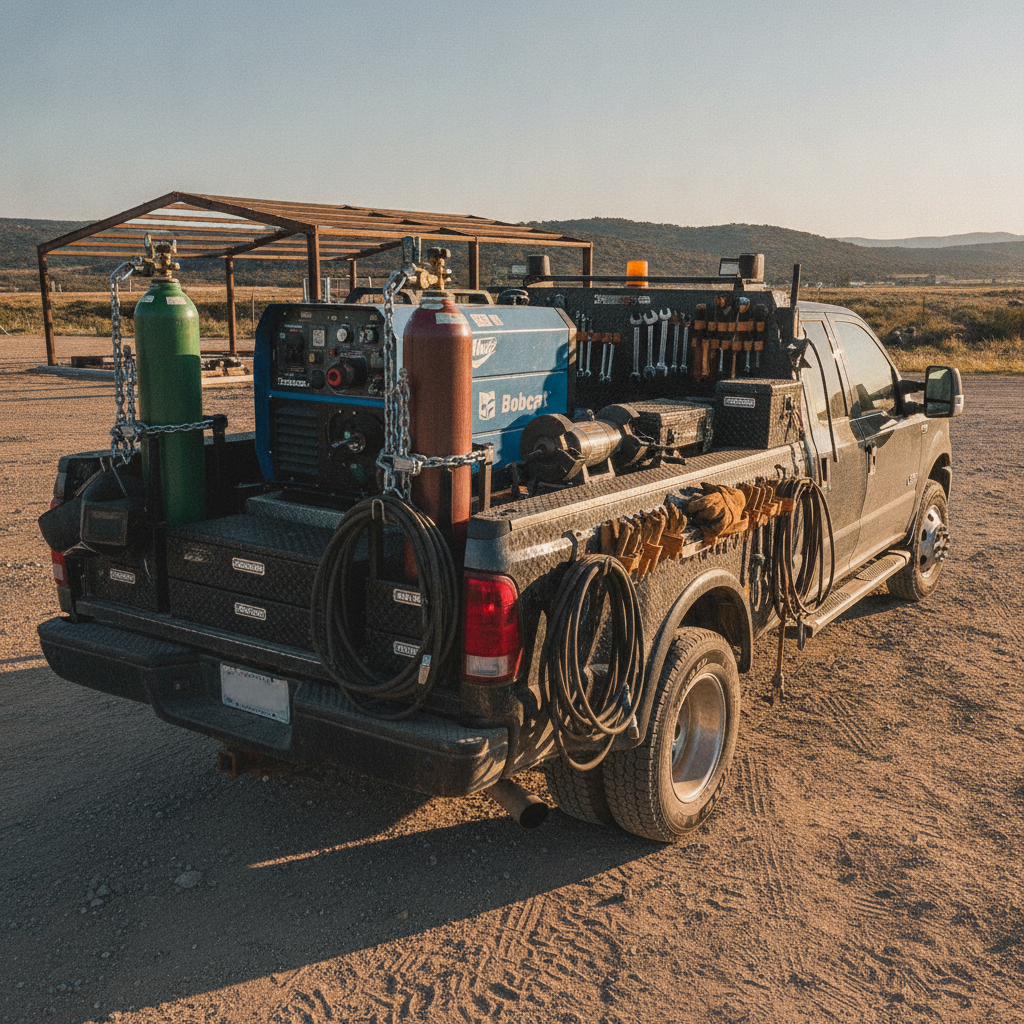
If your mobile rig setup looks like a scrap bin on wheels, you already know what I’m talking about. You pull up to the job, the guy’s waiting on you, and you spend the first twenty minutes digging through your truck bed like you’re on a treasure hunt. Except the treasure is a 7018 rod you swear you packed. Every minute of that nonsense is coming straight out of your pocket. Let’s fix that.
I’ve been doing mobile welding for over a decade. I’ve watched guys — good welders, technically solid — lose half their margin just because their rig was a disaster. It’s not about being neat for neat’s sake. It’s about money. Your time is your product. Every second you waste looking for a fitting wrench is a second you’re not billing.
This post covers the most common mobile rig setup mistakes I see in the field, and what to actually do about them. No fluff. Just practical changes that will shave real hours off your week.
Why Your Mobile Rig Setup Is Costing You More Than You Think
Let’s put a number on it. Say you waste fifteen minutes per job digging around your truck. You’re running five jobs a week. That’s over an hour of unbillable time, every single week, just from poor organization. At $100/hr, that’s $5,000 a year you’re leaving on the ground. Not because you can’t weld. Because you can’t find your stuff.
And that’s the conservative version. Some of the rigs I’ve seen, fifteen minutes is optimistic.
The other cost is perception. Customers notice. When you show up and look like you’ve never done this before, it plants a seed of doubt. Doesn’t matter if you lay the best bead they’ve ever seen. First impressions on a job site are worth something. A tight, organized rig says you’re a professional. A disaster on wheels says something else entirely.
If you’re still figuring out the business side of things, go read From Garage to Shop — it covers the bigger picture of setting yourself up as a legitimate operation, not just a guy with a truck.
Mistake #1: No Zones, No System
The single biggest mobile rig setup mistake I see is the complete absence of a system. Everything gets thrown in the truck bed wherever it fits. The grinders are next to the rod, the chains are on top of the extension cords, the gas fittings are rattling around loose in a milk crate somewhere.
You need zones. It’s that simple.
Here’s how I break it down:
- Hot zone: Everything you touch before you strike your first arc. Leads, stinger, ground clamp, safety gear. This stuff lives at the back of the truck, accessible in thirty seconds.
- Consumables zone: Rods, wire, tips, nozzles, anti-spatter. Dry, labeled, organized by process. A small lockbox or a dedicated drawer works great here.
- Tool zone: Grinders, clamps, squares, hammers. These don’t need to be pretty, but they need to be in the same place every single day.
- Gas zone: Cylinders secured upright, regulator accessible, hoses coiled and not kinked. Non-negotiable for safety reasons, not just efficiency.
The goal is that you can mentally walk through a job setup before you even open the tailgate. You know where everything is because you put it back in the same spot. Every time. Without exception.
Mistake #2: Leads That Look Like Spaghetti
Tangled leads are one of those problems that seem minor until you’re untangling them in the rain at 7am with a customer standing over you. Then they feel major.
Coil your leads the same way every time. Over-under method, velcro strap or a simple bungee, hung on a hook or laid flat in a dedicated spot. It takes about forty-five seconds when you’re wrapping up a job. It saves you five to ten minutes at the next one.
Same goes for your ground cable. Don’t just pitch it in the truck. It wraps around everything, it gets kinked, the clamp jaws pick up garbage. A short length of PVC pipe mounted horizontally makes a clean holder for your ground cable clamp. Costs maybe three dollars and five minutes to build.
If you’re running a multi-process setup out of the truck, lead management gets even more important. More processes mean more leads, more hoses, more potential for a tangled nightmare. Field-Ready Multi-Process Welders has solid info on what equipment makes sense when you’re juggling TIG, MIG, and stick from one rig.
Mistake #3: Consumables Everywhere (and Nowhere)
This one kills me. Guy shows up, needs a fresh contact tip, and spends eight minutes searching three different toolboxes and a bag in the cab before he finds one that might be the right size. Meanwhile, the clock’s ticking.
Your consumables need a home. One location. Labeled if possible.
I use a small aluminum case with foam inserts cut to hold specific items. Rods go in a rod quiver — dry, sorted by type, labeled. Tips, nozzles, and diffusers go in a small plastic organizer that cost me twelve bucks at the hardware store. It’s not fancy. It works.
The other consumables mistake is not restocking between jobs. You finish a job, you’re tired, you throw the empty rod box back in the truck and figure you’ll deal with it later. Then “later” is tomorrow morning when you’re already at the next site and you’re short on 6011. Build a five-minute end-of-job checklist. Check your consumables. Restock before you leave. Period.
Also worth noting: proper storage of consumables matters more than most guys realize. Low-hydrogen rods absorb moisture. If you’re leaving open rod containers rolling around in a truck bed through temperature swings and humidity, you’re going to have issues. Get a proper rod oven or at minimum a sealed container. Smart Shielding Gas Management gets into the details of keeping your consumables and gas in proper condition in the field.
Mistake #4: Tools You Can’t Find and Tools You Don’t Need
Two sides of the same problem. Either you can’t find the tool you need because it’s buried, or you’re hauling around forty pounds of tools you haven’t touched in six months because “you never know.”
Start by pulling everything out of your truck. Lay it on the ground. Look at it honestly. When did you last use each item? If it’s been over ninety days and it’s not a safety item, it might not belong on the daily rig.
Then think about what you reach for on every single job. Those items go in the most accessible spots. Everything else gets organized by frequency of use. Stuff you pull out once a month lives in the back corner. Stuff you pull out every job lives at arm’s reach.
A good underbody toolbox or a series of drawer units in the truck bed pays for itself fast. You stop buying tools you already own because you can’t find them. You stop losing small items that fall to the bottom of a pile. Everything visible, everything in its place.
Mistake #5: A Machine That’s Not Job-Ready Before You Leave
Here’s one that doesn’t get talked about enough. You arrive on site, you set up your rig, and then you spend ten minutes on the machine itself — adjusting settings, swapping out a liner you should have replaced yesterday, chasing a wire feed problem you ignored last week.
Your machine should leave your shop or your yard ready to run. Not “mostly ready.” Ready. Wire loaded, settings dialed for the work you’re going to do, everything checked.
If you’re running jobs back to back, do a quick machine check at the end of each job before you pack up. Swap out worn consumables, note any issues, top off wire. Five minutes there saves twenty minutes at the next site.
This matters even more if you’re running newer technology out of the field. Battery-powered and hybrid machines have their own maintenance considerations. Hybrid Battery-Powered Welders covers what to watch for when you’re keeping those units field-ready.
Mistake #6: No Standard Setup Routine
You ever watch a surgeon prep for an operation? Same steps, same order, every single time. It’s not because surgeons are robots. It’s because a standard routine eliminates errors and speeds up the process.
You need a setup routine. Written down, at first, until it becomes automatic. Same sequence every job. Pull up, assess the site, position the truck, set up your ground, run your leads, confirm gas, check your machine settings, done.
When you follow a routine, you stop forgetting things. You stop showing up and realizing your ground cable is still sitting on the truck bumper when you’re already fifty feet into the job. You stop running back and forth three times before you’re actually ready to work.
A routine also makes it easier to work faster without working sloppier. You’re not thinking about what comes next. You’re just executing. That’s when you start looking like someone who’s done this a thousand times. Because you have, and now your process shows it.
Bonus: The Small Stuff That Adds Up
A few more mobile rig setup details that might seem minor but matter on a long week:
- Lighting: A good work light mounted on the truck or a portable LED bar. Night jobs and dark corners happen. Don’t fumble around because you can’t see what you’re doing.
- Fire extinguisher: Accessible, not buried. You know why.
- Cleaning supplies: Wire brush, grinder discs, anti-spatter spray. In one spot. Always stocked.
- Paperwork zone: Job orders, receipts, invoices. A simple folder in the cab. Not scattered across the seat, not shoved in the glovebox.
- Straps and tie-downs: Proper ones, in the same spot every time. A cylinder that shifts in transit is a hazard, not just an inconvenience.
If you’re building out a proper mobile operation and thinking about the business side — pricing, niches, how to grow — Strategic Niches is worth your time. Getting your rig dialed in is step one. Knowing what work to chase is step two.
When Your Rig Reflects Your Business
Here’s the thing nobody tells you when you start out on your own: your truck is your office, your shop, and your business card all in one. The way it’s set up tells customers and other tradespeople something about you before you say a word.
A tight, organized mobile rig setup says you take your work seriously. It says you’ve thought about efficiency. It says you’re not going to waste their time digging around looking for a tip you packed last Tuesday.
That reputation compounds. Word of mouth in this trade is everything. Guys who show up ready, work clean, and wrap up fast get called back. Guys who show up and turn a two-hour job into four-hour production get avoided. The work quality matters, obviously. But the professionalism around the work matters more than most guys want to admit.
And honestly, a well-organized rig is just less stressful to work from. Less searching, less frustration, less of that low-grade annoyance that follows you through a job where nothing is where it should be. You’re going to be in and around this truck every working day. Make it work for you.
If you want to think bigger picture about where your mobile business is headed — equipment investments, market positioning, the math behind your decisions — Measure Twice, Invest Once is a good read on making smart calls before you spend money.
Fix It Once, Profit From It Every Day
None of this is complicated. That’s kind of the point. The fixes here aren’t expensive. They’re not technical. They just require you to spend an afternoon getting your rig squared away and then maintaining the discipline to keep it that way.
Spend one Saturday reorganizing your truck. Build your zones. Sort your consumables. Coil your leads properly. Create your setup checklist. Then stick to it for two weeks and see what happens to your job times.
My guess? You’ll wonder why you didn’t do it sooner. And you’ll stop losing money to a problem you had the power to fix the whole time.
A proper mobile rig setup isn’t a luxury for guys with big rigs and big budgets. It’s the baseline for running a professional mobile welding operation. Get it dialed in. Your hourly rate will thank you.